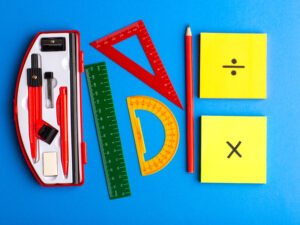
CBSE Grade 9 Mathematics introduces students to fundamental mathematical concepts that build a strong foundation for higher-level learning. The curriculum covers key topics such as number systems, algebra, coordinate geometry, linear equations, geometry, statistics, and probability. Through clear explanations, examples, and practice exercises, students develop problem-solving skills, logical reasoning, and analytical thinking essential for academic success in mathematics.
1. Number Systems
This chapter introduces different types of numbers such as rational and irrational numbers. Students learn how numbers are represented on the number line and how to perform operations with real numbers.
2. Polynomials
Polynomials are algebraic expressions formed using variables and constants. This chapter explains the degree of polynomials and introduces basic operations involving polynomial expressions.
3. Coordinate Geometry
Coordinate geometry helps represent points on a plane using ordered pairs. Students learn how to locate points on the Cartesian plane using the x-axis and y-axis.
4. Linear Equations in Two Variables
This chapter explains equations involving two variables and how they represent straight lines on a graph. Students learn to find solutions and understand their graphical representation.
5. Introduction to Euclid’s Geometry
Students explore the basic ideas of geometry developed by the Greek mathematician Euclid. The chapter introduces definitions, axioms, and postulates used to build geometric reasoning.
6. Lines and Angles
This chapter explains different types of angles and relationships formed when lines intersect or when a transversal cuts parallel lines.
7. Triangles
Triangles are one of the most important shapes in geometry. Students learn about their properties, angle relationships, and conditions for congruence.
8. Quadrilaterals
This chapter focuses on four-sided shapes such as parallelograms, rectangles, and squares. Students study their properties and angle relationships.
9. Areas of Parallelograms and Triangles
Students learn how to compare and calculate areas of different shapes, especially parallelograms and triangles that share the same base and height.
10. Circles
This chapter introduces the basic elements of a circle, such as radius, diameter, and chords, and explains the properties related to circles.
11. Constructions
Students learn geometric constructions using a compass and ruler, such as constructing angles, bisectors, and triangles.
12. Heron’s Formula
This chapter introduces a formula used to find the area of a triangle when the lengths of all three sides are known.
13. Surface Areas and Volumes
Students learn to calculate the surface area and volume of three-dimensional shapes like cubes, cylinders, and cones.
14. Statistics
This chapter introduces methods for collecting, organizing, and interpreting numerical data using tables and graphs.
15. Probability
Students learn the basic concept of probability and how to measure the likelihood of events occurring.