Curriculum
Mathematics Grade 10
Grade 10 Mathematics
0/14
-
Chapter 1. Real Numbers
 Preview
 -
Chapter 2. Polynomials
Preview
-
Chapter 3: PAIR OF LINEAR EQUATIONS IN TWO VARIABLES
Preview
-
Chapter 4: QUADRATIC EQUATIONS
Preview
-
Chapter 5: ARITHMETIC PROGRESSIONS
Preview
-
Chapter 6: TRIANGLES
Preview
-
Chapter 7: COORDINATE GEOMETRY
Preview
-
Chapter 8: INTRODUCTION TO TRIGONOMETRY
Preview
-
Chapter 9: SOME APPLICATIONS OF TRIGONOMETRY
Preview
-
Chapter 10: CIRCLES
Preview
-
Chapter 11: AREAS RELATED TO CIRCLES
Preview
-
Chapter 12: SURFACE AREAS AND VOLUMES
Preview
-
Chapter 13: STATISTICS
Preview
-
Chapter 14: PROBABILITY
Preview
Interactive Worksheets
0/0
Chapter Wise Worksheets
0/14

Solved Problems and solutions
0/1
Chapter 2. Polynomials
What Is a Polynomial?
A polynomial is an algebraic expression built from a variable (like x) using only addition, subtraction, multiplication, and non-negative whole-number powers. Each separate chunk separated by + or − is called a term.
The degree of a polynomial is the highest power of the variable appearing in it. This single number tells you most of what you need to know about the polynomial’s behaviour.
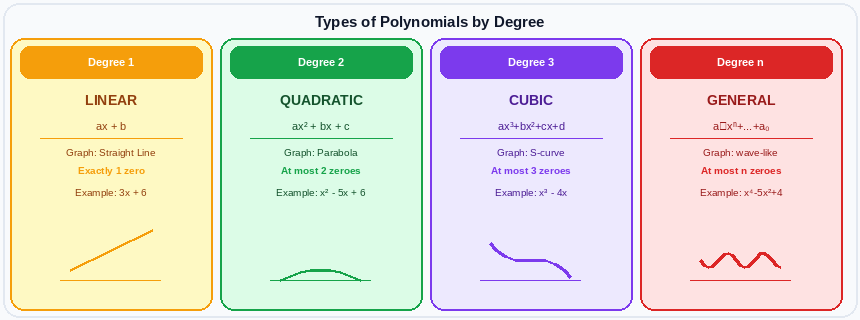
1/x, √x, and x⁻² are NOT polynomials because they contain negative or fractional powers. Examples like 3x² + 2x + 5 ARE polynomials.Is It a Polynomial? — Quick Reference
7x + 3 → degree 1 (linear)2x² − 5x + 1 → degree 2 (quadratic)x³ − 4x → degree 3 (cubic)5 → degree 0 (constant)x⁴ + 2x² − 3 → degree 41/(x+2) → variable in denominator√x + 3 → fractional power (x^½)x² + x⁻¹ → negative power2^x + 1 → variable is the exponent|x| + 5 → absolute value not allowedq(y) = 3y² − 2y + 9: Highest power = 2 → Quadratic polynomial, degree 2
r(t) = 2t³ − t + 5: Highest power = 3 → Cubic polynomial, degree 3
s(x) = x⁴ − 3x² + 1: Highest power = 4 → Polynomial of degree 4
f(x) = −8: No variable, constant → Constant polynomial, degree 0
Value of a Polynomial at a Given Point
To find the value of a polynomial p(x) at a specific number, you simply substitute that number in place of x and calculate. We write p(k) to mean “the value of p(x) when x = k”.
p(2) = 3(2)² − 2(2) + 5
p(2) = 3(4) − 4 + 5
p(2) = 12 − 4 + 5 = 13
At x = −1:
p(−1) = 3(−1)² − 2(−1) + 5
p(−1) = 3(1) + 2 + 5
p(−1) = 3 + 2 + 5 = 10
p(0): 2(0)³ − (0)² + 4(0) − 3 = 0 − 0 + 0 − 3 = −3 (always the constant term!)
p(−2): 2(−8) − (4) + 4(−2) − 3 = −16 − 4 − 8 − 3 = −31
Zeroes of a Polynomial — What They Mean
A zero of a polynomial p(x) is any real number k that makes p(k) = 0. In other words, a zero is an input that produces an output of zero. Zeroes are also called roots of the polynomial.
Geometrically: the x-coordinate where the graph of y = p(x) crosses or touches the x-axis
Degree 2 (quadratic): at most 2 zeroes
Degree 3 (cubic): at most 3 zeroes
Degree n: at most n zeroes
5x − 15 = 0
5x = 15
x = 15 ÷ 5 = 3
Verify: p(3) = 5(3) − 15 = 15 − 15 = 0 ✓
General rule: zero of ax + b = −b/a = −(−15)/5 = 15/5 = 3
p(2) = (2)² + (2) − 6 = 4 + 2 − 6 = 0 ✓ → Yes, x = 2 is a zero
Check x = −3:
p(−3) = (−3)² + (−3) − 6 = 9 − 3 − 6 = 0 ✓ → Yes, x = −3 is a zero
Factoring to confirm:
x² + x − 6 = (x − 2)(x + 3) → zeroes: x = 2 and x = −3
Geometrical Meaning of Zeroes — Graphs
The most powerful way to understand zeroes is geometrically. When you plot the graph of y = p(x), the zeroes are precisely the x-coordinates of the points where the curve meets the x-axis — this is true for every type of polynomial.
For a linear polynomial (degree 1), the graph is a straight line that crosses the x-axis at exactly one point. For a quadratic polynomial (degree 2), the graph is a parabola — a smooth U-shape that opens upward (if a > 0) or downward (if a < 0).
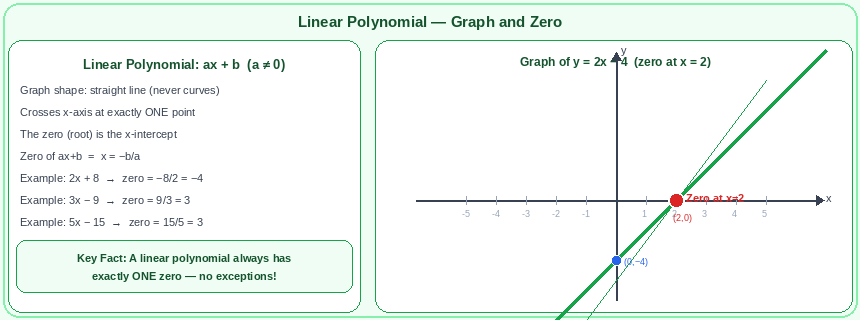
Zero = x = −b/a = −(constant term) ÷ (coefficient of x)
Example: Zero of 4x − 20 = −(−20)/4 = 20/4 = 5
Quadratic Polynomials: 3 Cases for the Parabola
For y = ax² + bx + c, the parabola opens upward when a > 0 and downward when a < 0. Where it meets the x-axis determines the number of zeroes.
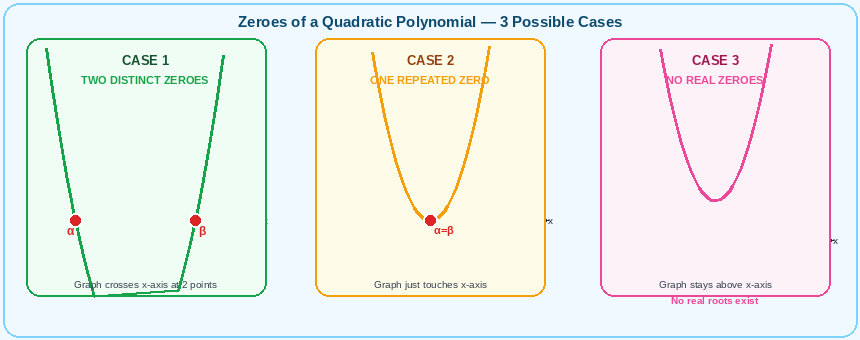
The Three Cases Explained
There are two different real zeroes: α and β.
e.g. x² − 5x + 6 → zeroes at 2 and 3
Two equal zeroes: α = β.
e.g. x² − 4x + 4 = (x−2)² → zero at 2 only
No real zeroes exist.
e.g. x² + x + 1 → always positive, no real root
Graphs of Cubic Polynomials
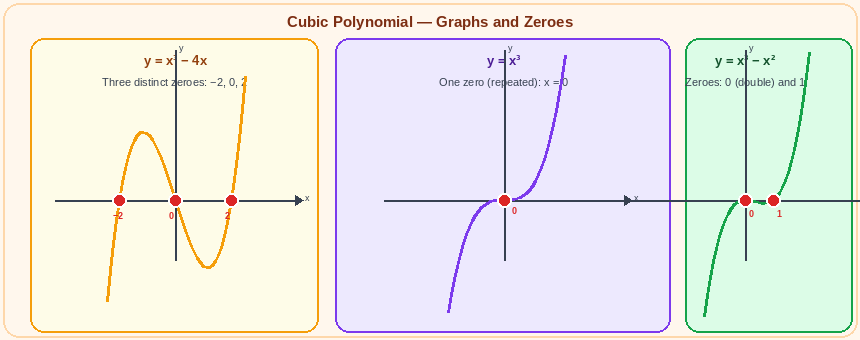
A cubic polynomial y = ax³ + bx² + cx + d always produces a smooth S-shaped curve. Unlike parabolas, a cubic curve always crosses the x-axis at least once — it must have at least one real zero. It can have 1, 2 (one repeated), or 3 distinct zeroes.
Relationship Between Zeroes and Coefficients
Here is one of the most useful discoveries in algebra: you don’t need to find the zeroes individually to know their sum and product. These values are directly readable from the coefficients of the polynomial itself!
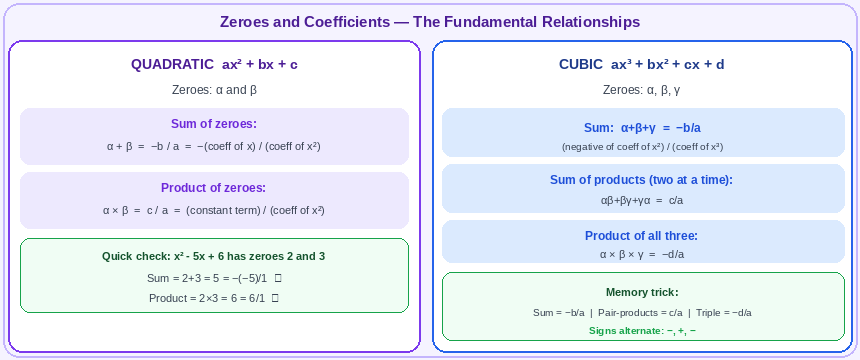
Zeroes: x = 3 and x = 4 (call them α = 3, β = 4)
Verify sum:
α + β = 3 + 4 = 7 = −(−7)/1 = −b/a ✓
Verify product:
α × β = 3 × 4 = 12 = 12/1 = c/a ✓
2x² − 9x + 10 → find two numbers with product = 2 × 10 = 20 and sum = −9
Those numbers: −4 and −5 (since −4 × −5 = 20 and −4 + −5 = −9)
2x² − 4x − 5x + 10 = 2x(x − 2) − 5(x − 2) = (2x − 5)(x − 2)
Zeroes: x = 5/2 and x = 2 (α = 5/2, β = 2)
Verify sum: 5/2 + 2 = 5/2 + 4/2 = 9/2 = −(−9)/2 = −b/a ✓
Verify product: (5/2) × 2 = 5 = 10/2 = c/a ✓
Zeroes: x = √5 and x = −√5 (α = √5, β = −√5)
Verify sum: √5 + (−√5) = 0 = −(0)/1 = −b/a [b = 0 since no x term] ✓
Verify product: √5 × (−√5) = −5 = −5/1 = c/a [c = −5] ✓
Sum of zeroes = −b/a = −11/3
Product of zeroes = c/a = −4/3
Check by factorising: 3x² + 11x − 4 = (3x − 1)(x + 4)
Zeroes: x = 1/3 and x = −4
Sum: 1/3 + (−4) = 1/3 − 12/3 = −11/3 ✓
Product: (1/3)(−4) = −4/3 ✓
p(1) = 1 − 6 + 11 − 6 = 0 ✓
p(2) = 8 − 24 + 22 − 6 = 0 ✓
p(3) = 27 − 54 + 33 − 6 = 0 ✓
Identify coefficients: a=1, b=−6, c=11, d=−6
Sum: α+β+γ = 1+2+3 = 6 = −(−6)/1 = −b/a ✓
Pair sum: αβ+βγ+γα = (1×2)+(2×3)+(3×1) = 2+6+3 = 11 = 11/1 = c/a ✓
Triple product: αβγ = 1×2×3 = 6 = −(−6)/1 = −d/a ✓
Constructing a Polynomial from Its Zeroes
We can work backwards: given the zeroes (or just the sum and product of zeroes), we can build the polynomial. For a quadratic, the formula is:
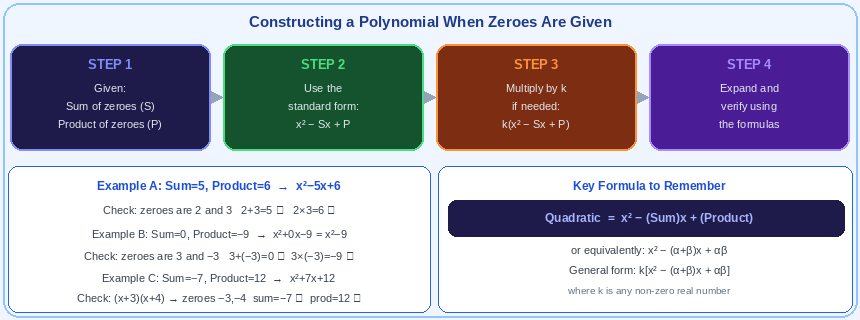
Step 2: Find product = 4 × (−3) = −12
Step 3: Polynomial = x² − (sum)x + (product) = x² − (1)x + (−12)
Result: x² − x − 12
Verify by factoring: x² − x − 12 = (x − 4)(x + 3) → zeroes: 4 and −3 ✓
x² − (−5)x + 4 = x² + 5x + 4
Verify: x² + 5x + 4 = (x + 1)(x + 4) → zeroes: −1 and −4
Sum: −1 + (−4) = −5 ✓
Product: (−1)(−4) = 4 ✓
Step 2: Product = (2+√3)(2−√3) = 4 − 3 = 1 [using (a+b)(a−b) = a²−b²]
Step 3: Polynomial = x² − (4)x + (1) = x² − 4x + 1
Practice Exercises with Answers
Set A — Find the Zeroes
Find all zeroes of each polynomial by factorising.
Set B — Sum and Product of Zeroes
Find the zeroes and verify the sum and product relationships.
(iii) √5, √5; Sum=2√5 ✓, Prod=5 ✓ | (iv) 0, 2; Sum=2=8/4 ✓, Prod=0 ✓
(v) 2, −2; Sum=0=0/7 ✓, Prod=−4=−28/7 ✓ | (vi) 2, −5/3; Sum=1/3 ✓, Prod=−10/3 ✓
Set C — Construct the Polynomial
Write a quadratic polynomial for each sum and product of zeroes given.
(iv) x² − √3 x + 1/3 | (v) x² − 4x + 4 = (x−2)² | (vi) x² + 6x + 8
Set D — Mixed Challenge Problems
(3) Ratio 3:4 → zeroes 6,8; product=48; poly: x²−14x+48 | (4) p(−2)=0 → 12−2k−10=0 → k=1
(5) α+β=1, α²+β²=13 → αβ=(1−13)/2=−6; poly: x²−x−6 | (6) Sum=6=6/1 ✓, Pair=11 ✓, Prod=6 ✓
Chapter Summary
🔑 Everything on One Page
Degree 2 = Quadratic (ax²+bx+c)
Degree 3 = Cubic (ax³+bx²+cx+d)
Degree n = at most n zeroes
Geometrically: x-intercepts of y=p(x)
Linear: exactly 1 zero
Quadratic: 0, 1, or 2 zeroes
Product αβ = c/a
Build: x² − (α+β)x + αβ
Pair sum αβ+βγ+γα = c/a
Triple product αβγ = −d/a
a < 0 → opens downward ∩
Zeroes = where curve meets x-axis
Polynomial = x² − Sx + P
General form: k(x² − Sx + P)