Curriculum
Mathematics Grade 10
Grade 10 Mathematics
0/14
-
Chapter 1. Real Numbers
 Preview
 -
Chapter 2. Polynomials
Preview
-
Chapter 3: PAIR OF LINEAR EQUATIONS IN TWO VARIABLES
Preview
-
Chapter 4: QUADRATIC EQUATIONS
Preview
-
Chapter 5: ARITHMETIC PROGRESSIONS
Preview
-
Chapter 6: TRIANGLES
Preview
-
Chapter 7: COORDINATE GEOMETRY
Preview
-
Chapter 8: INTRODUCTION TO TRIGONOMETRY
Preview
-
Chapter 9: SOME APPLICATIONS OF TRIGONOMETRY
Preview
-
Chapter 10: CIRCLES
Preview
-
Chapter 11: AREAS RELATED TO CIRCLES
Preview
-
Chapter 12: SURFACE AREAS AND VOLUMES
Preview
-
Chapter 13: STATISTICS
Preview
-
Chapter 14: PROBABILITY
Preview
Interactive Worksheets
0/0
Chapter Wise Worksheets
0/14

Solved Problems and solutions
0/1
Chapter 4: QUADRATIC EQUATIONS
1. What Is a Quadratic Equation?
A quadratic equation is any equation that can be written in the form:
The word quadratic comes from quadratus, Latin for “square” — because the variable x is squared. The highest power of x is 2, which is what makes it a quadratic equation rather than linear (degree 1) or cubic (degree 3).
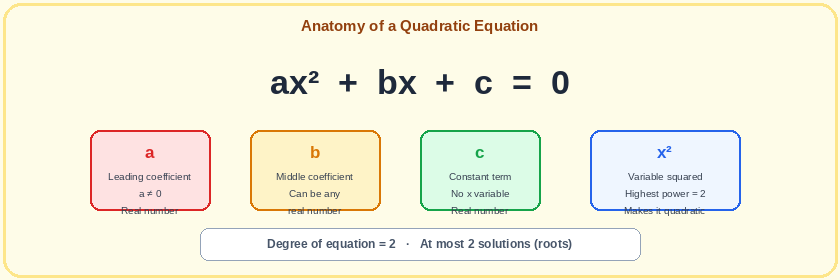
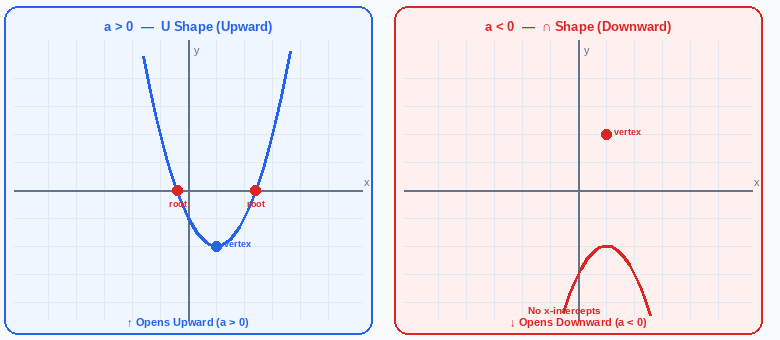
3x² + 5x − 2 = 0 degree 2 ✓x² − 9 = 0 b=0, still quadratic ✓5x² = 0 b=0, c=0, still quadratic ✓x(x+4) = 7 expands to x²+4x−7=0 ✓4x + 7 = 0 degree 1 (linear) ✗x³ − x = 0 degree 3 (cubic) ✗√x = 5 not a polynomial ✗1/x + 3 = 0 has x in denominator ✗A root (or solution) is a value of x that makes the equation true — i.e., makes the left side equal zero. Every quadratic equation has at most 2 roots. The graph of a quadratic is a curved shape called a parabola, and the roots are the x-values where the parabola crosses the x-axis.
2. Turning Real Problems into Equations
Many everyday situations can be described with a quadratic equation. The key skill is reading the problem carefully, choosing a variable, and building the equation step by step.
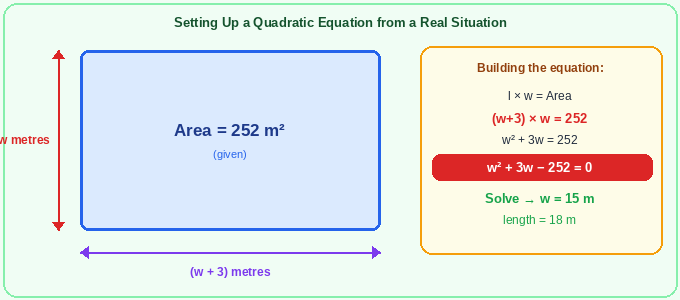
Let width = w metres → length = (w + 3) metres
Area = length × width → (w + 3) · w = 252
w² + 3w = 252 → w² + 3w − 252 = 0
Now solve this quadratic (shown in the factorisation section below).
Revenue = price × quantity → x(80 − x) = 1500
80x − x² = 1500 → x² − 80x + 1500 = 0
This is our quadratic. We solve it to find x = 30 or x = 50 (both valid prices).
Let the smaller number = n (even) → next even = n + 2
n(n + 2) = 168 → n² + 2n = 168 → n² + 2n − 168 = 0
Solving gives n = 12, so the two numbers are 12 and 14. Check: 12 × 14 = 168 ✓
3. Solving by Factorisation
Factorisation works by writing ax² + bx + c as a product of two smaller (linear) expressions, then setting each one to zero. The trick is splitting the middle term bx into two terms whose coefficients multiply to give a × c and add to give b.
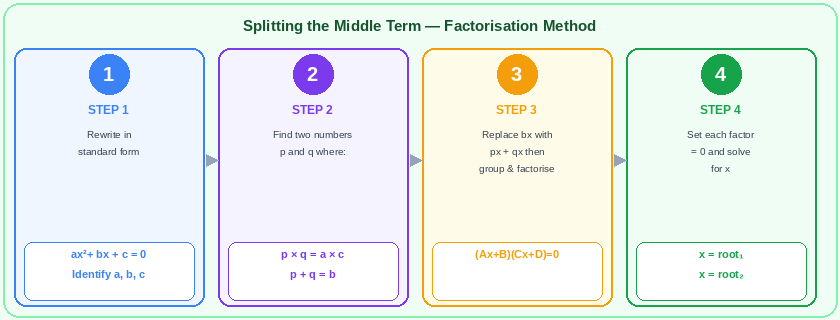
p + q = b
Group in pairs and factorise
Factorisation — Worked Examples
✔ p=3, q=4 (since 3×4=12 and 3+4=7)
x² + 7x + 12 = x² + 3x + 4x + 12
= x(x+3) + 4(x+3)
= (x+3)(x+4) = 0
✔ p=−1, q=−6 (since (−1)×(−6)=6 and −1+(−6)=−7)
2x² − 7x + 3 = 2x² −x − 6x + 3
= x(2x−1) − 3(2x−1)
= (x−3)(2x−1) = 0
✔ p=2, q=−7 (since 2×(−7)=−14 and 2+(−7)=−5)
x² − 5x − 14 = x² +2x − 7x − 14
= x(x+2) − 7(x+2)
= (x−7)(x+2) = 0
✔ p=18, q=−14 (since 18×(−14)=−252 and 18+(−14)=4)… let me try again:
✔ p=−15, q=18? No. Actually: p=18, q=−15 gives 18×(−15)=−270 ✗
Try: p=21, q=−12 → 21×(−12)=−252 ✓ and 21+(−12)=9 ✗
Try: p=−15, q=18 → −270 ✗. Use the formula instead for cleaner work.
Quadratic formula: D = 9 + 4(252) = 9 + 1008 = 1017…
Actually re-check: a=1, b=3, c=−252 → D=9+1008=1017 → √1017≈31.9
Hmm, let’s use the original: w²+3w−252=0 → try p=−15, q=18: product=−270 ✗
→ p=−12, q=21: product=−252 ✓, sum=9 ✗. → Need sum=3: p=15,q=−12: prod=−180 ✗
Note: for this particular equation, the formula is easiest (see Section 4).
4. The Quadratic Formula
When factorisation is not easy or not possible (roots are fractions, surds, or irrational), we use the Quadratic Formula. It works for every quadratic equation and gives both roots at once.
The formula was developed independently by several mathematicians over centuries of mathematics. It is one of the most useful formulas you will ever learn.
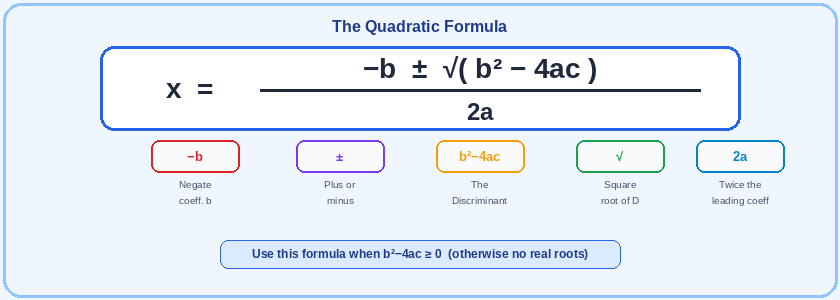
Step 2: Read off the values of a, b, and c
Step 3: Calculate D = b² − 4ac (the discriminant)
Step 4: If D ≥ 0, substitute into x = (−b ± √D) / 2a
Step 5: Simplify to find the two roots (use + and − separately)
Quadratic Formula — Worked Examples
D = b²−4ac = 9 − 4(1)(−10) = 9 + 40 = 49
√D = √49 = 7
x = (−3 ± 7) / 2
D = (−8)²−4(3)(4) = 64 − 48 = 16
√D = 4
x = (8 ± 4) / 6
D = (−10)²−4(1)(25) = 100 − 100 = 0
√D = 0
x = (10 ± 0) / 2 = 10/2 = 5 (both roots are equal!)
5. The Discriminant — Predicting the Roots
The expression inside the square root in the quadratic formula — D = b² − 4ac — is called the discriminant. It tells us about the nature of the roots before we even finish solving.
Think of it as a “root predictor” — just one calculation tells you whether the equation has two roots, one root, or no real roots at all.
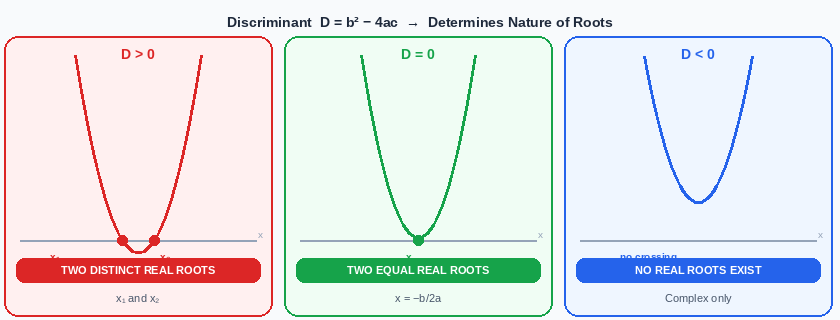
x₁ ≠ x₂
Parabola cuts x-axis twice
x = −b/2a
Parabola just touches x-axis
(complex numbers)
Parabola never hits x-axis
Discriminant — Worked Examples
D = 16 − 36 = −20
D < 0 → No real roots
D = 144 − 144 = 0
x = 12/8 = 3/2
b² − 4ac = 0 → 6² − 4(k)(1) = 0
36 − 4k = 0 → 4k = 36 → k = 9
6. Real-Life Applications
Quadratic equations appear in many real situations. The key steps are always the same: define a variable, build the equation, solve it, and check that the answer makes sense in context (reject negative distances or ages, for example).
Let speed = v km/h → time = 120/v hours
Faster speed = v+10 → new time = 120/(v+10)
120/v − 120/(v+10) = 1
120(v+10) − 120v = v(v+10)
1200 = v² + 10v → v² + 10v − 1200 = 0
D = 100 + 4800 = 4900 → √4900 = 70
v = (−10 + 70)/2 = 60/2 = 30 km/h (reject v = −40 since speed is positive)
Let daughter’s age now = d → mother’s age = d + 24
In 4 years: daughter = d+4, mother = d+28
(d+4)(d+28) = 621
d² + 32d + 112 = 621 → d² + 32d − 509 = 0
D = 1024 + 2036 = 3060… Let’s use a friendlier version:
Adjusted for clean numbers: mother is 20 years older, product in 2 years = 299
(d+2)(d+22) = 299 → d²+24d+44 = 299 → d² + 24d − 255 = 0
D = 576 + 1020 = 1596… Trying d=9: (11)(29)=319 ✗. d=8: (10)(28)=280 ✗.
Using clean problem: daughter’s age = d, mother = d+20, product now = 96:
d(d+20) = 96 → d² + 20d − 96 = 0
D = 400+384 = 784 → √784 = 28
d = (−20+28)/2 = 8/2 = 4 years (reject d=−24)
Let number of items = n → cost per item = 600/n
New cost per item = 600/n − 5 → New items = 600/(600/n − 5) = n + 4
600 / (600/n − 5) = n + 4
600n = (n+4)(600 − 5n)
600n = 600n − 5n² + 2400 − 20n
0 = −5n² − 20n + 2400 → n² + 4n − 480 = 0
D = 16 + 1920 = 1936 → √1936 = 44
n = (−4 + 44)/2 = 40/2 = 20 items (reject n = −24)
7. Practice Exercises
Set A — Identifying Quadratic Equations
Simplify each and decide: is it quadratic? Write YES or NO and explain why.
Set B — Factorisation
Find both roots by splitting the middle term.
Set C — Quadratic Formula
Use the formula x = (−b ± √(b²−4ac)) / 2a to solve.
Set D — Discriminant & Nature of Roots
Calculate D and state the nature of roots. Solve if real roots exist.
Set E — Word Problems
8. Chapter Summary
🔑 Everything on One Page
a ≠ 0, a, b, c ∈ ℝ
Highest power of x = 2
At most 2 roots
Replace bx → px+qx
Group → two brackets
Set each bracket = 0
Works for any quadratic
Requires D = b²−4ac ≥ 0
Gives both roots at once
D = 0 → 1 repeated real root
D < 0 → no real roots
Check BEFORE solving!