Curriculum
Grade IX Employability Skills Level-I
Lessons
0/5

Notes
0/5

Work Sheets
0/5
All Notes and All Worksheets
0/0
Unit 1-Communication Skills
Unit 1: Communication Skills
Employability Skills · School Revise

1. Methods of communication
Communication is the exchange of information through speaking, writing, signs or signals. The three main methods are verbal (spoken or written words), non-verbal (body language, gestures, facial expressions) and visual (pictures, charts, graphs).
Verbal communication is quick and allows instant feedback. Non-verbal communication supports the words we speak. Visual communication helps explain ideas that are hard to say in words.
2. Elements of the communication cycle
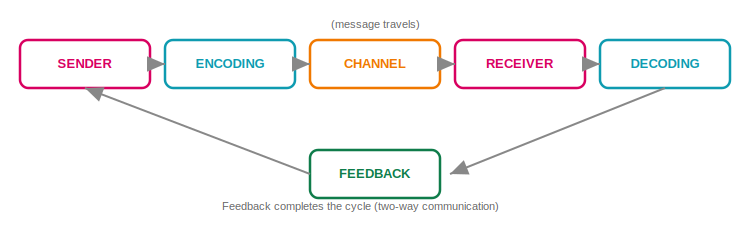
A message travels through a cycle: the sender has an idea, encodes it into words or signs, sends it through a channel (voice, letter, email), the receiver gets it, decodes (understands) it, and gives feedback.
Feedback tells the sender whether the message was understood correctly. Without feedback, communication is incomplete.
3. Perspectives in communication and factors affecting them
A perspective is the ‘filter’ through which each person sees a message. Factors that affect our perspective include visual perception, language, past experience, prejudices, feelings and the environment.
Being aware of these factors helps us avoid misunderstanding and communicate clearly with people who are different from us.
4. Basic writing skills
Good writing uses correct sentences. A sentence is a complete group of words with a subject and a predicate. The four kinds of sentences are declarative (statement), interrogative (question), imperative (command) and exclamatory (strong feeling).
Parts of speech (noun, pronoun, verb, adjective, adverb, etc.) and correct use of articles (a, an, the) help us build clear sentences and paragraphs.
Practice (Multiple Choice)
- 1. The response of the receiver to a message is called
- a) encoding
- b) feedback
- c) channel
- d) noise
- 2. Body language and gestures are a form of
- a) verbal communication
- b) non-verbal communication
- c) written communication
- d) visual aids
- 3. A sentence that asks a question is called
- a) declarative
- b) imperative
- c) interrogative
- d) exclamatory
- 4. The means by which a message is sent is the
- a) sender
- b) channel
- c) receiver
- d) idea
- 5. Using charts and pictures to share information is
- a) verbal
- b) visual
- c) non-verbal
- d) feedback
 Google