Curriculum
Grade IX Employability Skills Level-I
Lessons
0/5

Notes
0/5

Work Sheets
0/5
All Notes and All Worksheets
0/0
Uni 3-ICT Skills
Unit 3: Information & Communication Technology (ICT) Skills
Employability Skills · School Revise

1. Role of ICT and ICT tools
ICT stands for Information and Communication Technology. It means using electronic devices like computers, smartphones and tablets to store, process and share information. ICT is used in education, health, business and daily life.
Common ICT tools include mobile phones, tablets, radio, television, email and the internet.
2. Components of a computer system
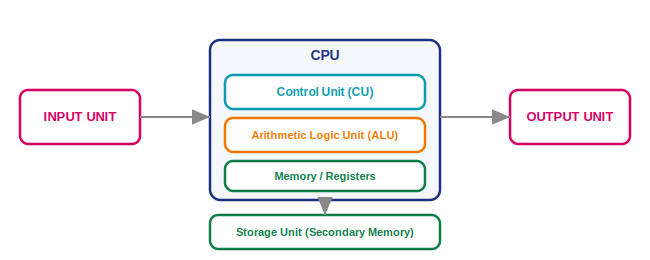
A computer has hardware (physical parts: input devices, CPU, output devices, storage) and software (programs such as the operating system and applications).
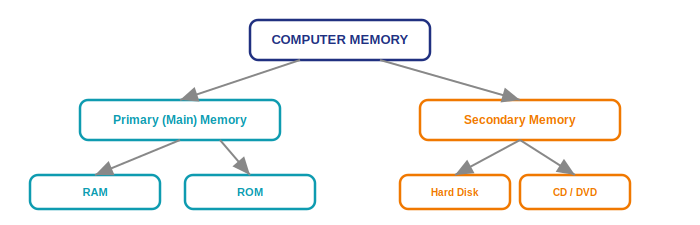
Memory is of two types: primary memory (RAM and ROM) and secondary memory (hard disk, CD/DVD, pen drive) used to store data permanently.
3. Peripheral devices
Peripheral devices connect to a computer. They are grouped as input devices (keyboard, mouse, scanner), output devices (monitor, printer, speaker) and storage devices (pen drive, external hard disk).
4. Basic computer operations
Always start and shut down a computer correctly. The operating system (Windows, Linux) controls the computer. Files store data and folders organise files. The keyboard and mouse are used to work on the desktop.
5. Internet and its applications; staying safe
The internet connects computers worldwide. Its applications include email, chatting, video conferencing, e-learning, e-shopping and e-banking.
Stay safe online: use strong passwords, do not share private information, be careful with links, and use anti-virus software. Cyber crimes include cyber bullying, hacking and phishing.
Practice (Multiple Choice)
- 1. ICT stands for
- a) Indian Computer Technology
- b) Information and Communication Technology
- c) Internet Control Tool
- d) Input Control Terminal
- 2. Which is an input device?
- a) monitor
- b) printer
- c) keyboard
- d) speaker
- 3. RAM and ROM are types of
- a) primary memory
- b) secondary memory
- c) input device
- d) software
- 4. The program that controls the computer is the
- a) browser
- b) operating system
- c) printer
- d) mouse
- 5. Trying to steal data by pretending to be trustworthy is
- a) e-learning
- b) phishing
- c) e-banking
- d) blogging
 Google