Curriculum
Science Grade XII Physics
Science Grade XII Physics
0/14
-
Chapter 1: Electric Charges and Fields
 Preview
 -
Chapter 2: Electrostatic Potential and Capacitance
Preview
-
Chapter 3: Current Electricity
Preview
-
Chapter 4: Moving Charges and Magnetism
Preview
-
Chapter 5: Magnetism and Matter
Preview
-
Chapter 6: Electromagnetic Induction
Preview
-
Chapter 7: Alternating Current
Preview
-
Chapter 8: Electromagnetic Waves
Preview
-
Chapter 9: Ray Optics and Optical Instruments
Preview
-
Chapter 10: Wave Optics
Preview
-
Chapter 11: Dual Nature of Radiation and Matter
Preview
-
Chapter 12: Atoms
Preview
-
Chapter 13: Nuclei
Preview
-
Chapter 14: Semiconductor Electronics
Preview
Chapter 1: Electric Charges and Fields
|
Grade 12 Science | Chapter 1 Electric Charges and FieldsElectric charge is the source of all electrical effects. This chapter develops charge and its properties, Coulomb’s law, the electric field and field lines, the dipole, and Gauss’s law.
|
|
Contents
|
1. Introduction: Electric Charge |
Electric charge is a basic property of matter that gives rise to all electrical effects. There are two kinds, positive and negative: like charges repel and unlike charges attract. Charge has two key properties. It is quantised, meaning it comes only in whole multiples of a smallest unit, the charge on one electron, written e. It is also conserved, meaning the total charge in an isolated system never changes.
|
Core idea Charge is quantised (q equals n times e) and conserved. The force between charges follows Coulomb’s law, and the influence of a charge on the space around it is described by the electric field.
|
2. Coulomb’s Law |
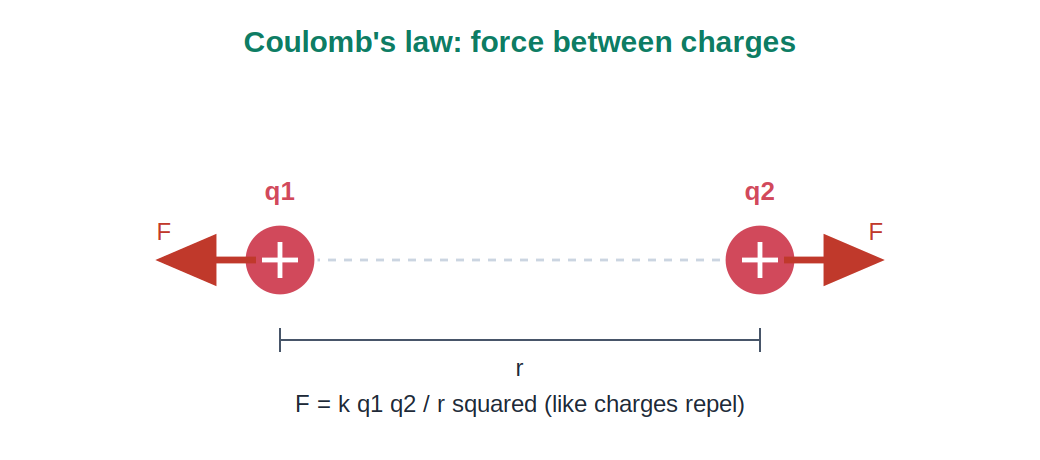
The force between two point charges was measured by Coulomb. Coulomb’s law states that the force is proportional to the product of the charges and inversely proportional to the square of the distance between them, F equals k times q1 times q2 divided by r squared, where k is about 9 times 10 to the power 9 in SI units. The force acts along the line joining the charges, repulsive for like charges and attractive for unlike.
|
Diagram 1 – Coulomb’s Law
Fig 1. Two like charges repel with equal and opposite forces along the line joining them, weaker as r grows. |
3. The Electric Field |
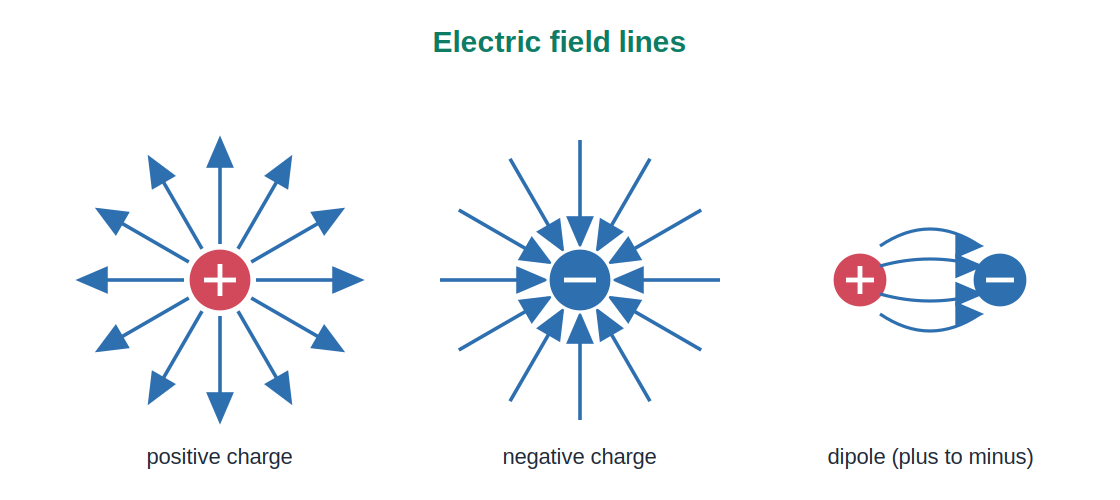
A charge changes the space around it, and we describe this with the electric field, E. The field at a point is the force per unit positive charge placed there, E equals F divided by q, measured in newtons per coulomb. The field of a point charge is E equals k times q divided by r squared. We picture the field with field lines that point away from a positive charge and toward a negative one, closer together where the field is stronger.
|
Diagram 2 – Electric Field Lines
Fig 2. Field lines point away from a positive charge, toward a negative charge, and from plus to minus in a dipole. |
4. The Electric Dipole |
An electric dipole is a pair of equal and opposite charges, plus q and minus q, separated by a small distance. Its strength and direction are given by the dipole moment, p equals q times d, a vector pointing from the negative to the positive charge. In a uniform field a dipole feels no net force but a torque that turns it to line up with the field, which is the basis of how many molecules respond to fields.
5. Gauss’s Law |
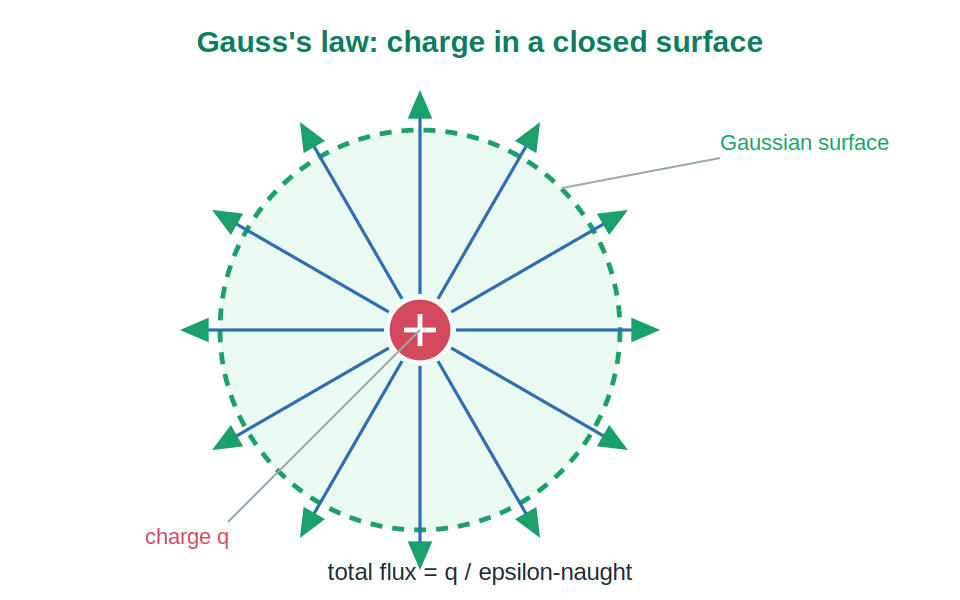
Electric flux measures how much field passes through a surface. Gauss’s law gives a powerful link between flux and charge: the total electric flux through any closed surface equals the charge enclosed divided by the constant epsilon-naught, flux equals q divided by epsilon-naught. It depends only on the charge inside, not on where that charge sits or on any charges outside the surface.
|
Diagram 3 – Gauss’s Law
Fig 3. The total flux out of a closed surface depends only on the charge enclosed within it. |
6. Applications of Gauss’s Law |
Gauss’s law makes it easy to find the field where there is symmetry. For a uniformly charged sphere, the field outside is the same as if all the charge sat at the centre. For an infinite charged sheet, the field is uniform and equal to the surface charge density divided by twice epsilon-naught, pointing away on both sides. For a long charged wire, the field falls off as one over the distance. In each case the symmetry lets us use Gauss’s law directly.
7. Key Reasoning (Principles) |
|
Principle 1: Charge is quantised and conserved Charge exists only in whole multiples of the basic unit e, and the total charge of an isolated system stays the same, so charge can be moved but never created or destroyed. |
|
Principle 2: The force follows an inverse square law By Coulomb’s law the force falls off as the square of the distance, so doubling the separation cuts the force to a quarter, just as gravity does with mass. |
|
Principle 3: Flux depends only on the enclosed charge Gauss’s law shows the total flux through a closed surface is set entirely by the charge inside it, which makes finding fields easy whenever there is symmetry. |
8. Worked Examples |
| Example 1 |
|
Q: State the two kinds of electric charge and how they interact. ▶ Show SolutionPositive and negative; like charges repel and unlike charges attract. Answer: Positive and negative; like repel, unlike attract. |
| Example 2 |
|
Q: What does it mean that charge is quantised? ▶ Show SolutionCharge comes only in whole multiples of the basic unit e. Answer: q equals n times e. |
| Example 3 |
|
Q: Write Coulomb’s law. ▶ Show SolutionF equals k times q1 times q2 divided by r squared. Answer: F = k q1 q2 / r squared. |
| Example 4 |
|
Q: Two charges are moved twice as far apart. What happens to the force? ▶ Show SolutionForce goes as one over r squared, so it falls to one quarter. Answer: It becomes one quarter. |
| Example 5 |
|
Q: Define the electric field at a point. ▶ Show SolutionThe force per unit positive charge placed at that point, E equals F divided by q. Answer: E = F / q. |
| Example 6 |
|
Q: In which direction do field lines point near a positive charge? ▶ Show SolutionAway from the positive charge. Answer: Away from it. |
| Example 7 |
|
Q: What is the electric dipole moment? ▶ Show Solutionp equals q times d, pointing from the negative to the positive charge. Answer: p = q d. |
| Example 8 |
|
Q: What does a dipole experience in a uniform field? ▶ Show SolutionNo net force, but a torque that turns it to line up with the field. Answer: A torque (no net force). |
| Example 9 |
|
Q: State Gauss’s law. ▶ Show SolutionThe total flux through a closed surface equals the enclosed charge divided by epsilon-naught. Answer: flux = q / epsilon-naught. |
| Example 10 |
|
Q: A charge of 2 microcoulomb is enclosed by a surface. By what does the flux change if the charge doubles? ▶ Show SolutionFlux is proportional to the enclosed charge. Doubling the charge doubles the flux. Answer: It doubles. |
9. Practice Sets A to D |
| Set A – Multiple Choice (Basic) |
|
1. Like charges: (a) attract (b) repel (c) do nothing (d) merge 2. Charge is measured in: (a) newton (b) coulomb (c) volt (d) joule 3. Coulomb’s force varies with distance as: (a) 1/r (b) 1/r squared (c) r (d) r squared 4. Electric field is force per unit: (a) mass (b) positive charge (c) area (d) length 5. Gauss’s law relates flux to the: (a) outside charge (b) enclosed charge (c) area only (d) field only ▶ Reveal Answers1. (b) repel. 2. (b) coulomb. 3. (b) 1/r squared. 4. (b) positive charge. 5. (b) enclosed charge. |
| Set B – Short Answer (Understanding) |
|
1. State the two properties of charge. 2. Write Coulomb’s law and name each symbol. 3. Define the electric field and give its unit. 4. What is an electric dipole and its moment? 5. State Gauss’s law in words. ▶ Reveal Answers1. Charge is quantised (whole multiples of e) and conserved (total stays constant). 2. F equals k q1 q2 divided by r squared; F is force, q1 and q2 the charges, r the separation, k the constant. 3. The force per unit positive charge, E equals F divided by q, in newtons per coulomb. 4. A pair of equal and opposite charges a small distance apart; its moment is p equals q times d, from minus to plus. 5. The total flux through any closed surface equals the charge enclosed divided by epsilon-naught. |
| Set C – Application and Reasoning |
|
1. Two charges are brought three times closer. How does the force change? 2. Why do field lines never cross? 3. Why does a dipole turn in a uniform field but not move off? 4. Why does flux not depend on charges outside the surface? 5. Why is the field of a charged sphere, from outside, like a point charge? ▶ Reveal Answers1. The force grows by a factor of nine, since it goes as one over r squared. 2. Because the field has only one direction at each point, so two lines cannot meet there. 3. Because the equal and opposite forces on its two charges give a turning torque but cancel as a net force. 4. Because their field lines that enter the surface also leave it, so they add no net flux. 5. Because, by symmetry, Gauss’s law gives the same field as if all the charge were at the centre. |
| Set D – Higher Order (Challenge) |
|
1. Explain why charge being quantised was a surprising discovery. 2. Compare Coulomb’s law with the law of gravitation. 3. Explain how field lines show both the direction and the strength of a field. 4. Explain why Gauss’s law makes symmetric problems easy. 5. A charge sits at the centre of a cube. What fraction of the flux passes through one face, and why? ▶ Reveal Answers1. Because charge appears smooth in everyday life, yet it is built from countless tiny equal units of e, like grains making sand. 2. Both are inverse square laws between two bodies, but Coulomb’s law acts on charge and can attract or repel, while gravity acts on mass and only attracts. 3. The direction of a line gives the field direction, and lines drawn closer together show where the field is stronger. 4. When the field has symmetry, the flux can be written simply over a chosen surface, so the field is found at once from the enclosed charge. 5. One sixth, because by symmetry the total flux q divided by epsilon-naught is shared equally among the six identical faces. |
|
Chapter Summary
|
|||||||||||||||||||||||||||||||
| 8-Point Exam Quick-Check | ||||||||||||||||||||||||||||||||
|
||||||||||||||||||||||||||||||||
|
School Revise Virtual Lab Explore these ideas with interactive simulations and visual tools.
|
|
Class 12 Physics Chapter 1: Electric Charges and Fields, Complete Notes and Practice This revision guide follows the current NCERT Class 12 Physics syllabus and develops electric charges and fields, covering the properties of charge, Coulomb’s law and the inverse square force, the electric field and field lines, the electric dipole and its moment, and Gauss’s law with its applications to a charged sphere, sheet and wire, with three diagrams, ten worked examples and graded practice. Visit SchoolRevise.com to revise, practise and excel. |
 Google