Curriculum
Science Grade XII Physics
Science Grade XII Physics
0/14
-
Chapter 1: Electric Charges and Fields
 Preview
 -
Chapter 2: Electrostatic Potential and Capacitance
Preview
-
Chapter 3: Current Electricity
Preview
-
Chapter 4: Moving Charges and Magnetism
Preview
-
Chapter 5: Magnetism and Matter
Preview
-
Chapter 6: Electromagnetic Induction
Preview
-
Chapter 7: Alternating Current
Preview
-
Chapter 8: Electromagnetic Waves
Preview
-
Chapter 9: Ray Optics and Optical Instruments
Preview
-
Chapter 10: Wave Optics
Preview
-
Chapter 11: Dual Nature of Radiation and Matter
Preview
-
Chapter 12: Atoms
Preview
-
Chapter 13: Nuclei
Preview
-
Chapter 14: Semiconductor Electronics
Preview
Chapter 6: Electromagnetic Induction
|
Grade 12 Science | Chapter 6 Electromagnetic InductionA changing magnetic field makes electricity. This chapter develops magnetic flux, Faraday’s law, Lenz’s law, induced EMF, and the AC generator.
|
|
Contents
|
1. Introduction: Electricity from Magnetism |
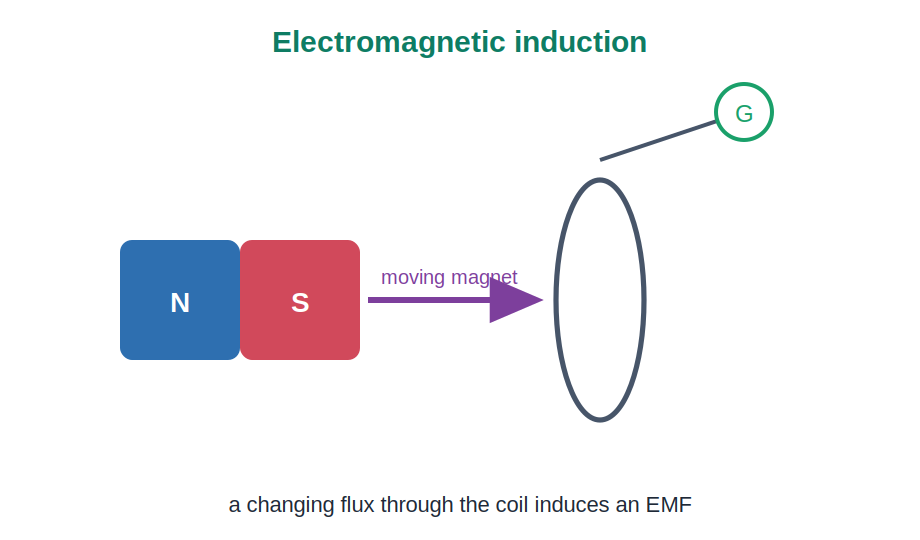
If a current makes magnetism, can magnetism make a current? Faraday found that it can, but only when the magnetic field through a circuit is changing. Moving a magnet near a coil, or changing the current in a nearby coil, produces a voltage and a current in the coil. This effect, electromagnetic induction, is how almost all the world’s electricity is generated.
|
Core idea A changing magnetic flux through a circuit induces an EMF (Faraday’s law). The induced current always opposes the change that caused it (Lenz’s law).
|
2. Magnetic Flux |
Magnetic flux measures how much magnetic field passes through a loop or coil. It depends on the strength of the field, the area of the loop, and the angle between them, and it is largest when the field passes straight through the loop. Induction depends not on the flux itself but on how fast the flux changes, so a quick change makes a larger effect than a slow one.
|
Diagram 1 – Electromagnetic Induction
Fig 1. Moving a magnet toward a coil changes the flux through it and induces a current, shown on the galvanometer. |
3. Faraday’s Law |
Faraday’s law states that the induced EMF equals the rate at which the magnetic flux through the circuit changes. The faster the flux changes, the larger the induced voltage. So moving a magnet quickly, using a stronger magnet, or winding more turns on the coil all increase the induced EMF. If the flux does not change, no EMF is induced, however strong the field.
4. Lenz’s Law |
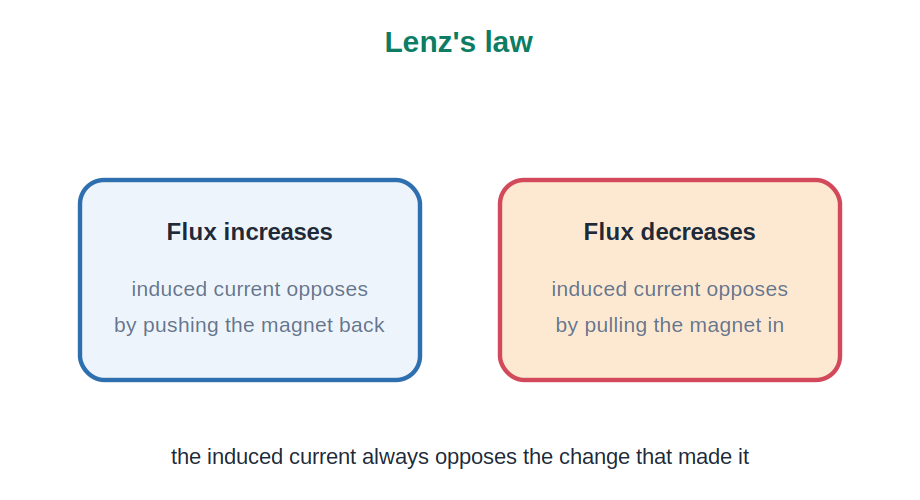
Lenz’s law tells us the direction of the induced current: it always flows so as to oppose the change that produced it. If a magnet is pushed toward a coil, the induced current makes the coil push back; if it is pulled away, the current tries to pull it back. This is simply the law of conservation of energy at work, since we must do work against this opposition to generate electricity.
|
Diagram 2 – Lenz’s Law
Fig 2. The induced current always opposes the change in flux, whether it is increasing or decreasing. |
5. The AC Generator |
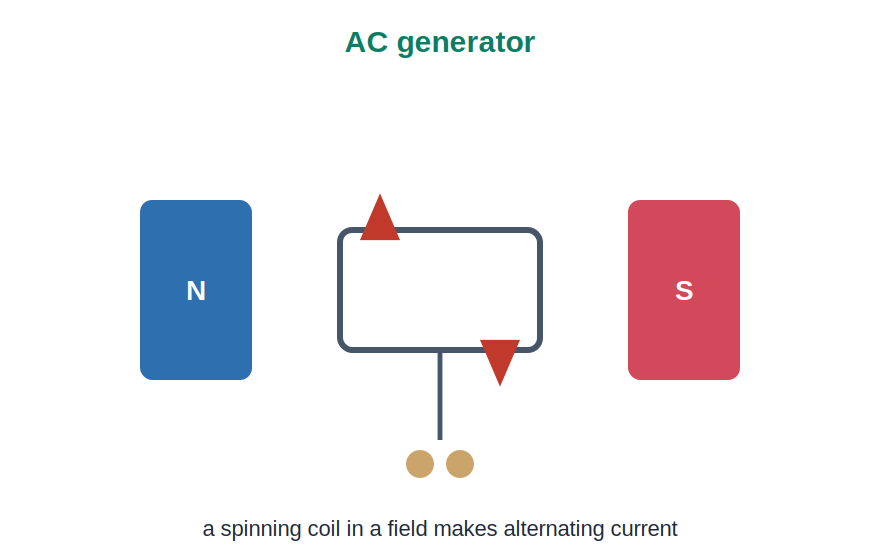
The AC generator turns motion into electricity using induction. A coil is spun in a magnetic field, so the flux through it changes continuously, inducing an EMF. As the coil turns, the EMF rises and falls and reverses each half turn, producing alternating current. This is how power stations generate electricity, whether the coil is turned by steam, water or wind.
|
Diagram 3 – The AC Generator
Fig 3. A coil spinning in a magnetic field has a changing flux, generating alternating current. |
6. Self and Mutual Induction |
Induction can happen within one coil or between two. In self induction, a changing current in a coil induces an EMF in the same coil that opposes the change, a property called inductance. In mutual induction, a changing current in one coil induces an EMF in a nearby coil. Mutual induction is the principle of the transformer, which steps voltages up or down for the power grid.
7. Key Reasoning (Principles) |
|
Principle 1: Only a changing flux induces an EMF A steady field produces no current; it is the rate of change of flux that induces an EMF, so faster changes give larger voltages. |
|
Principle 2: The induced current opposes the change By Lenz’s law the induced current always acts against whatever change caused it, which is conservation of energy in action. |
|
Principle 3: Spinning a coil makes alternating current As a coil turns in a field its flux rises, falls and reverses, so the induced EMF alternates, the basis of the AC generator. |
8. Worked Examples |
| Example 1 |
|
Q: What is needed to induce a current in a coil? ▶ Show SolutionA changing magnetic flux through the coil. Answer: A changing flux. |
| Example 2 |
|
Q: What does magnetic flux measure? ▶ Show SolutionHow much magnetic field passes through a loop or coil. Answer: Field through a loop. |
| Example 3 |
|
Q: State Faraday’s law. ▶ Show SolutionThe induced EMF equals the rate of change of the magnetic flux. Answer: EMF equals rate of change of flux. |
| Example 4 |
|
Q: How can the induced EMF be increased? ▶ Show SolutionBy changing the flux faster, using a stronger magnet, or more turns. Answer: Faster change, stronger field, more turns. |
| Example 5 |
|
Q: State Lenz’s law. ▶ Show SolutionThe induced current opposes the change that produced it. Answer: It opposes the change. |
| Example 6 |
|
Q: Which conservation law does Lenz’s law express? ▶ Show SolutionConservation of energy. Answer: Conservation of energy. |
| Example 7 |
|
Q: What does an AC generator do? ▶ Show SolutionIt spins a coil in a magnetic field to generate alternating current. Answer: Generates AC by a spinning coil. |
| Example 8 |
|
Q: Why does a generator make alternating current? ▶ Show SolutionBecause the flux through the spinning coil rises, falls and reverses each half turn. Answer: The flux reverses each half turn. |
| Example 9 |
|
Q: What is self induction? ▶ Show SolutionA changing current in a coil induces an opposing EMF in the same coil. Answer: EMF induced in the same coil. |
| Example 10 |
|
Q: What device works by mutual induction? ▶ Show SolutionThe transformer. Answer: The transformer. |
9. Practice Sets A to D |
| Set A – Multiple Choice (Basic) |
|
1. A current is induced only when the flux is: (a) zero (b) steady (c) changing (d) strong 2. Faraday’s law links EMF to the: (a) flux (b) rate of change of flux (c) area (d) current only 3. Lenz’s law says the induced current: (a) aids the change (b) opposes the change (c) is zero (d) reverses randomly 4. An AC generator produces: (a) steady current (b) alternating current (c) no current (d) heat only 5. A transformer works by: (a) self induction (b) mutual induction (c) friction (d) gravity ▶ Reveal Answers1. (c) changing. 2. (b) rate of change of flux. 3. (b) opposes the change. 4. (b) alternating current. 5. (b) mutual induction. |
| Set B – Short Answer (Understanding) |
|
1. What is magnetic flux? 2. State Faraday’s law. 3. State Lenz’s law and the law it expresses. 4. How does an AC generator work? 5. Distinguish self and mutual induction. ▶ Reveal Answers1. A measure of how much magnetic field passes through a loop or coil. 2. The induced EMF equals the rate of change of the magnetic flux. 3. The induced current opposes the change that caused it; it expresses conservation of energy. 4. A coil spins in a magnetic field, so its changing flux induces an alternating EMF. 5. Self induction is in the same coil from its own changing current; mutual induction is in a nearby coil. |
| Set C – Application and Reasoning |
|
1. Why does a stationary magnet near a coil induce no current? 2. Why does moving the magnet faster give a larger EMF? 3. Why must we do work to generate electricity? 4. Why does a generator coil have many turns? 5. Why is mutual induction useful for the power grid? ▶ Reveal Answers1. Because the flux is not changing, and only a changing flux induces a current. 2. Because the flux changes more quickly, and the EMF equals the rate of change of flux. 3. Because by Lenz’s law the induced current opposes our motion, so we work against it, supplying the energy. 4. Because more turns increase the induced EMF for the same change in flux. 5. Because a transformer uses it to step voltages up or down for efficient transmission. |
| Set D – Higher Order (Challenge) |
|
1. Explain why electromagnetic induction is the basis of most electricity generation. 2. Explain how Lenz’s law follows from conservation of energy. 3. Explain why the output of a simple generator alternates. 4. Explain why pushing a magnet into a coil is harder when the circuit is closed. 5. Explain how a transformer changes voltage without moving parts. ▶ Reveal Answers1. Because spinning a coil in a field, by any source of motion, induces an EMF, which is how power stations make electricity. 2. If the induced current aided the change instead of opposing it, energy would grow from nothing, so it must oppose the change to conserve energy. 3. Because the flux through the turning coil rises, falls and reverses each half turn, so the induced EMF alternates. 4. Because the induced current opposes the motion (Lenz’s law), so we feel a resisting force that we must push against. 5. A changing current in one coil induces an EMF in a second coil through mutual induction, with the turns ratio setting the voltage change. |
|
Chapter Summary
|
|||||||||||||||||||||||||||||||
| 8-Point Exam Quick-Check | ||||||||||||||||||||||||||||||||
|
||||||||||||||||||||||||||||||||
|
School Revise Virtual Lab Explore these ideas with interactive simulations and visual tools.
|
|
Class 12 Physics Chapter 6: Electromagnetic Induction, Complete Notes and Practice This revision guide follows the current NCERT Class 12 Physics syllabus and develops electromagnetic induction, covering magnetic flux, Faraday’s law that links induced EMF to the rate of change of flux, Lenz’s law and its basis in conservation of energy, the AC generator that spins a coil in a field, and self and mutual induction with the transformer, with three diagrams, ten worked examples and graded practice. Visit SchoolRevise.com to revise, practise and excel. |
 Google