Curriculum
Science Grade XII Physics
Science Grade XII Physics
0/14
-
Chapter 1: Electric Charges and Fields
 Preview
 -
Chapter 2: Electrostatic Potential and Capacitance
Preview
-
Chapter 3: Current Electricity
Preview
-
Chapter 4: Moving Charges and Magnetism
Preview
-
Chapter 5: Magnetism and Matter
Preview
-
Chapter 6: Electromagnetic Induction
Preview
-
Chapter 7: Alternating Current
Preview
-
Chapter 8: Electromagnetic Waves
Preview
-
Chapter 9: Ray Optics and Optical Instruments
Preview
-
Chapter 10: Wave Optics
Preview
-
Chapter 11: Dual Nature of Radiation and Matter
Preview
-
Chapter 12: Atoms
Preview
-
Chapter 13: Nuclei
Preview
-
Chapter 14: Semiconductor Electronics
Preview
Chapter 4: Moving Charges and Magnetism
|
Grade 12 Science | Chapter 4 Moving Charges and MagnetismMoving charges make magnetism. This chapter develops the field around a current, the force on a moving charge and on a wire, the solenoid, and how a galvanometer works.
|
|
Contents
|
1. Introduction: Magnetism from Currents |
A current is more than a flow of charge: it is also a source of magnetism. A wire carrying a current sets up a magnetic field around it, and a magnetic field in turn pushes on moving charges and on currents. This deep link between electricity and magnetism, discovered by Oersted, is the basis of motors, loudspeakers and many measuring instruments.
|
Core idea A current creates a magnetic field around it, and a magnetic field exerts a force on a moving charge, F equals q times v times B, and on a current carrying wire.
|
2. Field Around a Current |
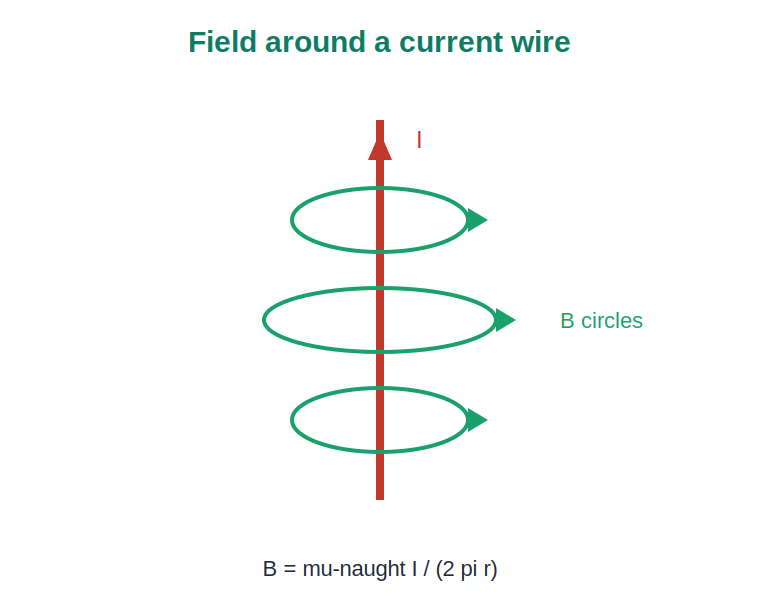
A straight wire carrying a current is surrounded by a magnetic field whose lines form circles around the wire. The field is stronger near the wire and weaker far away, given by B equals mu-naught times I divided by two pi r. The direction of the circles is found by the right hand rule: point the thumb along the current and the fingers curl the way the field points.
|
Diagram 1 – Field Around a Current Wire
Fig 1. A current carrying wire is encircled by magnetic field lines, weaker further out. |
3. Force on a Moving Charge |
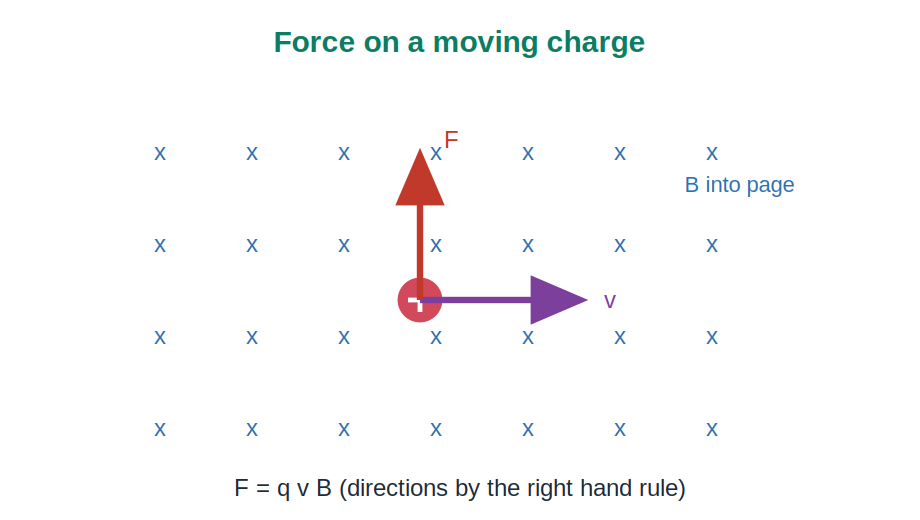
A magnetic field pushes on a charge only when the charge is moving. The force is F equals q times v times B when the velocity is at right angles to the field, and it acts at right angles to both the velocity and the field, found again by a right hand rule. Because the force is always sideways, it changes the direction of the charge without changing its speed, making the charge travel in a curve.
|
Diagram 2 – Force on a Moving Charge
Fig 2. A charge moving across a magnetic field feels a force at right angles to both its velocity and the field. |
4. Force on a Current Wire |
Since a current is made of moving charges, a current carrying wire in a magnetic field also feels a force, F equals B times I times length, when the wire is at right angles to the field. The direction is given by a right hand rule and is sideways to both the current and the field. This force is what turns the coil of an electric motor and moves the cone of a loudspeaker.
5. The Solenoid |
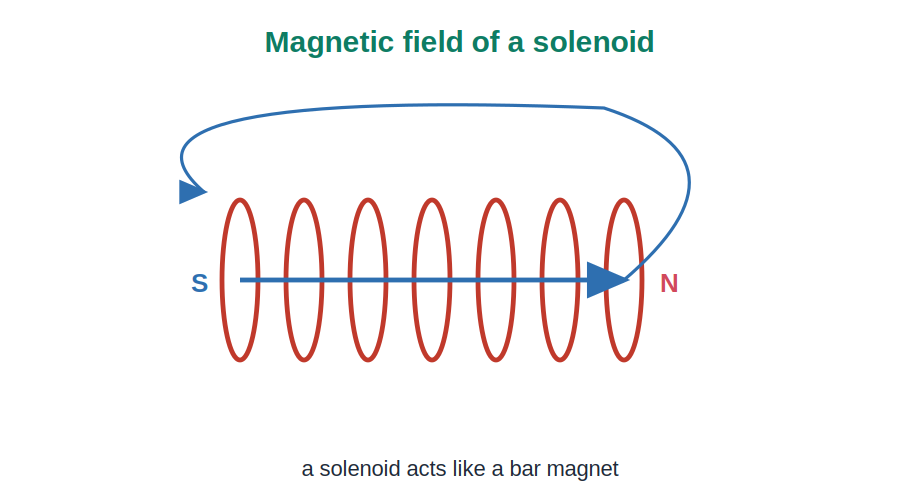
A solenoid is a long coil of many turns of wire. When a current flows, the fields of all the turns add together to give a strong, nearly uniform field inside, while outside it behaves just like a bar magnet, with a north and a south end. Placing an iron core inside makes the field much stronger, which is the basis of the electromagnet.
|
Diagram 3 – The Solenoid
Fig 3. A current carrying solenoid produces a field like a bar magnet, with a north and a south end. |
6. The Moving Coil Galvanometer |
The force on a current in a field is used in the galvanometer, the instrument that detects small currents. A coil sits in a magnetic field, and when a current passes through it the field exerts a turning force on the coil, turning a pointer against a spring. The larger the current, the more the coil turns, so the deflection of the pointer measures the current.
7. Key Reasoning (Principles) |
|
Principle 1: A current is a source of magnetism Moving charge sets up a magnetic field, so every current carrying wire is surrounded by circular field lines, linking electricity and magnetism. |
|
Principle 2: The magnetic force is sideways The force on a moving charge or a current acts at right angles to both the motion and the field, so it bends the path rather than speeding it up. |
|
Principle 3: Many turns make a strong, uniform field In a solenoid the fields of all the turns add, giving a strong uniform field inside and a bar magnet pattern outside. |
8. Worked Examples |
| Example 1 |
|
Q: What did Oersted discover? ▶ Show SolutionThat a current carrying wire produces a magnetic field around it. Answer: Currents make magnetism. |
| Example 2 |
|
Q: What shape are the field lines around a straight wire? ▶ Show SolutionCircles around the wire. Answer: Circles. |
| Example 3 |
|
Q: Write the force on a moving charge in a field. ▶ Show SolutionF equals q times v times B (when v is at right angles to B). Answer: F = q v B. |
| Example 4 |
|
Q: In what direction does the magnetic force act? ▶ Show SolutionAt right angles to both the velocity and the field. Answer: At right angles to both. |
| Example 5 |
|
Q: Why does the magnetic force not change a charge’s speed? ▶ Show SolutionBecause it is always sideways, so it changes direction, not speed. Answer: It is always sideways. |
| Example 6 |
|
Q: Write the force on a current carrying wire. ▶ Show SolutionF equals B times I times length (at right angles to B). Answer: F = B I L. |
| Example 7 |
|
Q: What does a solenoid behave like outside? ▶ Show SolutionA bar magnet, with a north and a south end. Answer: A bar magnet. |
| Example 8 |
|
Q: How is a solenoid’s field made stronger? ▶ Show SolutionBy placing an iron core inside it. Answer: With an iron core. |
| Example 9 |
|
Q: What does a galvanometer detect? ▶ Show SolutionSmall electric currents. Answer: Small currents. |
| Example 10 |
|
Q: What makes the galvanometer coil turn? ▶ Show SolutionThe turning force on the current carrying coil in the magnetic field. Answer: The force on the coil. |
9. Practice Sets A to D |
| Set A – Multiple Choice (Basic) |
|
1. A current carrying wire is surrounded by: (a) electric field only (b) magnetic field (c) gravity (d) nothing 2. Field lines around a straight wire are: (a) straight (b) circles (c) square (d) random 3. Force on a moving charge is: (a) q B (b) q v B (c) v / B (d) B / v 4. The magnetic force on a charge is: (a) along v (b) along B (c) at right angles to both (d) zero always 5. A solenoid acts like a: (a) capacitor (b) bar magnet (c) resistor (d) battery ▶ Reveal Answers1. (b) magnetic field. 2. (b) circles. 3. (b) q v B. 4. (c) at right angles to both. 5. (b) bar magnet. |
| Set B – Short Answer (Understanding) |
|
1. What is the shape and direction of the field around a wire? 2. Write the force on a moving charge and state its direction. 3. Write the force on a current carrying wire. 4. Describe the field of a solenoid. 5. How does a galvanometer work? ▶ Reveal Answers1. Circular field lines, with the direction given by the right hand rule. 2. F equals q times v times B, acting at right angles to both the velocity and the field. 3. F equals B times I times length, at right angles to the field. 4. A strong, nearly uniform field inside, and a bar magnet pattern with a north and south end outside. 5. A current in a coil in a magnetic field feels a turning force, moving a pointer by an amount that measures the current. |
| Set C – Application and Reasoning |
|
1. Why does a compass needle move near a current? 2. Why does a charged particle move in a circle in a uniform field? 3. Why does a motor coil turn? 4. Why does an iron core strengthen a solenoid? 5. Why must a charge be moving to feel a magnetic force? ▶ Reveal Answers1. Because the current sets up a magnetic field that the compass needle lines up with. 2. Because the sideways force keeps changing its direction at constant speed, bending the path into a circle. 3. Because the magnetic force on its current carrying sides gives a turning effect. 4. Because the iron becomes magnetised and adds greatly to the field of the coil. 5. Because the magnetic force depends on the velocity, so a charge at rest feels no force. |
| Set D – Higher Order (Challenge) |
|
1. Explain how electricity and magnetism are linked in this chapter. 2. Explain why the magnetic force does no work on a moving charge. 3. Explain how the force on a current is used in a motor. 4. Explain why a solenoid gives a uniform field inside. 5. Explain how the galvanometer turns a current into a readable deflection. ▶ Reveal Answers1. A current produces a magnetic field, and a magnetic field exerts a force on currents and moving charges, so each can give rise to the other. 2. Because the force is always at right angles to the motion, it never acts along the path, so it does no work and the speed stays constant. 3. The field pushes the two sides of the coil in opposite directions, giving a turning force that rotates the coil continuously. 4. Because the fields of the many turns add together along the axis, giving a strong and nearly uniform field inside. 5. The field exerts a turning force on the current carrying coil, which moves a pointer against a spring by an amount that grows with the current. |
|
Chapter Summary
|
|||||||||||||||||||||||||||||||
| 8-Point Exam Quick-Check | ||||||||||||||||||||||||||||||||
|
||||||||||||||||||||||||||||||||
|
School Revise Virtual Lab Explore these ideas with interactive simulations and visual tools.
|
|
Class 12 Physics Chapter 4: Moving Charges and Magnetism, Complete Notes and Practice This revision guide follows the current NCERT Class 12 Physics syllabus and develops magnetism from currents, covering the magnetic field around a current carrying wire, the force on a moving charge given by q times v times B, the force on a current carrying wire, the solenoid that acts like a bar magnet and the electromagnet, and the moving coil galvanometer, with three diagrams, ten worked examples and graded practice. Visit SchoolRevise.com to revise, practise and excel. |
 Google