Curriculum
Science Grade XII Physics
Science Grade XII Physics
0/14
-
Chapter 1: Electric Charges and Fields
 Preview
 -
Chapter 2: Electrostatic Potential and Capacitance
Preview
-
Chapter 3: Current Electricity
Preview
-
Chapter 4: Moving Charges and Magnetism
Preview
-
Chapter 5: Magnetism and Matter
Preview
-
Chapter 6: Electromagnetic Induction
Preview
-
Chapter 7: Alternating Current
Preview
-
Chapter 8: Electromagnetic Waves
Preview
-
Chapter 9: Ray Optics and Optical Instruments
Preview
-
Chapter 10: Wave Optics
Preview
-
Chapter 11: Dual Nature of Radiation and Matter
Preview
-
Chapter 12: Atoms
Preview
-
Chapter 13: Nuclei
Preview
-
Chapter 14: Semiconductor Electronics
Preview
Chapter 2: Electrostatic Potential and Capacitance
|
Grade 12 Science | Chapter 2 Electrostatic Potential and CapacitanceCharges store energy in the space around them. This chapter develops electric potential, equipotentials, potential energy, and the capacitor that stores charge and energy.
|
|
Contents
|
1. Introduction: Electric Potential |
Just as a mass high up stores gravitational energy, a charge in an electric field stores energy. The electric potential at a point, V, is the work done to bring a unit positive charge from far away to that point, measured in volts. The difference in potential between two points, the potential difference, drives charges to move, and it is what a battery provides in a circuit.
|
Core idea Electric potential V is the energy per unit charge at a point, in volts. A capacitor stores charge and energy, with capacitance C equals Q divided by V.
|
2. Potential of a Point Charge |
A single point charge sets up a potential around it given by V equals k times q divided by r, where r is the distance from the charge. Unlike the field, potential is a scalar, so it has size but no direction, and the potentials of several charges simply add. The potential is high close to a positive charge and falls off with distance, reaching zero far away.
3. Equipotential Surfaces |
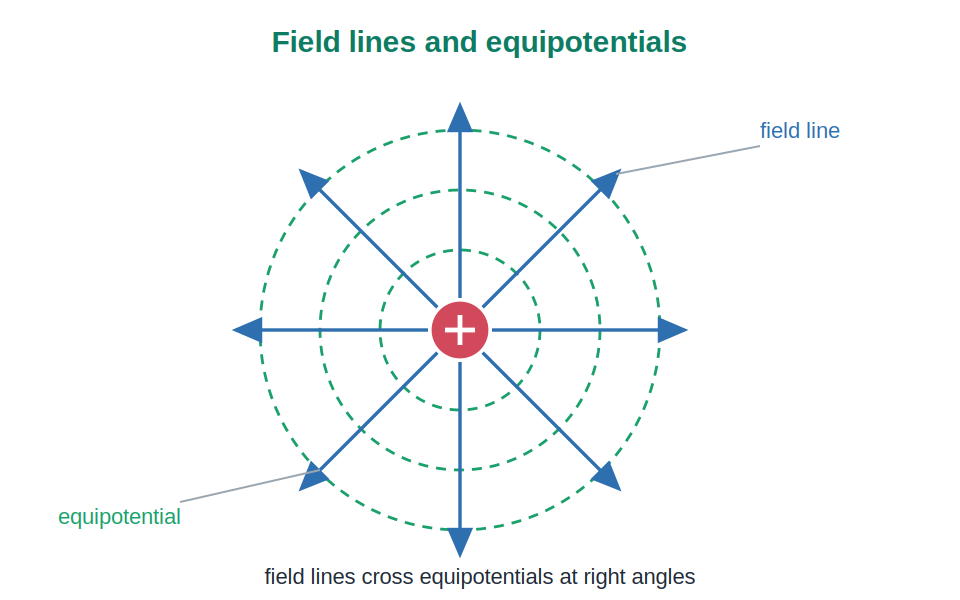
An equipotential surface joins all the points that are at the same potential. No work is done moving a charge along such a surface, since the potential does not change. A key fact is that field lines always cross equipotentials at right angles. Around a point charge the equipotentials are spheres, shown as circles, set across the radial field lines.
|
Diagram 1 – Field Lines and Equipotentials
Fig 1. Around a charge the equipotentials are circles, crossed at right angles by the radial field lines. |
4. The Capacitor |
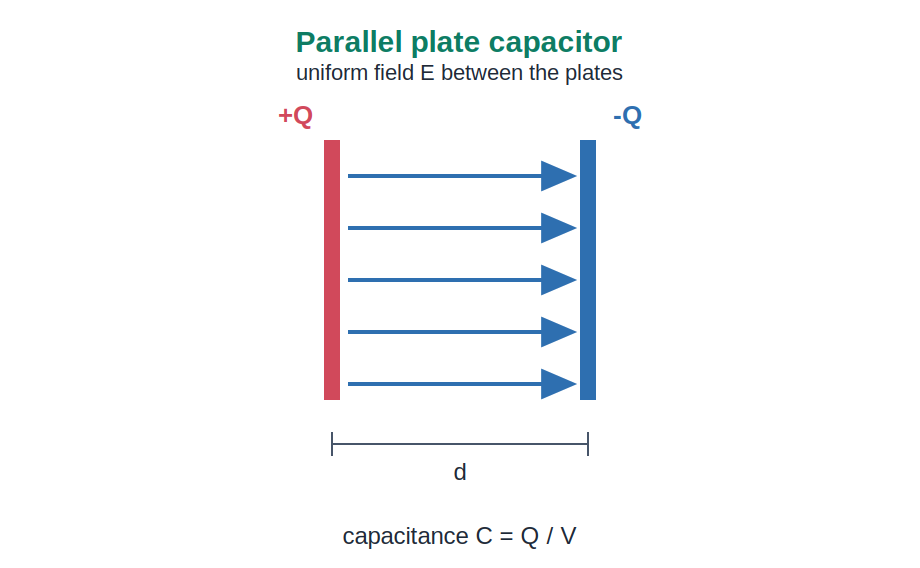
A capacitor stores electric charge. The simplest is the parallel plate capacitor, two flat plates a small distance apart. When connected to a battery, one plate gains charge plus Q and the other minus Q, and a uniform field fills the gap. Its capacitance, the charge stored per volt, is C equals Q divided by V, measured in farads. A larger plate area or a smaller gap gives a larger capacitance.
|
Diagram 2 – The Parallel Plate Capacitor
Fig 2. Two plates carry plus Q and minus Q with a uniform field between them; capacitance is C equals Q divided by V. |
5. Combinations of Capacitors |
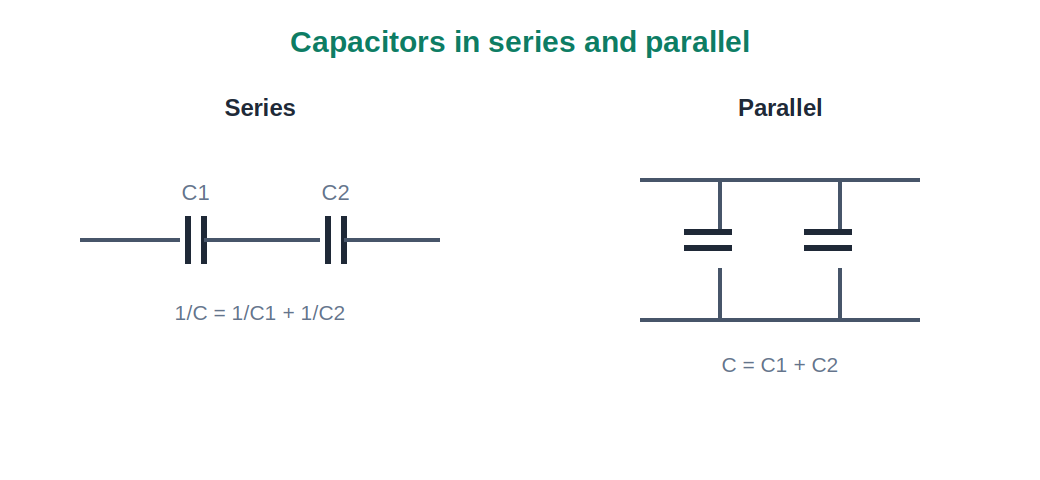
Capacitors can be joined in two ways. In series, they carry the same charge and the combined capacitance is smaller than any one, given by one over C equals one over C1 plus one over C2. In parallel, they share the same voltage and the capacitances simply add, C equals C1 plus C2. Choosing the arrangement lets a designer set the total capacitance needed in a circuit.
|
Diagram 3 – Capacitors in Series and Parallel
Fig 3. In series the reciprocals add; in parallel the capacitances add directly. |
6. Energy Stored in a Capacitor |
Charging a capacitor stores energy in the field between its plates. The energy stored is U equals one half times C times V squared, which can also be written as one half times Q times V. This stored energy can be released quickly, which is why capacitors are used in camera flashes and many electronic circuits where a sudden burst of energy is needed.
7. Key Reasoning (Principles) |
|
Principle 1: Potential is energy per unit charge The potential at a point is the work to bring a unit positive charge there from far away, so a potential difference is what drives charge to move. |
|
Principle 2: Field lines meet equipotentials at right angles Because no work is done moving along an equipotential, the field can have no component along it, so field lines must cross it at right angles. |
|
Principle 3: A capacitor stores charge and energy Capacitance C equals Q divided by V measures how much charge a capacitor holds per volt, and the stored energy is one half C V squared. |
8. Worked Examples |
| Example 1 |
|
Q: Define electric potential. ▶ Show SolutionThe work done to bring a unit positive charge from far away to the point. Answer: Work per unit charge to that point. |
| Example 2 |
|
Q: In what unit is potential measured? ▶ Show SolutionThe volt. Answer: The volt. |
| Example 3 |
|
Q: Write the potential of a point charge. ▶ Show SolutionV equals k times q divided by r. Answer: V = k q / r. |
| Example 4 |
|
Q: Is potential a scalar or a vector? ▶ Show SolutionA scalar; it has size but no direction. Answer: A scalar. |
| Example 5 |
|
Q: What is an equipotential surface? ▶ Show SolutionA surface on which every point has the same potential. Answer: Same potential everywhere on it. |
| Example 6 |
|
Q: At what angle do field lines cross equipotentials? ▶ Show SolutionAt right angles. Answer: At right angles. |
| Example 7 |
|
Q: Write the definition of capacitance. ▶ Show SolutionC equals Q divided by V. Answer: C = Q / V. |
| Example 8 |
|
Q: A capacitor stores 6 microcoulomb at 2 volt. Find its capacitance. ▶ Show SolutionC equals Q divided by V equals 6 microcoulomb divided by 2 volt. So C equals 3 microfarad. Answer: 3 microfarad. |
| Example 9 |
|
Q: Two 4 microfarad capacitors are joined in parallel. Find the total. ▶ Show SolutionIn parallel C equals C1 plus C2 equals 4 plus 4. So C equals 8 microfarad. Answer: 8 microfarad. |
| Example 10 |
|
Q: Write the energy stored in a capacitor. ▶ Show SolutionU equals one half times C times V squared. Answer: U = half C V squared. |
9. Practice Sets A to D |
| Set A – Multiple Choice (Basic) |
|
1. Potential is measured in: (a) ampere (b) volt (c) coulomb (d) ohm 2. Potential of a point charge varies as: (a) 1/r (b) 1/r squared (c) r (d) r squared 3. Along an equipotential, the work done is: (a) maximum (b) zero (c) negative (d) infinite 4. Capacitance is defined as: (a) Q V (b) Q / V (c) V / Q (d) Q + V 5. Energy stored in a capacitor is: (a) C V (b) half C V squared (c) Q / V (d) V / C ▶ Reveal Answers1. (b) volt. 2. (a) 1/r. 3. (b) zero. 4. (b) Q / V. 5. (b) half C V squared. |
| Set B – Short Answer (Understanding) |
|
1. Define electric potential and its unit. 2. Write the potential of a point charge. 3. What is an equipotential surface and one key property? 4. Define capacitance and give the rules for series and parallel. 5. Write the energy stored in a capacitor. ▶ Reveal Answers1. The work to bring a unit positive charge from far away to a point, measured in volts. 2. V equals k times q divided by r. 3. A surface of constant potential; no work is done moving a charge along it, and field lines cross it at right angles. 4. C equals Q divided by V; in series one over C equals one over C1 plus one over C2; in parallel C equals C1 plus C2. 5. U equals one half times C times V squared, or one half times Q times V. |
| Set C – Application and Reasoning |
|
1. A capacitor holds 10 microcoulomb at 5 volt. Find C. 2. Two 6 microfarad capacitors are in series. Find the total. 3. Why is no work done moving a charge along an equipotential? 4. Why does a smaller plate gap increase capacitance? 5. Why are capacitors used in a camera flash? ▶ Reveal Answers1. C equals 10 microcoulomb divided by 5 volt equals 2 microfarad. 2. One over C equals one over 6 plus one over 6 equals one over 3, so C equals 3 microfarad. 3. Because the potential does not change along it, so no energy is needed to move between its points. 4. Because the same voltage gives a stronger field and more stored charge, so C, the charge per volt, rises. 5. Because they store energy and can release it in a sudden burst to make the flash. |
| Set D – Higher Order (Challenge) |
|
1. Explain why potential is useful even though the field already describes the charge. 2. A 2 microfarad capacitor is charged to 100 volt. Find the energy stored. 3. Explain why series capacitance is always smaller than the smallest capacitor. 4. Explain why field lines must be perpendicular to a conductor surface. 5. Compare how charge and voltage behave for capacitors in series and in parallel. ▶ Reveal Answers1. Because potential is a single scalar that simply adds for many charges, making energy and work far easier to handle than adding field vectors. 2. U equals one half times 2 microfarad times 100 squared equals one half times 2e-6 times 10000, which is 0.01 joule. 3. Because adding the reciprocals gives a larger reciprocal, so the combined capacitance is less than any single value. 4. Because a conductor surface is an equipotential, and field lines always cross an equipotential at right angles. 5. In series the charge is the same on each and the voltages add; in parallel the voltage is the same and the charges add. |
|
Chapter Summary
|
|||||||||||||||||||||||||||||||
| 8-Point Exam Quick-Check | ||||||||||||||||||||||||||||||||
|
||||||||||||||||||||||||||||||||
|
School Revise Virtual Lab Explore these ideas with interactive simulations and visual tools.
|
|
Class 12 Physics Chapter 2: Electrostatic Potential and Capacitance, Complete Notes and Practice This revision guide follows the current NCERT Class 12 Physics syllabus and develops electrostatic potential, covering the meaning of potential and potential difference, the potential of a point charge, equipotential surfaces and their right angle crossing with field lines, the parallel plate capacitor and capacitance, combinations of capacitors in series and parallel, and the energy stored in a capacitor, with three diagrams, ten worked examples and graded practice. Visit SchoolRevise.com to revise, practise and excel. |
 Google