Curriculum
Science Grade XII Physics
Science Grade XII Physics
0/14
-
Chapter 1: Electric Charges and Fields
 Preview
 -
Chapter 2: Electrostatic Potential and Capacitance
Preview
-
Chapter 3: Current Electricity
Preview
-
Chapter 4: Moving Charges and Magnetism
Preview
-
Chapter 5: Magnetism and Matter
Preview
-
Chapter 6: Electromagnetic Induction
Preview
-
Chapter 7: Alternating Current
Preview
-
Chapter 8: Electromagnetic Waves
Preview
-
Chapter 9: Ray Optics and Optical Instruments
Preview
-
Chapter 10: Wave Optics
Preview
-
Chapter 11: Dual Nature of Radiation and Matter
Preview
-
Chapter 12: Atoms
Preview
-
Chapter 13: Nuclei
Preview
-
Chapter 14: Semiconductor Electronics
Preview
Chapter 5: Magnetism and Matter
|
Grade 12 Science | Chapter 5 Magnetism and MatterMagnets and materials respond to magnetic fields. This chapter develops the bar magnet and its field, the Earth’s magnetism, how materials behave in a field, and the hysteresis loop.
|
|
Contents
|
1. Introduction: Magnets and Fields |
A magnet has two poles, a north and a south, and like poles repel while unlike poles attract. A single pole on its own has never been found: cutting a magnet in two simply gives two smaller magnets, each with its own pair of poles. This chapter looks at the field of a magnet, the Earth’s own magnetism, and how different materials behave when placed in a field.
|
Core idea A magnet has a north and south pole that cannot be separated. Its field lines run from N to S outside the magnet, and materials respond as diamagnetic, paramagnetic or ferromagnetic.
|
2. The Bar Magnet |
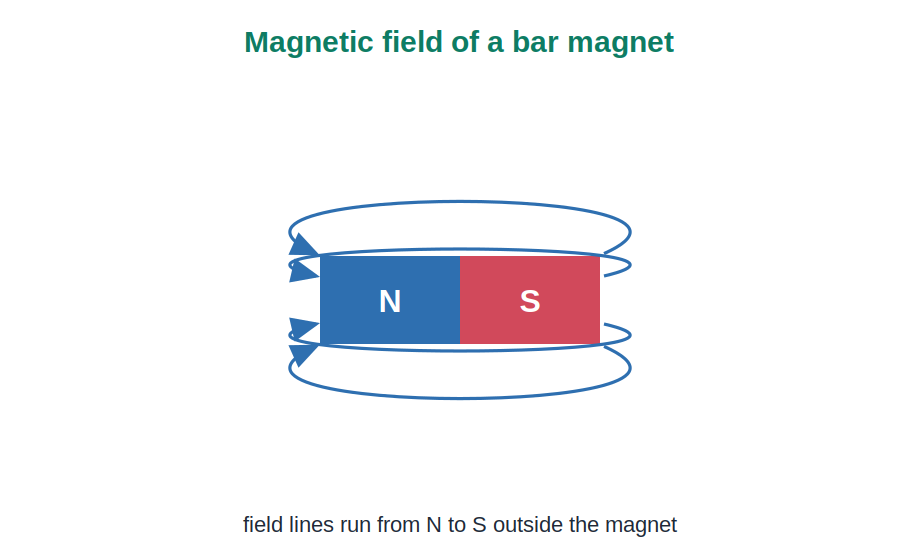
A bar magnet sets up a magnetic field in the space around it. The field lines emerge from the north pole, curve around, and enter the south pole, running from N to S outside the magnet and S to N inside. The lines are closest together near the poles, where the field is strongest. A small compass placed nearby lines up along these field lines.
|
Diagram 1 – Field of a Bar Magnet
Fig 1. The field lines of a bar magnet run from the north pole to the south pole outside the magnet. |
3. The Earth as a Magnet |
The Earth itself behaves like a giant magnet, with a magnetic field that a compass needle lines up with. This is why a compass works: its needle is a small magnet that turns to point roughly north and south. The Earth’s magnetic poles do not sit exactly at the geographic poles, so a compass points a little away from true north, an effect that navigators must allow for.
4. Magnetic Materials |
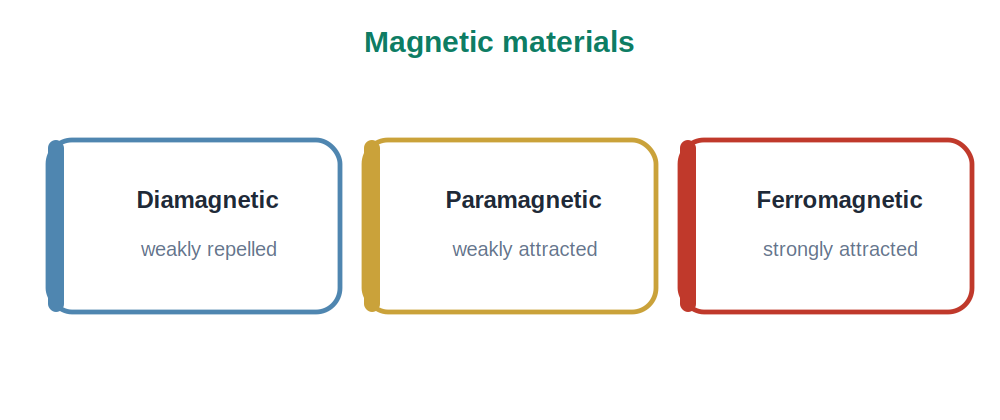
Materials respond to a magnetic field in three ways. Diamagnetic materials are very weakly repelled by a field. Paramagnetic materials are weakly attracted. Ferromagnetic materials, such as iron, are strongly attracted and can themselves become magnets. This strong response is why iron is used in magnets, motors and transformers.
|
Diagram 2 – Magnetic Materials
Fig 2. Diamagnetic materials are weakly repelled, paramagnetic weakly attracted, and ferromagnetic strongly attracted. |
5. Hysteresis |
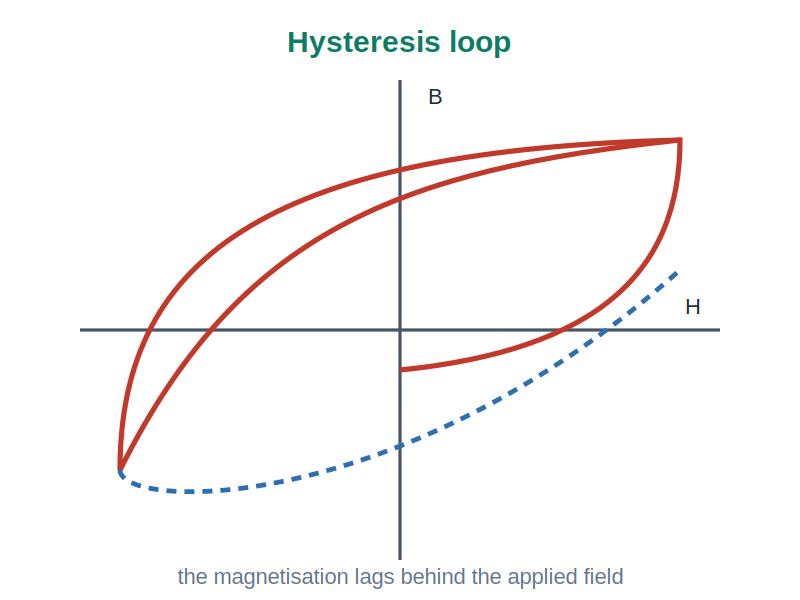
When a ferromagnetic material is magnetised and then the field is removed, it does not fully lose its magnetism: its magnetisation lags behind the applied field. A graph of the magnetisation against the applied field traces a loop called the hysteresis loop. A wide loop means the material keeps its magnetism well, suiting permanent magnets, while a narrow loop suits cores that must magnetise and demagnetise easily.
|
Diagram 3 – The Hysteresis Loop
Fig 3. The magnetisation lags behind the applied field, tracing a loop. |
6. Permanent Magnets and Electromagnets |
Magnets are of two useful kinds. A permanent magnet, made of a hard ferromagnetic material with a wide hysteresis loop, keeps its magnetism for a long time. An electromagnet, made by winding a coil around a soft iron core, is magnetic only while a current flows, and can be switched on and off. This makes electromagnets ideal for cranes, bells and relays.
7. Key Reasoning (Principles) |
|
Principle 1: Magnetic poles come in pairs A single isolated pole has never been found, so cutting a magnet only makes smaller magnets, each with its own north and south. |
|
Principle 2: Materials respond in three ways Diamagnetic materials are weakly repelled, paramagnetic weakly attracted, and ferromagnetic strongly attracted, depending on how their atoms behave in a field. |
|
Principle 3: Ferromagnets show hysteresis Their magnetisation lags the applied field, so they keep some magnetism when the field is removed, the basis of permanent magnets. |
8. Worked Examples |
| Example 1 |
|
Q: How many poles does a magnet have? ▶ Show SolutionTwo, a north and a south. Answer: Two. |
| Example 2 |
|
Q: What happens if you cut a magnet in half? ▶ Show SolutionYou get two smaller magnets, each with its own pair of poles. Answer: Two smaller magnets. |
| Example 3 |
|
Q: In which direction do field lines run outside a magnet? ▶ Show SolutionFrom the north pole to the south pole. Answer: North to south. |
| Example 4 |
|
Q: Why does a compass point north and south? ▶ Show SolutionBecause the Earth behaves like a giant magnet, and the needle lines up with its field. Answer: The Earth is a magnet. |
| Example 5 |
|
Q: How does a diamagnetic material behave in a field? ▶ Show SolutionIt is very weakly repelled. Answer: Weakly repelled. |
| Example 6 |
|
Q: How does a paramagnetic material behave? ▶ Show SolutionIt is weakly attracted. Answer: Weakly attracted. |
| Example 7 |
|
Q: Which materials are strongly attracted to a magnet? ▶ Show SolutionFerromagnetic materials, such as iron. Answer: Ferromagnetic materials. |
| Example 8 |
|
Q: What is hysteresis? ▶ Show SolutionThe lag of a material’s magnetisation behind the applied field. Answer: Magnetisation lags the field. |
| Example 9 |
|
Q: What kind of magnet keeps its magnetism for a long time? ▶ Show SolutionA permanent magnet. Answer: A permanent magnet. |
| Example 10 |
|
Q: When is an electromagnet magnetic? ▶ Show SolutionOnly while a current flows through its coil. Answer: While current flows. |
9. Practice Sets A to D |
| Set A – Multiple Choice (Basic) |
|
1. A magnet has: (a) one pole (b) two poles (c) three poles (d) no poles 2. Field lines outside a magnet go from: (a) S to N (b) N to S (c) N to N (d) nowhere 3. Iron is: (a) diamagnetic (b) paramagnetic (c) ferromagnetic (d) non magnetic 4. Magnetisation lagging the field is called: (a) induction (b) hysteresis (c) resonance (d) drift 5. An electromagnet is magnetic: (a) always (b) only with current (c) never (d) only when hot ▶ Reveal Answers1. (b) two poles. 2. (b) N to S. 3. (c) ferromagnetic. 4. (b) hysteresis. 5. (b) only with current. |
| Set B – Short Answer (Understanding) |
|
1. Why can a single magnetic pole not be isolated? 2. Describe the field lines of a bar magnet. 3. Name the three classes of magnetic material with their behaviour. 4. What is a hysteresis loop? 5. Compare a permanent magnet and an electromagnet. ▶ Reveal Answers1. Because poles always occur in pairs, so cutting a magnet only makes smaller magnets each with both poles. 2. They run from the north pole to the south pole outside, closest together near the poles. 3. Diamagnetic (weakly repelled), paramagnetic (weakly attracted), ferromagnetic (strongly attracted). 4. A loop traced by magnetisation against applied field, showing the lag between them. 5. A permanent magnet keeps its magnetism; an electromagnet is magnetic only while current flows and can be switched off. |
| Set C – Application and Reasoning |
|
1. Why does iron make a good electromagnet core? 2. Why does a compass not point exactly to true north? 3. Why is a wide hysteresis loop good for a permanent magnet? 4. Why is a soft iron core used where the magnet must switch on and off? 5. Why do two north poles pushed together repel? ▶ Reveal Answers1. Because it is strongly ferromagnetic, so it becomes strongly magnetised when current flows. 2. Because the Earth’s magnetic poles are not exactly at the geographic poles. 3. Because the material keeps its magnetism strongly even after the field is removed. 4. Because soft iron magnetises and demagnetises easily, so the magnet follows the current closely. 5. Because like poles repel each other. |
| Set D – Higher Order (Challenge) |
|
1. Explain why magnetism, unlike charge, has no single poles. 2. Explain how the hysteresis loop guides the choice of material. 3. Explain why an electromagnet is more useful than a permanent magnet in a crane. 4. Explain why the Earth behaving as a magnet makes navigation possible. 5. Explain why ferromagnetic materials can be made into magnets but diamagnetic ones cannot. ▶ Reveal Answers1. Because magnetism comes from circulating currents and aligned atoms that always present both a north and a south together, so a lone pole never appears. 2. A wide loop keeps magnetism for permanent magnets, while a narrow loop suits cores that must change quickly, so the loop shape sets the use. 3. Because it can be switched on to lift iron and off to drop it, which a permanent magnet cannot do. 4. Because a compass needle lines up with the Earth’s field, giving a reliable direction to steer by. 5. Because ferromagnetic atoms can align and stay aligned to form a magnet, while diamagnetic materials only weakly oppose a field and do not retain magnetism. |
|
Chapter Summary
|
|||||||||||||||||||||||||||||||
| 8-Point Exam Quick-Check | ||||||||||||||||||||||||||||||||
|
||||||||||||||||||||||||||||||||
|
School Revise Virtual Lab Explore these ideas with interactive simulations and visual tools.
|
|
Class 12 Physics Chapter 5: Magnetism and Matter, Complete Notes and Practice This revision guide follows the current NCERT Class 12 Physics syllabus and develops magnetism and matter, covering the bar magnet and its field lines, the inseparable north and south poles, the Earth as a magnet, the diamagnetic, paramagnetic and ferromagnetic materials, the hysteresis loop, and permanent magnets and electromagnets, with three diagrams, ten worked examples and graded practice. Visit SchoolRevise.com to revise, practise and excel. |
 Google