Curriculum
Science Grade XII Physics
Science Grade XII Physics
0/14
-
Chapter 1: Electric Charges and Fields
 Preview
 -
Chapter 2: Electrostatic Potential and Capacitance
Preview
-
Chapter 3: Current Electricity
Preview
-
Chapter 4: Moving Charges and Magnetism
Preview
-
Chapter 5: Magnetism and Matter
Preview
-
Chapter 6: Electromagnetic Induction
Preview
-
Chapter 7: Alternating Current
Preview
-
Chapter 8: Electromagnetic Waves
Preview
-
Chapter 9: Ray Optics and Optical Instruments
Preview
-
Chapter 10: Wave Optics
Preview
-
Chapter 11: Dual Nature of Radiation and Matter
Preview
-
Chapter 12: Atoms
Preview
-
Chapter 13: Nuclei
Preview
-
Chapter 14: Semiconductor Electronics
Preview
Chapter 8: Electromagnetic Waves
|
Grade 12 Science | Chapter 8 Electromagnetic WavesLight is an electromagnetic wave. This chapter develops what these waves are, how they travel, the full spectrum from radio to gamma, and the link between speed, frequency and wavelength.
|
|
Contents
|
1. Introduction: Waves of Field |
A changing electric field creates a magnetic field, and a changing magnetic field creates an electric field. Maxwell saw that the two together can travel through space as a wave, the electromagnetic wave. Light is one such wave, and so are radio waves, microwaves and X-rays. This chapter looks at what these waves are, the spectrum they form, and how they are used.
|
Core idea An electromagnetic wave is a travelling oscillation of electric and magnetic fields at right angles. All such waves travel at the speed of light c in a vacuum, with c equals f times lambda.
|
2. Nature of an Electromagnetic Wave |
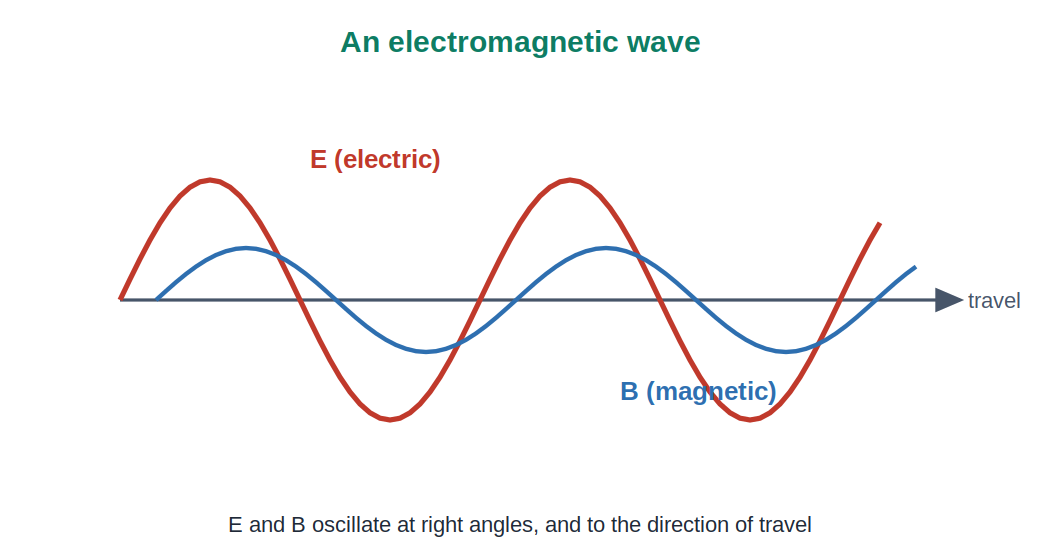
In an electromagnetic wave, an electric field and a magnetic field oscillate together. The two fields are at right angles to each other, and both are at right angles to the direction the wave travels, so the wave is transverse. Unlike sound, an electromagnetic wave needs no material to travel through, which is why light reaches us across the empty space from the Sun.
|
Diagram 1 – An Electromagnetic Wave
Fig 1. The electric and magnetic fields oscillate at right angles to each other and to the direction of travel. |
3. Speed, Frequency and Wavelength |
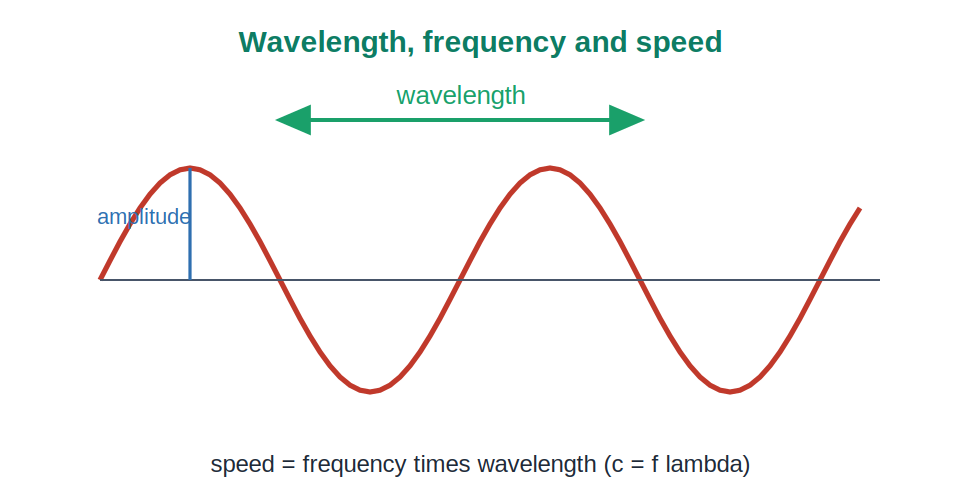
Every wave has a wavelength, the distance between repeats, a frequency, the number of waves passing each second, and an amplitude, the size of the oscillation. These are linked by the wave equation: speed equals frequency times wavelength, c equals f times lambda. For electromagnetic waves in a vacuum the speed is always the same, so a higher frequency means a shorter wavelength.
|
Diagram 2 – Wavelength, Frequency and Speed
Fig 2. Wavelength is the distance between repeats; speed equals frequency times wavelength. |
4. The Electromagnetic Spectrum |
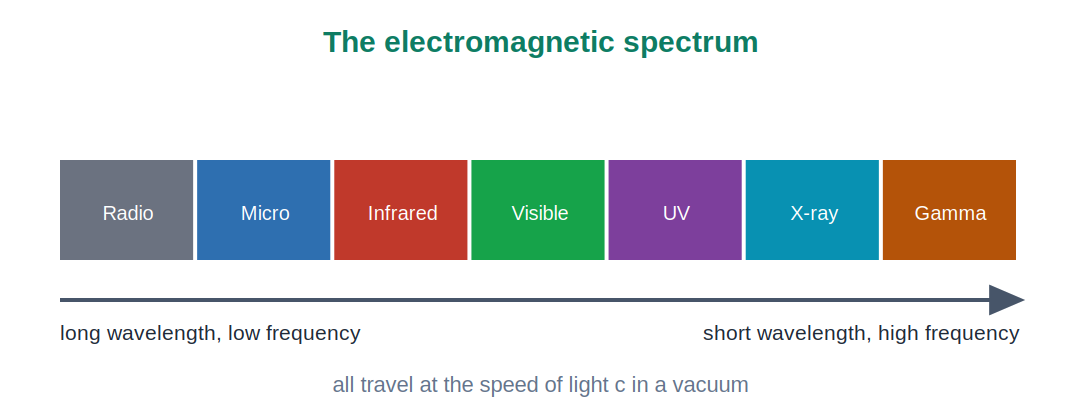
Electromagnetic waves come in a vast range of wavelengths, together called the spectrum. In order of rising frequency and shrinking wavelength, the families are radio waves, microwaves, infrared, visible light, ultraviolet, X-rays and gamma rays. Visible light, the part our eyes detect, is only a thin slice in the middle of this enormous range.
|
Diagram 3 – The Electromagnetic Spectrum
Fig 3. From radio waves to gamma rays, frequency rises and wavelength falls; visible light is a thin slice. |
5. Properties of the Waves |
All electromagnetic waves share key properties. They are transverse, they travel at the speed of light in a vacuum, they carry energy and momentum, and they need no medium. They can be reflected, refracted and diffracted like other waves. What changes across the spectrum is the frequency and wavelength, and with them the energy each wave carries, which is greater at higher frequency.
6. Uses of the Spectrum |
Each part of the spectrum has its uses. Radio waves carry broadcasts and mobile signals, microwaves heat food and carry phone and satellite links, infrared is used in remote controls and heat sensing, visible light lets us see, ultraviolet can sterilise, X-rays image bones, and gamma rays are used in medicine. Their different energies suit them to different tasks.
7. Key Reasoning (Principles) |
|
Principle 1: Changing fields make a travelling wave A changing electric field makes a magnetic field and the reverse, so the two sustain each other and travel together as a wave through empty space. |
|
Principle 2: All EM waves travel at the speed of light In a vacuum every electromagnetic wave moves at c, so by c equals f times lambda a higher frequency always means a shorter wavelength. |
|
Principle 3: Higher frequency carries more energy The energy of an electromagnetic wave rises with its frequency, which is why X-rays and gamma rays are far more penetrating than radio waves. |
8. Worked Examples |
| Example 1 |
|
Q: What is an electromagnetic wave? ▶ Show SolutionA travelling oscillation of electric and magnetic fields. Answer: Oscillating electric and magnetic fields. |
| Example 2 |
|
Q: How are the electric and magnetic fields arranged? ▶ Show SolutionAt right angles to each other and to the direction of travel. Answer: At right angles to each other and to travel. |
| Example 3 |
|
Q: Is an electromagnetic wave transverse or longitudinal? ▶ Show SolutionTransverse. Answer: Transverse. |
| Example 4 |
|
Q: At what speed do electromagnetic waves travel in a vacuum? ▶ Show SolutionThe speed of light, c. Answer: The speed of light. |
| Example 5 |
|
Q: Write the wave equation. ▶ Show SolutionSpeed equals frequency times wavelength, c equals f times lambda. Answer: c = f lambda. |
| Example 6 |
|
Q: If frequency rises, what happens to wavelength at fixed speed? ▶ Show SolutionThe wavelength gets shorter. Answer: It gets shorter. |
| Example 7 |
|
Q: List the spectrum in order of rising frequency. ▶ Show SolutionRadio, microwave, infrared, visible, ultraviolet, X-ray, gamma. Answer: Radio to gamma. |
| Example 8 |
|
Q: Which part of the spectrum can our eyes detect? ▶ Show SolutionVisible light. Answer: Visible light. |
| Example 9 |
|
Q: Does an electromagnetic wave need a medium? ▶ Show SolutionNo, it can travel through empty space. Answer: No. |
| Example 10 |
|
Q: Which carries more energy, a radio wave or an X-ray? ▶ Show SolutionAn X-ray, because it has a much higher frequency. Answer: An X-ray. |
9. Practice Sets A to D |
| Set A – Multiple Choice (Basic) |
|
1. In an EM wave the fields are: (a) parallel (b) at right angles (c) the same (d) absent 2. EM waves are: (a) longitudinal (b) transverse (c) still (d) sound 3. In a vacuum all EM waves travel at: (a) different speeds (b) the speed of light (c) the speed of sound (d) zero 4. The wave equation is: (a) c = f / lambda (b) c = f lambda (c) c = lambda / f (d) c = f + lambda 5. Visible light lies: (a) at the radio end (b) in the middle (c) at the gamma end (d) outside the spectrum ▶ Reveal Answers1. (b) at right angles. 2. (b) transverse. 3. (b) the speed of light. 4. (b) c = f lambda. 5. (b) in the middle. |
| Set B – Short Answer (Understanding) |
|
1. Describe the structure of an electromagnetic wave. 2. Write and explain the wave equation. 3. List the electromagnetic spectrum in order. 4. State three shared properties of EM waves. 5. Give one use of three different parts of the spectrum. ▶ Reveal Answers1. An electric field and a magnetic field oscillate at right angles to each other and to the direction of travel. 2. Speed equals frequency times wavelength, c equals f times lambda, so at fixed speed higher frequency means shorter wavelength. 3. Radio, microwave, infrared, visible, ultraviolet, X-ray, gamma. 4. They are transverse, travel at the speed of light in a vacuum, and carry energy without needing a medium. 5. Radio for broadcasts, infrared for remote controls, X-rays for imaging bones. |
| Set C – Application and Reasoning |
|
1. Why can light reach us from the Sun across empty space? 2. Why does a higher frequency wave have a shorter wavelength? 3. Why are X-rays more penetrating than radio waves? 4. Why is visible light described as a thin slice of the spectrum? 5. Why are microwaves suitable for satellite links? ▶ Reveal Answers1. Because an electromagnetic wave needs no medium and travels through the vacuum of space. 2. Because the speed is fixed, so by c equals f times lambda a larger frequency must come with a smaller wavelength. 3. Because they have a much higher frequency and so carry far more energy. 4. Because the eye detects only a narrow band of wavelengths within the enormous full range. 5. Because they pass easily through the atmosphere and carry signals over long distances. |
| Set D – Higher Order (Challenge) |
|
1. Explain how a changing field gives rise to a travelling wave. 2. Explain why all EM waves share the same speed in a vacuum yet differ so much in effect. 3. Explain why the energy of the wave increases across the spectrum. 4. A wave has frequency f and wavelength lambda. Explain how doubling f changes lambda. 5. Explain why the spectrum is continuous rather than a set of separate kinds. ▶ Reveal Answers1. A changing electric field creates a magnetic field, which in changing creates an electric field, so the two regenerate each other and travel onward as a wave. 2. They all move at c, but their different frequencies and wavelengths give them very different energies and so very different effects. 3. Because energy rises with frequency, so moving from radio toward gamma steadily increases the energy each wave carries. 4. Since c equals f times lambda is fixed, doubling the frequency halves the wavelength. 5. Because frequency can take any value, the families blend smoothly into one another, forming one continuous spectrum. |
|
Chapter Summary
|
|||||||||||||||||||||||||||||||
| 8-Point Exam Quick-Check | ||||||||||||||||||||||||||||||||
|
||||||||||||||||||||||||||||||||
|
School Revise Virtual Lab Explore these ideas with interactive simulations and visual tools.
|
|
Class 12 Physics Chapter 8: Electromagnetic Waves, Complete Notes and Practice This revision guide follows the current NCERT Class 12 Physics syllabus and develops electromagnetic waves, covering their nature as oscillating electric and magnetic fields at right angles, their transverse character and travel at the speed of light, the wave equation linking speed, frequency and wavelength, the full spectrum from radio waves to gamma rays, and the uses of each part, with three diagrams, ten worked examples and graded practice. Visit SchoolRevise.com to revise, practise and excel. |
 Google