Curriculum
Grade XII Chemistry
Chemistry lessons
0/10
-
CH-1 Solutions
 Preview
 -
CH-2 Electro Chemistry
Preview
-
CH_3 Chemical Kinetics
Preview
-
CH-4 D and F Block
Preview
-
CH-5 Coordination Compounds
Preview
-
CH-6-Haloalkanes-Haloarenes
Preview
-
CH-7-Alcohols-Phenols-Ethers
Preview
-
CH-8-Aldehydes-Ketones-Acids
Preview
-
CH-9 Amines
Preview
-
CH-10 Biomolecules
Preview
Work Sheets
0/10

CH-1 Solutions
|
Grade 12 Science | Chapter 1 SolutionsA solution is a homogeneous mixture of two or more substances. This chapter builds ways to measure concentration, Henry’s law, Raoult’s law, ideal and non ideal solutions, the colligative properties and the van’t Hoff factor.
|
|
Contents
|
1. Concentration of Solutions |
A solution is a homogeneous mixture in which a solute is dissolved in a solvent. We describe how much solute is present in several ways. Mass percentage is the mass of solute in 100 grams of solution. Mole fraction is the moles of one component divided by the total moles. Molarity is the moles of solute per litre of solution, and molality is the moles of solute per kilogram of solvent.
|
Core idea Molarity is measured per litre of solution, so it changes a little with temperature as the volume changes. Molality is measured per kilogram of solvent, so it stays fixed at every temperature.
|
2. Solubility and Henry’s Law |
The solubility of a gas in a liquid rises as the pressure of the gas above it rises, and usually falls as the temperature rises. Henry’s law states that the partial pressure of a gas over a solution is proportional to its mole fraction in the solution, p equals K times x, where K is Henry’s constant. A large value of K means the gas is only slightly soluble. This is why a fizzy drink is bottled under pressure and loses its gas once opened.
3. Vapour Pressure and Raoult’s Law |
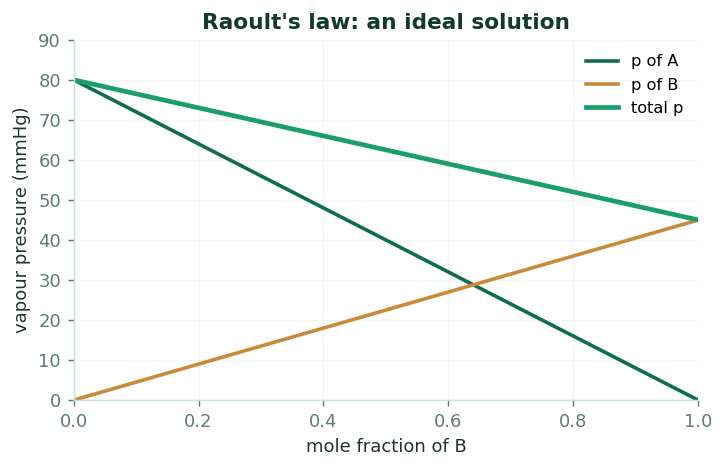
For a solution of two volatile liquids, Raoult’s law says the partial vapour pressure of each component equals its mole fraction times its pure vapour pressure, p of A equals x of A times p of A pure. The total vapour pressure is the sum of the two. When the solute is non volatile, the vapour pressure of the solution is simply the mole fraction of the solvent times the pure solvent value, so adding solute always lowers the vapour pressure.
|
Diagram 1 – Raoult’s Law
Fig 1. In an ideal solution each partial pressure is a straight line and the total pressure runs between the two pure values. |
4. Ideal and Non ideal Solutions |
An ideal solution obeys Raoult’s law across the whole range, with no heat taken in or given out and no change in volume on mixing, as with benzene and toluene. A non ideal solution shows deviations. A positive deviation has weaker forces between unlike molecules, a higher vapour pressure than expected, as with ethanol and water. A negative deviation has stronger forces between unlike molecules and a lower vapour pressure, as with chloroform and acetone. Constant boiling mixtures called azeotropes cannot be separated fully by distillation.
5. Colligative Properties |
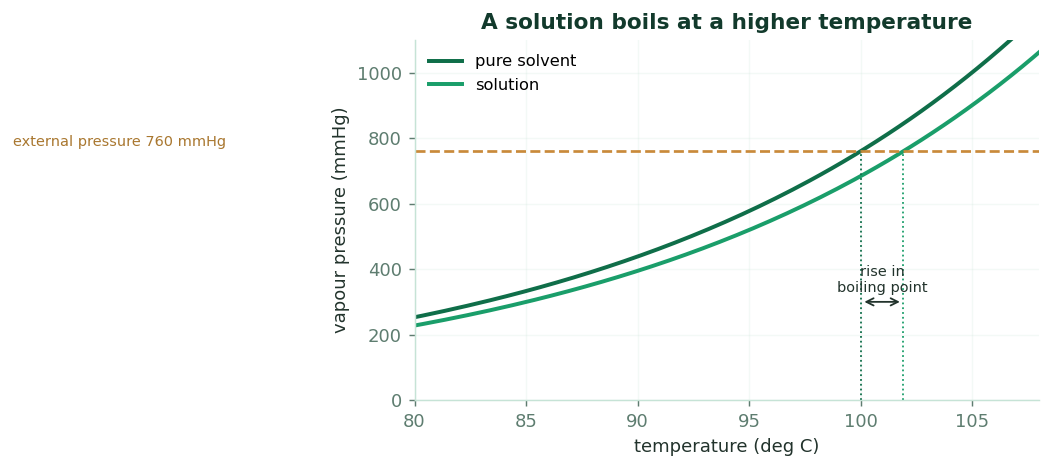
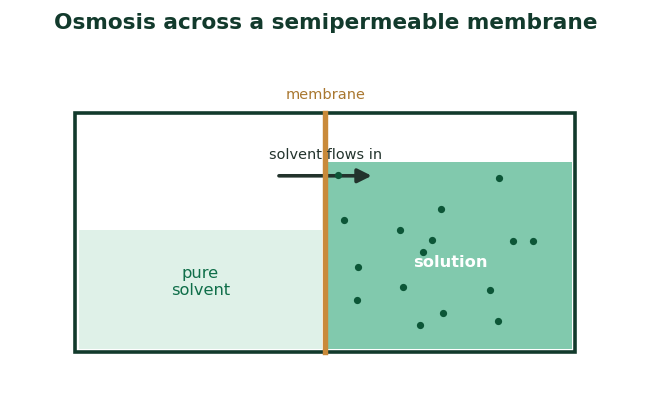
Colligative properties depend only on the number of solute particles present, not on what the solute is. There are four. The relative lowering of vapour pressure equals the mole fraction of the solute. The elevation of boiling point is delta T equals K times m, using the boiling point constant. The depression of freezing point is delta T equals K times m, using the freezing point constant. The osmotic pressure is pi equals C R T, where C is the molar concentration.
|
Diagram 2 – Boiling Point Elevation
Fig 2. The solution has a lower vapour pressure, so it must be heated to a higher temperature to reach the external pressure and boil. |
|
Diagram 3 – Osmosis
Fig 3. Solvent passes through the membrane into the solution until the extra pressure from the raised column balances the flow. |
6. The van’t Hoff Factor |
Some solutes break apart into ions or join together in solution, so the number of particles is not what the formula suggests. The van’t Hoff factor i corrects for this. It is the number of particles actually present divided by the number expected. The colligative formulas become delta T equals i K m and pi equals i C R T. For common salt, which splits into two ions, i is close to 2, so its effects are almost doubled.
7. Key Reasoning (Principles) |
|
Principle 1: Colligative properties count particles These properties respond to how many solute particles are dissolved, not to their chemical nature, so one mole of any non electrolyte gives the same effect. |
|
Principle 2: Molality does not change with temperature Because molality is set by the mass of solvent, not its volume, it stays the same when the solution is warmed or cooled, unlike molarity. |
|
Principle 3: Deviations come from molecular forces When unlike molecules attract each other more or less strongly than like ones, the vapour pressure sits below or above the Raoult’s law line. |
8. Worked Examples |
| Example 1 |
|
Q: Find the molarity of a solution made by dissolving 5.85 g of common salt (molar mass 58.5) in enough water to make 500 mL of solution. Show SolutionMoles of salt equals 5.85 divided by 58.5, which is 0.10 mol. Volume is 0.500 L, so molarity is 0.10 divided by 0.500. Answer: 0.20 mol per litre. |
| Example 2 |
|
Q: Find the molality when 5.85 g of common salt is dissolved in 500 g of water. Show SolutionMoles of salt is 0.10 mol. Mass of solvent is 0.500 kg, so molality is 0.10 divided by 0.500. Answer: 0.20 mol per kilogram. |
| Example 3 |
|
Q: Why does molarity change with temperature but molality does not? Show SolutionMolarity uses the volume of solution, which expands or contracts with temperature. Molality uses the mass of solvent, which does not change with temperature. Answer: Volume changes with temperature, mass does not. |
| Example 4 |
|
Q: State Henry’s law. Show SolutionThe partial pressure of a gas above a solution is proportional to its mole fraction in the solution. Answer: p equals K times x. |
| Example 5 |
|
Q: Two liquids A and B form an ideal solution. Write the total vapour pressure. Show SolutionEach partial pressure follows Raoult’s law. The total is the sum of the two partial pressures. Answer: p total equals x of A times p A pure plus x of B times p B pure. |
| Example 6 |
|
Q: The relative lowering of vapour pressure of a solution is 0.2. What is the mole fraction of the solute? Show SolutionFor a non volatile solute the relative lowering equals the mole fraction of the solute. Answer: 0.2. |
| Example 7 |
|
Q: The boiling point constant of water is 0.52. Find the boiling point of a 1 molal solution. Show SolutionElevation is 0.52 times 1, which is 0.52 degrees. Add to the normal boiling point of 100 degrees. Answer: 100.52 degrees C. |
| Example 8 |
|
Q: The freezing point constant of water is 1.86. Find the freezing point of a 1 molal solution. Show SolutionDepression is 1.86 times 1, which is 1.86 degrees. Subtract from 0 degrees. Answer: minus 1.86 degrees C. |
| Example 9 |
|
Q: Find the osmotic pressure of a 0.1 molar solution at 300 K, with R equal to 0.0821. Show SolutionOsmotic pressure is C R T. This is 0.1 times 0.0821 times 300. Answer: 2.46 atmospheres. |
| Example 10 |
|
Q: Why is the freezing point drop of a salt solution larger than expected for its molality? Show SolutionSalt splits into two ions, so the number of particles roughly doubles. The van’t Hoff factor i is about 2, so the effect is close to twice as large. Answer: Salt dissociates, so i is about 2. |
9. Practice Sets A to D |
| Set A – Multiple Choice (Basic) |
|
1. Molality is moles of solute per: (a) litre of solution (b) kilogram of solvent (c) mole of solvent (d) gram of solute 2. Henry’s law relates gas solubility to: (a) temperature only (b) partial pressure (c) volume (d) colour 3. Raoult’s law gives the: (a) freezing point (b) partial vapour pressure (c) density (d) pH 4. A colligative property depends on the: (a) type of solute (b) number of particles (c) colour (d) shape 5. Osmotic pressure is given by: (a) pi equals C R T (b) p equals K x (c) F equals m a (d) q equals n e Reveal Answers1. (b) kilogram of solvent. 2. (b) partial pressure. 3. (b) partial vapour pressure. 4. (b) number of particles. 5. (a) pi equals C R T. |
| Set B – Short Answer (Understanding) |
|
1. Define molarity and molality. 2. State Henry’s law and give one use. 3. Write Raoult’s law for two volatile liquids. 4. Name the four colligative properties. 5. What is the van’t Hoff factor? Reveal Answers1. Molarity is moles of solute per litre of solution; molality is moles of solute per kilogram of solvent. 2. The partial pressure of a gas over a solution is proportional to its mole fraction; it explains fizzy drinks. 3. p of A equals x of A times p A pure, and the total is the sum of both partial pressures. 4. Relative lowering of vapour pressure, elevation of boiling point, depression of freezing point, and osmotic pressure. 5. The number of particles actually present divided by the number expected from the formula. |
| Set C – Application and Reasoning |
|
1. Why does a solution boil at a higher temperature than the pure solvent? 2. Why is salt spread on icy roads in cold countries? 3. Why does a gas become less soluble as the liquid is warmed? 4. Why can an azeotrope not be separated fully by simple distillation? 5. Why does adding a non volatile solute lower the vapour pressure? Reveal Answers1. Its vapour pressure is lower, so it must reach a higher temperature before the vapour pressure equals the outside pressure. 2. The salt lowers the freezing point of water, so ice melts and does not form as easily. 3. Warming gives gas molecules more energy to escape the liquid, so fewer stay dissolved. 4. It boils at a constant temperature with the same composition in vapour and liquid, so the two cannot be split. 5. Solvent molecules at the surface are replaced by solute, so fewer escape into the vapour. |
| Set D – Higher Order (Challenge) |
|
1. Compare a positive and a negative deviation from Raoult’s law. 2. Explain why colligative properties can be used to find molar mass. 3. Explain how reverse osmosis can purify sea water. 4. Why does the van’t Hoff factor of common salt differ from that of glucose? 5. Two solutions have the same molarity but different osmotic pressures. Suggest why. Reveal Answers1. A positive deviation has weaker forces between unlike molecules and a higher vapour pressure; a negative deviation has stronger forces and a lower vapour pressure. 2. The size of a colligative effect fixes the number of particles, and from the mass dissolved the molar mass follows. 3. Applying a pressure greater than the osmotic pressure pushes solvent back through the membrane, leaving the salt behind. 4. Salt splits into two ions so its factor is near 2, while glucose stays as one molecule so its factor is 1. 5. One solute may dissociate into ions while the other does not, so it produces more particles and a larger pressure. |
|
Chapter Summary
|
|||||||||||||||||||||||||||||||
| Eight Point Exam Quick Check | ||||||||||||||||||||||||||||||||
|
||||||||||||||||||||||||||||||||
|
School Revise Virtual Lab Explore these ideas with interactive simulations and visual tools.
|
|
Class 12 Chemistry Chapter 1: Solutions, Complete Notes and Practice These free Class 12 Chemistry notes on Solutions follow the current NCERT syllabus and cover concentration, Raoult’s law, colligative properties, osmosis and the van’t Hoff factor, with clear diagrams, worked examples and graded practice, free on SchoolRevise.com. |
 Google