Curriculum
Grade XII Chemistry
Chemistry lessons
0/10
-
CH-1 Solutions
 Preview
 -
CH-2 Electro Chemistry
Preview
-
CH_3 Chemical Kinetics
Preview
-
CH-4 D and F Block
Preview
-
CH-5 Coordination Compounds
Preview
-
CH-6-Haloalkanes-Haloarenes
Preview
-
CH-7-Alcohols-Phenols-Ethers
Preview
-
CH-8-Aldehydes-Ketones-Acids
Preview
-
CH-9 Amines
Preview
-
CH-10 Biomolecules
Preview
Work Sheets
0/10

CH-4 D and F Block
|
Grade 12 Science | Chapter 4 The d and f Block ElementsThe transition metals of the d block and the inner transition metals of the f block share partly filled d and f orbitals. This chapter builds their configuration, variable oxidation states, colour, magnetism, catalysis and the lanthanoid contraction.
|
|
Contents
|
1. Position and Configuration |
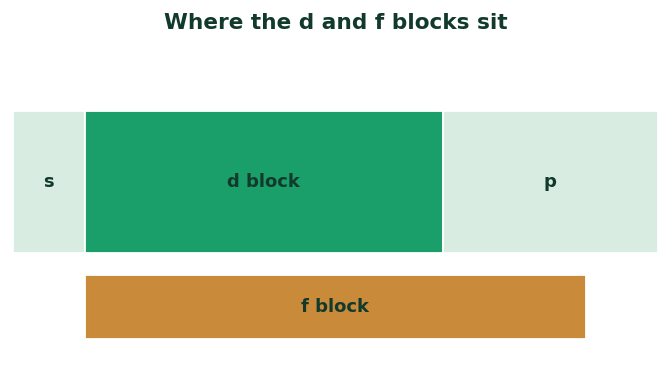
The d block lies in the middle of the periodic table, in groups 3 to 12, where the d orbitals are being filled. Their general configuration is (n minus 1) d filled, then n s. The f block, the lanthanoids and actinoids, sits below the table, where the deeper f orbitals fill. A transition element is one with a partly filled d shell in at least one of its states.
|
Core idea Partly filled d orbitals are the root of the special behaviour of these metals: variable oxidation states, colour, magnetism and catalytic power.
|
|
Diagram 1 – Block Positions
Fig 1. The d block fills the centre of the table and the f block sits apart below it. |
2. Variable Oxidation States |
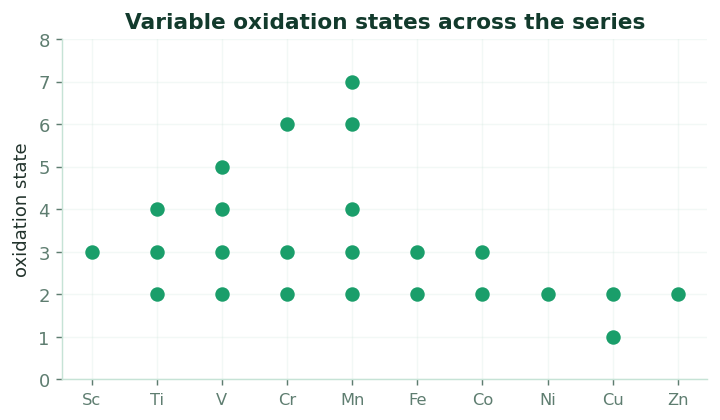
Because the n s and (n minus 1) d electrons are close in energy, a transition metal can lose different numbers of them, giving variable oxidation states. Manganese, for example, runs from plus two all the way to plus seven. Main group metals, by contrast, usually show a single fixed state.
|
Diagram 2 – Coloured Ions
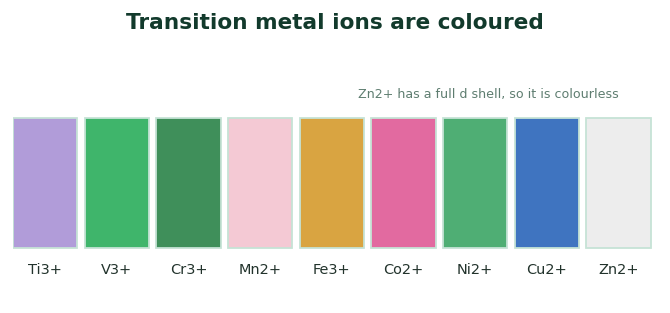
Fig 2. Different ions of the transition metals show different colours, a direct sign of their partly filled d shells. |
3. Colour of Compounds |
Most transition metal compounds are coloured. In the metal ion the d orbitals are split into two energy sets, and an electron can jump between them by absorbing part of the visible light. The colour we see is what is left over. An ion with an empty or a full d shell, such as zinc plus two, is colourless because no such jump is possible.
4. Magnetic Properties |
An ion with unpaired electrons is drawn into a magnetic field and is called paramagnetic. The strength depends on how many unpaired electrons there are, estimated by the spin only value, the square root of n times n plus two, in Bohr magnetons, where n is the number of unpaired electrons. An ion with all electrons paired is only weakly repelled.
|
Diagram 3 – Oxidation States
Fig 3. Each metal shows a spread of oxidation states, widest in the middle of the series around manganese. |
5. Catalysis and Alloys |
Transition metals and their compounds are excellent catalysts, because their variable oxidation states let them accept and give back electrons easily. They also form hard alloys and interstitial compounds, where small atoms sit in the gaps of the metal lattice, adding strength and hardness.
6. The f Block and Contraction |
The lanthanoids fill the four f orbitals and are very alike in their chemistry. Across the series the steady, poor shielding by f electrons causes a slow shrinking in size, the lanthanoid contraction. This makes the elements just after them smaller than expected, so pairs such as zirconium and hafnium are almost the same size.
7. Key Reasoning (Principles) |
|
Principle 1: Partly filled d orbitals drive the chemistry Variable oxidation states, colour, magnetism and catalytic power all trace back to the partly filled and closely spaced d orbitals of these metals. |
|
Principle 2: Colour comes from d to d jumps An electron absorbing visible light to jump between the split d levels leaves the complementary colour, which is what the eye sees. |
|
Principle 3: The lanthanoid contraction shrinks later elements Poor shielding by f electrons lets the nucleus pull the shells in, so elements following the lanthanoids are smaller than a simple trend would suggest. |
8. Worked Examples |
| Example 1 |
|
Q: Why do transition metals show variable oxidation states? Show SolutionThe n s and d electrons are close in energy. Different numbers can be lost. Answer: Because their s and d electrons are close in energy. |
| Example 2 |
|
Q: Why is a copper plus two ion coloured but a zinc plus two ion is not? Show SolutionCopper plus two has a partly filled d shell allowing a d to d jump. Zinc plus two has a full d shell. Answer: Copper plus two allows a d to d jump, zinc plus two does not. |
| Example 3 |
|
Q: A manganese plus two ion has five unpaired electrons. Find its spin only magnetic moment. Show SolutionUse the square root of n times n plus two. This is the square root of five times seven. Answer: About 5.92 Bohr magnetons. |
| Example 4 |
|
Q: Which element shows the widest range of oxidation states in the first series? Show SolutionIt lies in the middle of the series. Answer: Manganese. |
| Example 5 |
|
Q: Why are transition metals good catalysts? Show SolutionVariable states let them exchange electrons easily. Answer: Their variable oxidation states aid electron exchange. |
| Example 6 |
|
Q: What is an interstitial compound? Show SolutionSmall atoms occupy the gaps in the metal lattice. Answer: Small atoms sitting in the gaps of a metal lattice. |
| Example 7 |
|
Q: What causes the lanthanoid contraction? Show SolutionPoor shielding by f electrons. Answer: Poor shielding by the f electrons. |
| Example 8 |
|
Q: Why are zirconium and hafnium hard to separate? Show SolutionThe contraction makes them nearly the same size. Answer: They are almost the same size. |
| Example 9 |
|
Q: Give the general outer configuration of a d block element. Show SolutionThe d shell fills after the s. Answer: (n minus 1) d then n s. |
| Example 10 |
|
Q: Is an ion with all paired electrons paramagnetic? Show SolutionParamagnetism needs unpaired electrons. Answer: No, it is not. |
9. Practice Sets A to D |
| Set A – Multiple Choice (Basic) |
|
1. The d block lies in groups: (a) 1 to 2 (b) 3 to 12 (c) 13 to 18 (d) 1 to 18 2. Colour in transition metal ions comes from: (a) s to s jumps (b) d to d jumps (c) nuclear change (d) mass 3. Paramagnetism needs: (a) paired electrons (b) unpaired electrons (c) no electrons (d) protons 4. The widest oxidation range in the first series is shown by: (a) Sc (b) Zn (c) Mn (d) Cu 5. The lanthanoid contraction is caused by: (a) good shielding (b) poor f shielding (c) large size (d) low charge Reveal Answers1. (b) 3 to 12. 2. (b) d to d jumps. 3. (b) unpaired electrons. 4. (c) Mn. 5. (b) poor f shielding. |
| Set B – Short Answer (Understanding) |
|
1. What is a transition element? 2. Why do these metals show variable oxidation states? 3. How does colour arise in their compounds? 4. Write the spin only magnetic moment formula. 5. What is the lanthanoid contraction? Reveal Answers1. An element with a partly filled d shell in the atom or in one of its ions. 2. Because the s and d electrons are close in energy, so different numbers can be removed. 3. An electron absorbs part of visible light to jump between split d levels, and the rest is seen. 4. The square root of n times n plus two Bohr magnetons, where n is the number of unpaired electrons. 5. The slow shrinking in size across the lanthanoids due to poor shielding by f electrons. |
| Set C – Application and Reasoning |
|
1. Why is scandium not counted as a typical transition metal? 2. Why does the colour of a complex change when the ligands change? 3. Why is iron a good catalyst in the making of ammonia? 4. Why do transition metals form hard alloys? 5. Why are the later lanthanoids only a little smaller than the earlier ones? Reveal Answers1. Its common ion, scandium plus three, has an empty d shell, so it lacks the typical d electron behaviour. 2. Different ligands split the d levels by different amounts, so a different colour of light is absorbed. 3. Its variable oxidation states let it accept and give back electrons, offering a lower energy path. 4. Their strong metallic bonding and small atoms in the lattice gaps make the structure hard and strong. 5. The contraction is gradual, so each step is small, though the total across the series is large. |
| Set D – Higher Order (Challenge) |
|
1. Explain how partly filled d orbitals unite colour, magnetism and variable states. 2. Explain why the plus two state becomes more stable across the first series. 3. Explain how the lanthanoid contraction affects the elements of the third transition series. 4. Why can a spin only estimate differ from the measured magnetic moment? 5. Explain why transition metal catalysts are often used as fine powders. Reveal Answers1. Partly filled d orbitals give unpaired electrons for magnetism, split levels for colour and losable electrons for variable states. 2. The nuclear charge rises across the series, holding the d electrons more tightly, so removing only the two s electrons becomes easier to favour. 3. It makes those elements smaller and denser than expected, so pairs like zirconium and hafnium are nearly identical. 4. The spin only value ignores any contribution from orbital motion, which can add to the measured value. 5. A fine powder has a large surface area, so many more sites are available for the reaction to occur. |
|
Chapter Summary
|
|||||||||||||||||||||||||||||||
| Eight Point Exam Quick Check | ||||||||||||||||||||||||||||||||
|
||||||||||||||||||||||||||||||||
|
School Revise Virtual Lab Explore these ideas with interactive simulations and visual tools.
|
|
Class 12 Chemistry Chapter 4: The d and f Block Elements, Complete Notes and Practice These free Class 12 Chemistry notes on the d and f block follow the NCERT syllabus and cover electronic configuration, variable oxidation states, colour, magnetic behaviour, catalysis and the lanthanoid contraction, with worked examples and graded practice, free on SchoolRevise.com. |
 Google