Curriculum
Grade XII Chemistry
Chemistry lessons
0/10
-
CH-1 Solutions
 Preview
 -
CH-2 Electro Chemistry
Preview
-
CH_3 Chemical Kinetics
Preview
-
CH-4 D and F Block
Preview
-
CH-5 Coordination Compounds
Preview
-
CH-6-Haloalkanes-Haloarenes
Preview
-
CH-7-Alcohols-Phenols-Ethers
Preview
-
CH-8-Aldehydes-Ketones-Acids
Preview
-
CH-9 Amines
Preview
-
CH-10 Biomolecules
Preview
Work Sheets
0/10

CH_3 Chemical Kinetics
|
Grade 12 Science | Chapter 3 Chemical KineticsChemical kinetics studies how fast reactions go and what controls their speed. This chapter builds reaction rate, rate law and order, the integrated rate equations, the effect of temperature, collision theory and catalysis.
|
|
Contents
|
1. Rate of Reaction |
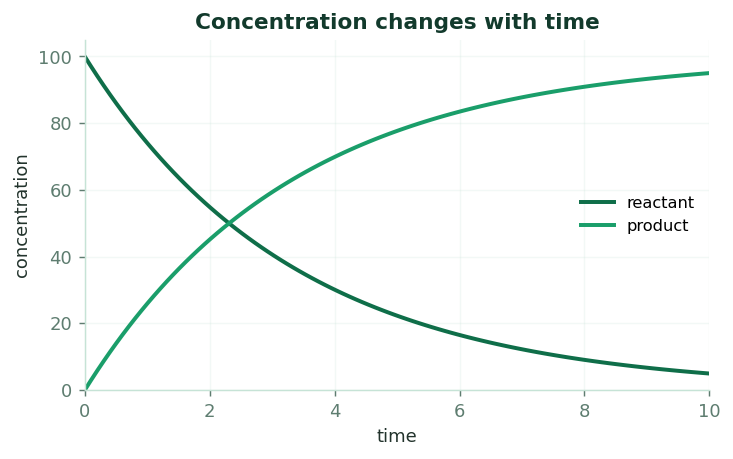
The rate of a reaction is how quickly a reactant is used up or a product forms, measured as a change in concentration over time. The average rate is taken over an interval, while the instantaneous rate is the rate at a single moment, given by the slope of the concentration against time graph.
|
Core idea Rate is a change in concentration divided by the time taken. It falls as the reaction proceeds, because the reactants are steadily used up.
|
|
Diagram 1 – Concentration and Time
Fig 1. The reactant falls and the product rises, quickly at first and then more slowly as the reaction runs down. |
2. Rate Law and Order |
The rate law links the rate to the concentrations, rate equals k times concentration of A to a power times concentration of B to a power. The powers give the order with respect to each reactant, and their sum is the overall order. Molecularity is the number of species that meet in a single step, and it is always a whole number.
3. Integrated Rate Equations |
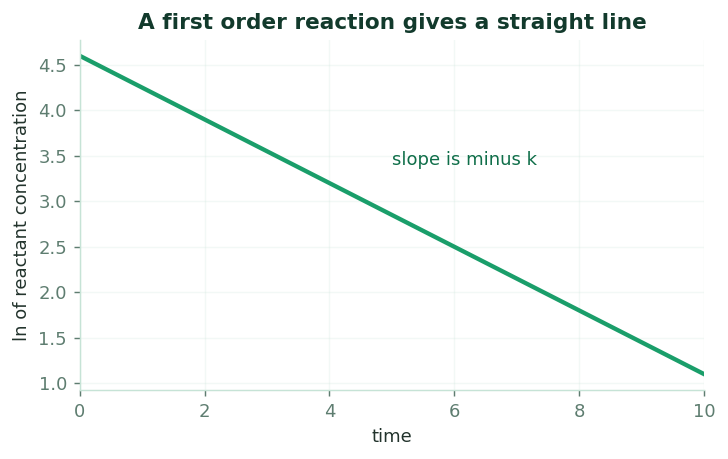
Integrating the rate law shows how concentration falls with time. For a zero order reaction the concentration falls in a straight line. For a first order reaction the logarithm of the concentration falls in a straight line, and the half life, the time to fall to half, is constant and equal to 0.693 divided by k.
|
Diagram 2 – First Order Plot
Fig 2. For a first order reaction a plot of the logarithm of concentration against time is a straight line of slope minus k. |
4. Effect of Temperature |
Reactions speed up sharply when heated. The Arrhenius equation gives this, k equals A times e to the power minus activation energy over R T. The activation energy is the energy barrier that colliding molecules must clear. As a rule of thumb the rate roughly doubles for every ten degree rise in temperature.
5. Collision Theory |
Collision theory pictures a reaction as the result of molecules colliding. Only collisions that carry at least the activation energy and strike with the right orientation lead to reaction. Raising the temperature or the concentration increases the number of effective collisions and so the rate.
|
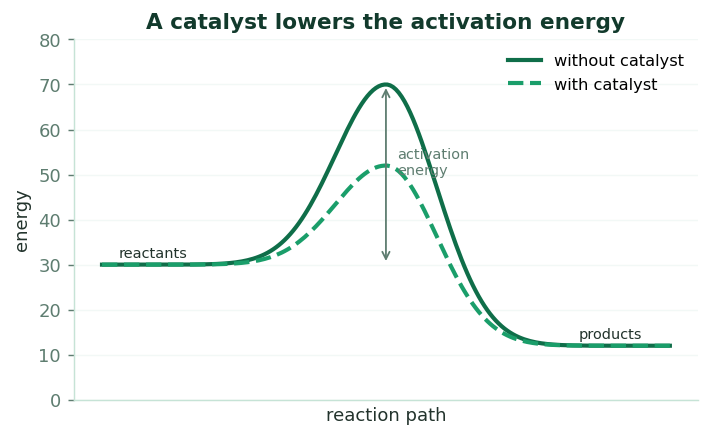
Diagram 3 – Energy Barrier
Fig 3. Molecules must climb the activation energy barrier to react, and a catalyst offers a lower path so more of them succeed. |
6. Catalysis |
A catalyst speeds a reaction without being used up. It works by offering a different path with a lower activation energy, so a larger fraction of collisions can react. It does not change how far the reaction goes, only how quickly it gets there.
7. Key Reasoning (Principles) |
|
Principle 1: Rate depends on concentration More reactant crowded into a space gives more collisions each second, so the rate rises with concentration in the way the rate law describes. |
|
Principle 2: Temperature clears the barrier Heating gives more molecules the activation energy, so far more collisions succeed and the rate climbs steeply, not gently. |
|
Principle 3: A catalyst lowers the barrier By offering a path of lower activation energy a catalyst lets more collisions react, speeding the reaction without being consumed. |
8. Worked Examples |
| Example 1 |
|
Q: A reaction has rate law rate equals k times A times B. What is its overall order? Show SolutionAdd the powers, one and one. Answer: Second order. |
| Example 2 |
|
Q: Give the units nature of the rate. Show SolutionRate is a change in concentration over time. Answer: Concentration per unit time. |
| Example 3 |
|
Q: A first order reaction has a half life of 20 minutes. Find its rate constant. Show Solutionk equals 0.693 divided by the half life. This is 0.693 divided by 20. Answer: 0.03465 per minute. |
| Example 4 |
|
Q: What stays constant during a first order reaction as it proceeds? Show SolutionThe half life does not change with concentration. Answer: The half life. |
| Example 5 |
|
Q: What does the Arrhenius equation relate? Show SolutionIt links the rate constant to temperature and activation energy. Answer: k to temperature and activation energy. |
| Example 6 |
|
Q: By roughly how much does a rate change for a ten degree rise? Show SolutionA common rule of thumb from the Arrhenius equation. Answer: It roughly doubles. |
| Example 7 |
|
Q: What is molecularity? Show SolutionIt counts the species meeting in one step. Answer: The number of species in an elementary step. |
| Example 8 |
|
Q: How does a catalyst speed a reaction? Show SolutionIt offers a path with a lower barrier. Answer: By lowering the activation energy. |
| Example 9 |
|
Q: Does a catalyst change the position of equilibrium? Show SolutionIt speeds both directions equally. Answer: No, only the speed. |
| Example 10 |
|
Q: Why does a reaction slow as it proceeds? Show SolutionReactants are used up. Fewer collisions occur each second. Answer: The reactant concentration falls. |
9. Practice Sets A to D |
| Set A – Multiple Choice (Basic) |
|
1. The rate of a reaction usually: (a) rises with time (b) falls with time (c) stays fixed (d) is zero 2. Overall order is the: (a) sum of the powers in the rate law (b) number of reactants (c) temperature (d) mass 3. A first order half life is: (a) 0.693 over k (b) k over 2 (c) 2k (d) k squared 4. Activation energy is the: (a) energy released (b) barrier to react (c) bond energy (d) heat of reaction 5. A catalyst changes the: (a) equilibrium (b) activation energy (c) products (d) enthalpy Reveal Answers1. (b) falls with time. 2. (a) sum of the powers in the rate law. 3. (a) 0.693 over k. 4. (b) barrier to react. 5. (b) activation energy. |
| Set B – Short Answer (Understanding) |
|
1. Define average and instantaneous rate. 2. Write a general rate law and name its parts. 3. Give the first order half life relation. 4. State the Arrhenius equation in words. 5. How does a catalyst work? Reveal Answers1. Average rate is taken over an interval; instantaneous rate is at a single moment, the slope of the concentration time graph. 2. Rate equals k times concentrations raised to their orders; k is the rate constant and the powers are the orders. 3. The half life equals 0.693 divided by the rate constant, and it is constant. 4. The rate constant rises with temperature and falls as the activation energy rises. 5. It offers a different path with a lower activation energy, so more collisions can react. |
| Set C – Application and Reasoning |
|
1. Why does milk spoil faster in warm weather? 2. Why does a lit splint glow brighter in pure oxygen than in air? 3. Why is the half life of a first order reaction independent of concentration? 4. Why does grinding a solid speed its reaction? 5. Why does a catalyst not appear in the overall equation? Reveal Answers1. Warmth gives molecules more energy, so far more collisions clear the barrier and the spoiling reactions speed up. 2. Pure oxygen is more concentrated, so there are more effective collisions each second and a faster reaction. 3. The time to halve depends only on the rate constant, which does not change as the concentration falls. 4. Grinding increases the surface area, so more particles are exposed and more collisions occur each second. 5. It is regenerated by the end, so the same amount is present before and after and it cancels out. |
| Set D – Higher Order (Challenge) |
|
1. Explain why a small rise in temperature gives a large rise in rate. 2. Distinguish order and molecularity with an example. 3. Explain how collision theory accounts for the effect of orientation. 4. Why can a reaction be fast yet have a large activation energy? 5. Sketch in words how a catalyst changes the energy profile. Reveal Answers1. Heating shifts many more molecules past the activation energy, and since the fraction rises steeply the rate can double for a ten degree rise. 2. Order is found from experiment and can be fractional, while molecularity counts species in one step and is a whole number. 3. Even an energetic collision fails if the molecules are wrongly lined up, so only well aimed collisions react. 4. A high barrier can be offset by a large frequency factor or a high temperature, giving many successful collisions. 5. It adds a new lower peak, so the barrier is smaller while the start and end energies stay the same. |
|
Chapter Summary
|
|||||||||||||||||||||||||||||||
| Eight Point Exam Quick Check | ||||||||||||||||||||||||||||||||
|
||||||||||||||||||||||||||||||||
|
School Revise Virtual Lab Explore these ideas with interactive simulations and visual tools.
|
|
Class 12 Chemistry Chapter 3: Chemical Kinetics, Complete Notes and Practice These free Class 12 Chemistry notes on Chemical Kinetics follow the NCERT syllabus and cover reaction rate, rate law and order, integrated equations, the Arrhenius equation, collision theory and catalysis, with worked examples and graded practice, free on SchoolRevise.com. |
 Google