Curriculum
Grade XII Chemistry
Chemistry lessons
0/10
-
CH-1 Solutions
 Preview
 -
CH-2 Electro Chemistry
Preview
-
CH_3 Chemical Kinetics
Preview
-
CH-4 D and F Block
Preview
-
CH-5 Coordination Compounds
Preview
-
CH-6-Haloalkanes-Haloarenes
Preview
-
CH-7-Alcohols-Phenols-Ethers
Preview
-
CH-8-Aldehydes-Ketones-Acids
Preview
-
CH-9 Amines
Preview
-
CH-10 Biomolecules
Preview
Work Sheets
0/10

CH-8-Aldehydes-Ketones-Acids
|
Grade 12 Science | Chapter 8 Aldehydes, Ketones and Carboxylic AcidsAll three families are built around the carbonyl group, a carbon double bonded to oxygen. This chapter builds their structure and naming, nucleophilic addition to the carbonyl, the strong acidity of carboxylic acids and the tests that tell them apart.
|
|
Contents
|
1. The Carbonyl Group |
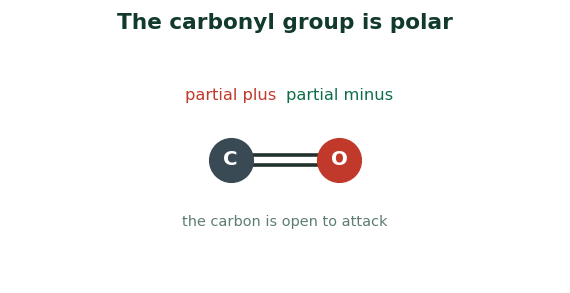
The carbonyl group is a carbon double bonded to an oxygen. Because oxygen pulls the shared electrons towards itself, the carbon is left slightly positive and the oxygen slightly negative. This makes the carbon a target for electron rich nucleophiles, which is the key to the chemistry of these families.
|
Core idea The carbonyl carbon carries a small positive charge, so nucleophiles attack it, while the oxygen is ready to take up the negative charge that results.
|
|
Diagram 1 – The Carbonyl Group
Fig 1. The oxygen draws the electrons of the double bond, leaving the carbon positive and open to attack. |
2. Naming and Structure |
An aldehyde has the carbonyl at the end of a chain, with at least one hydrogen on it, and its name ends in al. A ketone has the carbonyl between two carbons, and its name ends in one. A carboxylic acid has a carbonyl and a hydroxyl on the same carbon, the carboxyl group, and its name ends in oic acid.
3. Preparation |
These compounds are made largely by oxidation of alcohols. A primary alcohol gives first an aldehyde and then a carboxylic acid, while a secondary alcohol gives a ketone. Aldehydes and ketones also come from other routes, and carboxylic acids come from the further oxidation of aldehydes or primary alcohols.
4. Nucleophilic Addition |
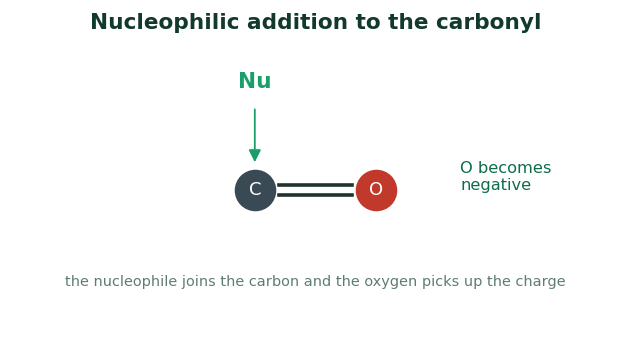
The signature reaction is nucleophilic addition. A nucleophile joins the carbonyl carbon, the double bond opens and the oxygen takes up a negative charge. Aldehydes are more reactive than ketones, because a ketone has two carbon groups that both crowd the carbon and push electron density onto it, making it a poorer target.
|
Diagram 2 – Nucleophilic Addition
Fig 2. The nucleophile bonds to the carbon and the oxygen picks up the charge as the double bond opens. |
5. Acidity of Carboxylic Acids |
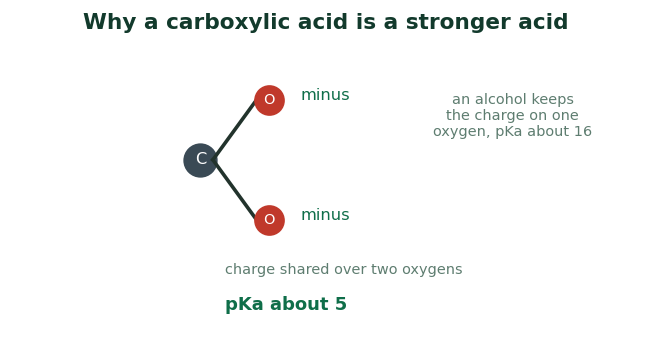
Carboxylic acids are far more acidic than alcohols or phenols. When the acid loses its proton, the negative charge is shared equally over two oxygens of the carboxylate ion. This wide sharing makes the ion very stable, so the proton leaves readily and the acid is strong among organic acids.
|
Diagram 3 – Carboxylic Acid Acidity
Fig 3. The charge is shared over two equal oxygens, stabilising the ion far more than in an alcohol. |
6. Key Reactions and Tests |
Aldehydes are readily oxidised to carboxylic acids, but ketones are not, which lets us tell them apart. Gentle oxidising tests, such as Tollens’ silver mirror and Fehling’s solution, are positive for an aldehyde and negative for a ketone. Both aldehydes and ketones can be reduced back to alcohols, and carboxylic acids react as typical acids.
7. Key Reasoning (Principles) |
|
Principle 1: The carbonyl carbon is attacked Because the oxygen pulls electrons away, the carbon is electron poor, so electron rich nucleophiles add to it in the key reaction of these families. |
|
Principle 2: Aldehydes beat ketones for reactivity A ketone is more crowded and its two carbon groups push electron density onto the carbon, so it is a poorer target than an aldehyde. |
|
Principle 3: The carboxylate ion is very stable Sharing the negative charge over two equal oxygens stabilises the ion strongly, so a carboxylic acid gives up its proton far more readily than an alcohol. |
8. Worked Examples |
| Example 1 |
|
Q: Why is the carbonyl carbon open to attack? Show SolutionThe oxygen pulls electrons away. Answer: It carries a small positive charge. |
| Example 2 |
|
Q: What ending does an aldehyde name take? Show SolutionThe carbonyl is at the end. Answer: al. |
| Example 3 |
|
Q: What ending does a ketone name take? Show SolutionThe carbonyl is in the middle. Answer: one. |
| Example 4 |
|
Q: From what alcohol is a ketone made? Show SolutionThe carbonyl ends up in the middle. Answer: A secondary alcohol. |
| Example 5 |
|
Q: Which is more reactive to nucleophilic addition? Show SolutionCrowding and electron push matter. Answer: An aldehyde. |
| Example 6 |
|
Q: Why is a carboxylic acid more acidic than an alcohol? Show SolutionThe charge is shared over two oxygens. Answer: Its ion is stabilised over two oxygens. |
| Example 7 |
|
Q: Which test gives a silver mirror with an aldehyde? Show SolutionA gentle oxidising test. Answer: Tollens’ test. |
| Example 8 |
|
Q: Does Fehling’s solution react with a ketone? Show SolutionKetones are not easily oxidised. Answer: No. |
| Example 9 |
|
Q: What do aldehydes and ketones reduce to? Show SolutionThe double bond becomes single. Answer: Alcohols. |
| Example 10 |
|
Q: What is the carboxyl group? Show SolutionA carbonyl and a hydroxyl together. Answer: A carbonyl plus a hydroxyl on one carbon. |
9. Practice Sets A to D |
| Set A – Multiple Choice (Basic) |
|
1. The carbonyl carbon is: (a) slightly negative (b) slightly positive (c) neutral (d) aromatic 2. An aldehyde name ends in: (a) one (b) al (c) ol (d) oic acid 3. More reactive to nucleophilic addition is: (a) a ketone (b) an aldehyde (c) an ether (d) an alkane 4. A carboxylic acid is more acidic because its ion shares charge over: (a) one oxygen (b) two oxygens (c) a ring (d) a metal 5. A silver mirror forms with an aldehyde in: (a) Fehling’s (b) Tollens’ test (c) bromine water (d) litmus Reveal Answers1. (b) slightly positive. 2. (b) al. 3. (b) an aldehyde. 4. (b) two oxygens. 5. (b) Tollens’ test. |
| Set B – Short Answer (Understanding) |
|
1. Describe the carbonyl group. 2. How are aldehydes, ketones and acids named? 3. What is nucleophilic addition? 4. Why is a carboxylic acid strongly acidic? 5. How can you tell an aldehyde from a ketone? Reveal Answers1. A carbon double bonded to oxygen, polar so the carbon is positive and the oxygen negative. 2. Aldehydes end in al, ketones in one, and carboxylic acids in oic acid. 3. A nucleophile joins the carbonyl carbon, the double bond opens and the oxygen takes the charge. 4. Its ion shares the negative charge over two equal oxygens, making it very stable. 5. An aldehyde gives a positive Tollens’ and Fehling’s test, a ketone does not. |
| Set C – Application and Reasoning |
|
1. Why does a nucleophile attack the carbon and not the oxygen? 2. Why is propanal more reactive than propanone? 3. Why is ethanoic acid a stronger acid than ethanol? 4. Why does a ketone resist gentle oxidation? 5. Why does reducing a carbonyl give an alcohol? Reveal Answers1. The carbon is electron poor and positive, so the electron rich nucleophile is drawn to it. 2. Propanone has two carbon groups that crowd the carbon and push electrons onto it, so it is a poorer target. 3. Its ion spreads the charge over two oxygens, while the ethanol ion holds it on one, so ethanoic acid loses its proton more easily. 4. It has no hydrogen on the carbonyl carbon to remove, so it cannot be oxidised to an acid gently. 5. Adding hydrogen across the double bond turns the carbonyl into a hydroxyl group. |
| Set D – Higher Order (Challenge) |
|
1. Explain how polarity of the carbonyl drives its whole chemistry. 2. Explain the reactivity order of aldehydes and ketones in full. 3. Explain the acidity order of alcohol, phenol and carboxylic acid. 4. Explain how Tollens’ test distinguishes the two carbonyl families. 5. Explain why formaldehyde is the most reactive carbonyl of all. Reveal Answers1. The positive carbon invites nucleophiles and the oxygen accepts the charge, so addition is the central reaction throughout. 2. Both crowding by the two carbon groups and their push of electron density make a ketone a poorer target than an aldehyde. 3. A carboxylic acid shares charge over two oxygens, phenol over a ring, and an alcohol over one oxygen, giving that order of strength. 4. The aldehyde is oxidised, reducing the silver ions to a silver mirror, while the ketone leaves them untouched. 5. It has two hydrogens and no electron pushing carbon groups, so its carbon is the most exposed and positive. |
|
Chapter Summary
|
|||||||||||||||||||||||||||||||
| Eight Point Exam Quick Check | ||||||||||||||||||||||||||||||||
|
||||||||||||||||||||||||||||||||
|
School Revise Virtual Lab Explore these ideas with interactive simulations and visual tools.
|
|
Class 12 Chemistry Chapter 8: Aldehydes, Ketones and Carboxylic Acids, Complete Notes and Practice These free Class 12 Chemistry notes on Aldehydes, Ketones and Carboxylic Acids follow the NCERT syllabus and cover the carbonyl group, naming, nucleophilic addition, the acidity of carboxylic acids and key tests, with worked examples and graded practice, free on SchoolRevise.com. |
 Google