Curriculum
Grade XII Chemistry
Chemistry lessons
0/10
-
CH-1 Solutions
 Preview
 -
CH-2 Electro Chemistry
Preview
-
CH_3 Chemical Kinetics
Preview
-
CH-4 D and F Block
Preview
-
CH-5 Coordination Compounds
Preview
-
CH-6-Haloalkanes-Haloarenes
Preview
-
CH-7-Alcohols-Phenols-Ethers
Preview
-
CH-8-Aldehydes-Ketones-Acids
Preview
-
CH-9 Amines
Preview
-
CH-10 Biomolecules
Preview
Work Sheets
0/10

CH-2 Electro Chemistry
|
Grade 12 Science | Chapter 2 ElectrochemistryElectrochemistry links chemical change and electricity. This chapter builds galvanic cells, electrode potential and the electrochemical series, the Nernst equation, the conductance of solutions and Faraday’s laws of electrolysis.
|
|
Contents
|
1. Galvanic Cells |
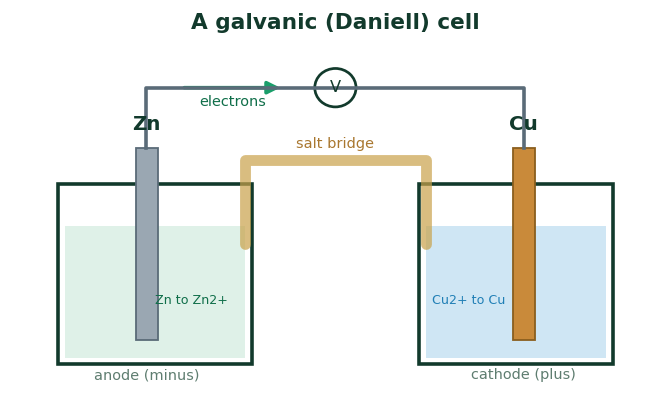
A galvanic cell turns a spontaneous redox reaction into electricity. Oxidation happens at the anode, which is the negative electrode, and reduction at the cathode, the positive electrode. Electrons travel through the outside wire from anode to cathode, while a salt bridge lets ions move to keep each side electrically balanced.
|
Core idea In every galvanic cell, electrons leave the anode where oxidation occurs, pass through the wire to do useful work, and arrive at the cathode where reduction occurs.
|
|
Diagram 1 – Galvanic Cell
Fig 1. Zinc is oxidised at the anode and copper ions are reduced at the cathode, while electrons flow through the wire and ions through the salt bridge. |
2. Electrode Potential and the SHE |
Every electrode has a tendency to lose or gain electrons, measured as its electrode potential. Because a single electrode cannot be measured alone, we compare it against the standard hydrogen electrode, which is given a value of exactly zero. The value measured against it, under standard conditions, is the standard electrode potential.
3. Cell Potential and the Series |
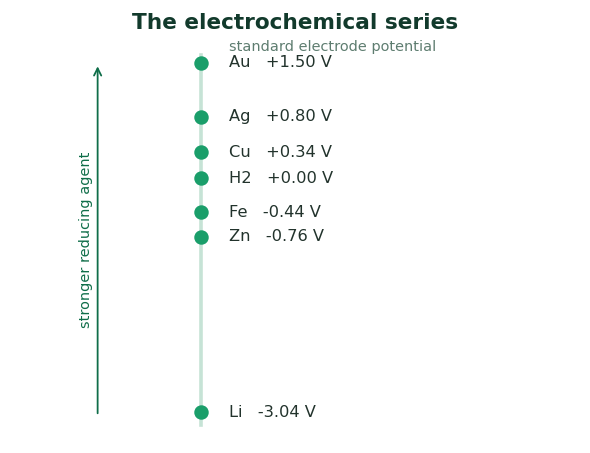
The cell potential is the difference between the two electrode potentials, E cell equals E cathode minus E anode. A positive value means the reaction runs on its own. Ranking electrodes by their standard potential gives the electrochemical series, which shows at a glance which metal will displace which from solution.
|
Diagram 2 – Electrochemical Series
Fig 2. Metals higher up are stronger reducing agents and are more easily oxidised, so they can displace those lower down. |
4. The Nernst Equation |
Cell potential changes with concentration. The Nernst equation gives this, E equals E standard minus 0.059 divided by n times the logarithm of the reaction quotient, at 298 kelvin. It links the potential to concentration, connects the standard potential to the equilibrium constant, and ties to free energy through delta G equals minus n F E.
5. Conductance of Solutions |
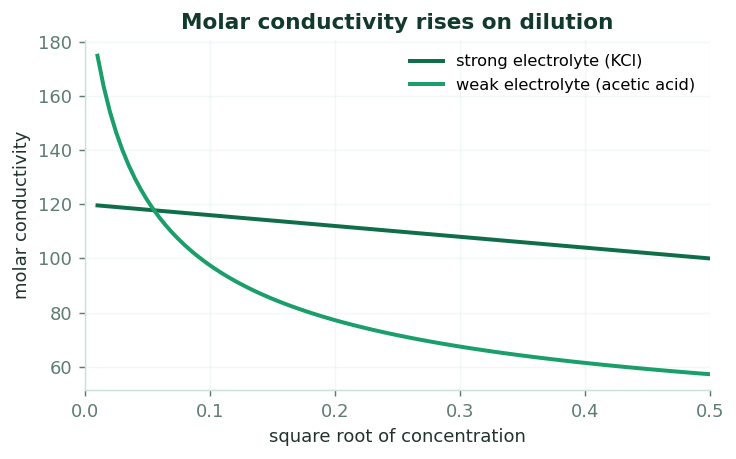
An electrolyte solution conducts through the movement of ions. Its conductivity falls as it is diluted, because there are fewer ions per unit volume. Its molar conductivity rises on dilution, as the ions move more freely. Kohlrausch’s law states that the molar conductivity at infinite dilution is the sum of separate contributions from each ion.
|
Diagram 3 – Molar Conductivity
Fig 3. A strong electrolyte falls gently on dilution, while a weak electrolyte rises steeply as more of it ionises. |
6. Electrolysis and Faraday’s Laws |
Electrolysis uses an outside current to drive a non spontaneous reaction. Faraday’s first law says the mass deposited is proportional to the charge passed. Faraday’s second law says that equal charges deposit amounts in proportion to their equivalent masses. One mole of electrons carries 96500 coulombs, called one faraday.
7. Key Reasoning (Principles) |
|
Principle 1: Electrons flow from anode to cathode In a galvanic cell the more reactive metal is oxidised at the anode and pushes electrons through the wire to the cathode, where reduction takes place. |
|
Principle 2: A positive cell potential means spontaneous Since delta G equals minus n F E, a positive cell potential gives a negative free energy change, so the reaction proceeds on its own. |
|
Principle 3: Molar conductivity rises on dilution As a solution is diluted the ions are freed from each other and move more easily, so the molar conductivity increases, sharply for a weak electrolyte. |
8. Worked Examples |
| Example 1 |
|
Q: A cell uses zinc (standard potential minus 0.76) and copper (plus 0.34). Find the cell potential. Show SolutionCopper has the higher potential, so it is the cathode. E cell equals 0.34 minus minus 0.76. Answer: 1.10 volts. |
| Example 2 |
|
Q: In that cell, which electrode is the anode? Show SolutionOxidation happens at the lower potential electrode. Zinc has the lower potential. Answer: Zinc is the anode. |
| Example 3 |
|
Q: Find the free energy change for the zinc copper cell, with n equal to 2 and F equal to 96500. Show SolutionDelta G equals minus n F E. This is minus 2 times 96500 times 1.10. Answer: minus 212300 joules, about minus 212 kilojoules. |
| Example 4 |
|
Q: What is the standard potential of the standard hydrogen electrode? Show SolutionIt is the chosen reference against which all others are measured. Answer: Zero volts. |
| Example 5 |
|
Q: Write the Nernst equation at 298 kelvin. Show SolutionThe potential falls below the standard value as the quotient rises. Answer: E equals E standard minus 0.059 divided by n times log Q. |
| Example 6 |
|
Q: How much charge deposits one mole of copper, where n is 2? Show SolutionCharge equals n times the faraday. This is 2 times 96500. Answer: 193000 coulombs. |
| Example 7 |
|
Q: How much charge deposits one mole of silver, where n is 1? Show SolutionCharge equals n times the faraday. Answer: 96500 coulombs. |
| Example 8 |
|
Q: Why does conductivity fall but molar conductivity rise on dilution? Show SolutionConductivity depends on ions per unit volume, which falls. Molar conductivity accounts for the amount, and the ions move more freely. Answer: Fewer ions per volume, but freer movement. |
| Example 9 |
|
Q: State Kohlrausch’s law. Show SolutionThe limiting molar conductivity is built from ionic parts. Answer: It is the sum of the separate ionic conductivities. |
| Example 10 |
|
Q: Give one difference between a primary and a secondary cell. Show SolutionA primary cell cannot be recharged. A secondary cell can be recharged by reversing the current. Answer: A secondary cell can be recharged; a primary cell cannot. |
9. Practice Sets A to D |
| Set A – Multiple Choice (Basic) |
|
1. Oxidation in a galvanic cell occurs at the: (a) cathode (b) anode (c) salt bridge (d) wire 2. The standard hydrogen electrode has a potential of: (a) 1 V (b) 0 V (c) minus 1 V (d) 0.5 V 3. Cell potential equals: (a) anode minus cathode (b) cathode minus anode (c) their sum (d) their product 4. One faraday is about: (a) 9650 C (b) 96500 C (c) 965 C (d) 96.5 C 5. Molar conductivity on dilution: (a) falls (b) rises (c) stays fixed (d) becomes zero Reveal Answers1. (b) anode. 2. (b) 0 V. 3. (b) cathode minus anode. 4. (b) 96500 C. 5. (b) rises. |
| Set B – Short Answer (Understanding) |
|
1. Define anode and cathode in a galvanic cell. 2. What is standard electrode potential? 3. Write the expression for cell potential. 4. State Faraday’s first law. 5. What does Kohlrausch’s law give? Reveal Answers1. The anode is where oxidation occurs and is negative; the cathode is where reduction occurs and is positive. 2. The potential of an electrode under standard conditions, measured against the standard hydrogen electrode. 3. E cell equals E cathode minus E anode. 4. The mass deposited during electrolysis is proportional to the charge passed. 5. The limiting molar conductivity as the sum of the separate ionic contributions. |
| Set C – Application and Reasoning |
|
1. Why does a salt bridge keep a cell working? 2. Why can zinc displace copper from copper sulphate solution? 3. Why does cell potential fall as the products build up? 4. Why is molar conductivity of a weak electrolyte low at high concentration? 5. Why must electrolysis be driven by an outside source? Reveal Answers1. It lets ions move between the half cells to keep each side neutral, so the current keeps flowing. 2. Zinc is higher in the series, a stronger reducing agent, so it is oxidised and pushes copper out. 3. By the Nernst equation, a larger reaction quotient lowers the potential below its standard value. 4. Only a small fraction is ionised at high concentration, so there are few ions to carry the current. 5. The reaction is non spontaneous, so energy must be supplied to force it to proceed. |
| Set D – Higher Order (Challenge) |
|
1. Link cell potential, free energy and the equilibrium constant. 2. Explain how a rechargeable cell stores and returns energy. 3. Explain why a more negative electrode potential means a more reactive metal. 4. Why is the molar conductivity at infinite dilution useful for a weak electrolyte? 5. A current deposits twice as much silver as copper for the same charge. Explain. Reveal Answers1. Delta G equals minus n F E, and a positive standard potential gives a large equilibrium constant, so all three agree on how far a reaction goes. 2. Charging drives the reaction backwards to store energy, and discharging lets it run forwards to give energy back. 3. A more negative potential means the metal loses electrons more readily, so it is oxidised more easily and is more reactive. 4. It cannot be found directly by extrapolation, so Kohlrausch’s law builds it from ionic values instead. 5. Silver needs one electron per ion while copper needs two, so the same charge frees twice as many silver atoms. |
|
Chapter Summary
|
|||||||||||||||||||||||||||||||
| Eight Point Exam Quick Check | ||||||||||||||||||||||||||||||||
|
||||||||||||||||||||||||||||||||
|
School Revise Virtual Lab Explore these ideas with interactive simulations and visual tools.
|
|
Class 12 Chemistry Chapter 2: Electrochemistry, Complete Notes and Practice These free Class 12 Chemistry notes on Electrochemistry follow the NCERT syllabus and cover galvanic cells, electrode potential, the electrochemical series, the Nernst equation, conductance and Faraday’s laws, with worked examples and graded practice, free on SchoolRevise.com. |
 Google