Curriculum
Grade XII Chemistry
Chemistry lessons
0/10
-
CH-1 Solutions
 Preview
 -
CH-2 Electro Chemistry
Preview
-
CH_3 Chemical Kinetics
Preview
-
CH-4 D and F Block
Preview
-
CH-5 Coordination Compounds
Preview
-
CH-6-Haloalkanes-Haloarenes
Preview
-
CH-7-Alcohols-Phenols-Ethers
Preview
-
CH-8-Aldehydes-Ketones-Acids
Preview
-
CH-9 Amines
Preview
-
CH-10 Biomolecules
Preview
Work Sheets
0/10

CH-9 Amines
|
Grade 12 Science | Chapter 9 AminesAmines are built from nitrogen carrying a lone pair, which makes them bases and gives them a rich chemistry. This chapter builds their classification and naming, preparation, basicity, reactions and the useful diazonium salts made from them.
|
|
Contents
|
1. Classification and Structure |
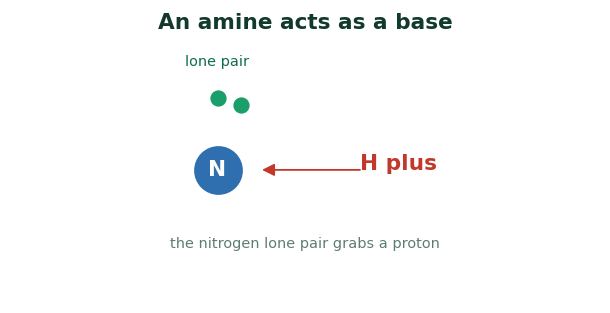
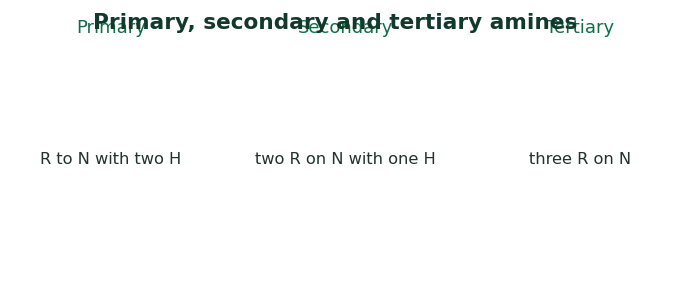
An amine comes from ammonia by replacing one or more hydrogens with carbon groups. It is primary, secondary or tertiary by how many carbon groups are joined to the nitrogen. In every case the nitrogen keeps a lone pair of electrons, and this lone pair is the key to how amines behave.
|
Core idea The lone pair on nitrogen can accept a proton, which is why amines are bases, and can attack electron poor centres, which drives many of their reactions.
|
|
Diagram 1 – Amine as a Base
Fig 1. The nitrogen offers its lone pair to a passing proton, so the amine acts as a base. |
|
Diagram 2 – Amine Types
Fig 2. Primary, secondary and tertiary amines differ by how many carbon groups sit on the nitrogen. |
2. Naming |
Amines are named from the carbon groups on the nitrogen followed by amine, as in methylamine or ethylamine. A ring amine such as aniline has its own common name. Secondary and tertiary amines are named by listing all the groups on the nitrogen.
3. Preparation |
Amines are made by several routes. Reducing a nitro compound gives an amine, which is the usual way to make aniline. Reducing a nitrile adds carbon and gives a primary amine, and reducing an amide gives an amine as well. Ammonia reacting with a haloalkane also gives amines, though often as a mixture.
4. Basicity of Amines |
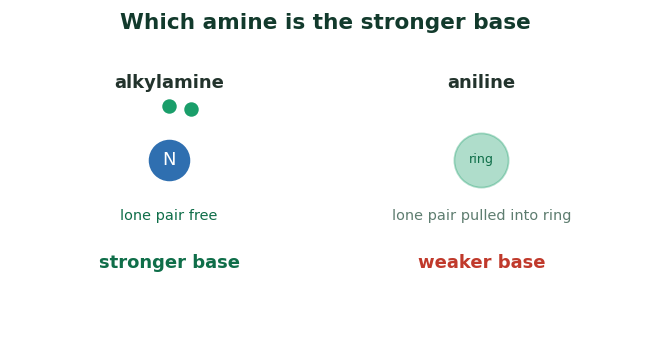
Because the nitrogen lone pair can accept a proton, amines are bases. An alkylamine is a stronger base than ammonia, because the carbon groups push electron density onto the nitrogen and make the lone pair more available. Aniline is a weaker base, because its lone pair is pulled into the ring and is less free to grab a proton.
|
Diagram 3 – Basicity
Fig 3. A free lone pair makes an alkylamine a good base, while the ring pulls the aniline lone pair away and weakens it. |
5. Reactions |
Amines react as bases with acids to form salts. They also undergo acylation, where the nitrogen picks up an acyl group. With nitrous acid, a primary amine on a ring gives a diazonium salt, a very useful intermediate. The lone pair also makes the ring of aniline more open to electrophilic substitution.
6. Diazonium Salts and Uses |
A diazonium salt carries a nitrogen to nitrogen group and is made from a primary aromatic amine and nitrous acid at low temperature. It is a springboard to many products, because the diazonium group can be swapped for other groups. Its coupling reactions make the bright azo dyes used to colour fabrics.
7. Key Reasoning (Principles) |
|
Principle 1: The lone pair makes the amine a base The nitrogen holds a lone pair that can accept a proton, so amines behave as bases and form salts with acids. |
|
Principle 2: Groups on nitrogen change the basicity Carbon groups push electrons onto the nitrogen and strengthen the base, while a ring pulls the lone pair away and weakens it, so aniline is a weak base. |
|
Principle 3: Diazonium salts open many doors A diazonium group made from an aromatic amine can be replaced by many others or coupled to make dyes, so it is a key building block. |
8. Worked Examples |
| Example 1 |
|
Q: What makes an amine a base? Show SolutionThe nitrogen lone pair accepts a proton. Answer: Its nitrogen lone pair. |
| Example 2 |
|
Q: How is an amine classified as primary, secondary or tertiary? Show SolutionCount the carbon groups on nitrogen. Answer: By the number of carbon groups on the nitrogen. |
| Example 3 |
|
Q: Which is a stronger base, methylamine or ammonia? Show SolutionThe carbon group pushes electrons onto nitrogen. Answer: Methylamine. |
| Example 4 |
|
Q: Which is a weaker base, ethylamine or aniline? Show SolutionThe ring pulls the lone pair away. Answer: Aniline. |
| Example 5 |
|
Q: How is aniline usually prepared? Show SolutionReduce a nitro compound. Answer: By reducing nitrobenzene. |
| Example 6 |
|
Q: What forms when a primary aromatic amine meets nitrous acid at low temperature? Show SolutionA nitrogen to nitrogen group forms. Answer: A diazonium salt. |
| Example 7 |
|
Q: Name one important use of diazonium salts. Show SolutionThey couple to give colour. Answer: Making azo dyes. |
| Example 8 |
|
Q: Why is the ring of aniline more open to electrophilic substitution? Show SolutionThe lone pair enriches the ring. Answer: The nitrogen lone pair enriches the ring. |
| Example 9 |
|
Q: What do amines form with acids? Show SolutionThey accept a proton. Answer: Salts. |
| Example 10 |
|
Q: What does reducing a nitrile give? Show SolutionIt adds carbon and nitrogen. Answer: A primary amine. |
9. Practice Sets A to D |
| Set A – Multiple Choice (Basic) |
|
1. An amine is a base because of its nitrogen: (a) proton (b) lone pair (c) charge (d) mass 2. A tertiary amine has on nitrogen: (a) one carbon group (b) two (c) three (d) none 3. Stronger base than ammonia is: (a) aniline (b) an alkylamine (c) water (d) an alcohol 4. Aniline is a weak base because its lone pair is: (a) free (b) pulled into the ring (c) removed (d) doubled 5. Diazonium salts are used to make: (a) soaps (b) azo dyes (c) metals (d) acids Reveal Answers1. (b) lone pair. 2. (c) three. 3. (b) an alkylamine. 4. (b) pulled into the ring. 5. (b) azo dyes. |
| Set B – Short Answer (Understanding) |
|
1. How are amines classified? 2. Why is an amine a base? 3. Why is an alkylamine more basic than ammonia? 4. Why is aniline a weak base? 5. What is a diazonium salt used for? Reveal Answers1. As primary, secondary or tertiary by how many carbon groups are joined to the nitrogen. 2. Its nitrogen lone pair can accept a proton, which is the mark of a base. 3. Its carbon groups push electron density onto the nitrogen, making the lone pair more available. 4. Its lone pair is drawn into the benzene ring, so it is less free to accept a proton. 5. It is a key intermediate, above all for coupling into brightly coloured azo dyes. |
| Set C – Application and Reasoning |
|
1. Why does a longer chain alkylamine remain a good base? 2. Why does aniline turn the ring towards electrophilic substitution? 3. Why must diazonium salts be made at low temperature? 4. Why do amines dissolve in dilute acid? 5. Why can ammonia give a mixture of amines with a haloalkane? Reveal Answers1. Its carbon groups still push electrons onto the nitrogen, keeping the lone pair available for a proton. 2. The nitrogen lone pair feeds electron density into the ring, making it richer and more open to electrophiles. 3. They are unstable and break down when warm, so they are kept cold to survive long enough to be used. 4. They accept a proton to form a soluble salt, so they dissolve in acid even when the free amine does not. 5. The first amine formed still has a lone pair and reacts again, so a mixture of products builds up. |
| Set D – Higher Order (Challenge) |
|
1. Explain the full basicity order of alkylamine, ammonia and aniline. 2. Explain how the same lone pair drives both basicity and reactivity of the ring. 3. Explain why a diazonium salt is such a versatile intermediate. 4. Explain why acylation reduces the basicity of an amine. 5. Explain how azo dyes gain their strong colour. Reveal Answers1. Carbon groups strengthen the base above ammonia, while a ring draws the lone pair away, so alkylamine beats ammonia beats aniline. 2. The lone pair accepts a proton to give basicity, and in aniline it also feeds the ring, guiding substitution there. 3. Its group can be swapped for many others or coupled to a ring, so it leads to a wide family of products. 4. Acylation ties up the lone pair in a new bond, so it is no longer free to accept a proton and the base weakens. 5. Coupling joins two ring systems through the nitrogen to nitrogen link, giving a large system that absorbs visible light strongly. |
|
Chapter Summary
|
|||||||||||||||||||||||||||||||
| Eight Point Exam Quick Check | ||||||||||||||||||||||||||||||||
|
||||||||||||||||||||||||||||||||
|
School Revise Virtual Lab Explore these ideas with interactive simulations and visual tools.
|
|
Class 12 Chemistry Chapter 9: Amines, Complete Notes and Practice These free Class 12 Chemistry notes on Amines follow the NCERT syllabus and cover classification, naming, preparation, the basicity of amines, their reactions and diazonium salts, with clear diagrams, worked examples and graded practice, free on SchoolRevise.com. |
 Google