Curriculum
Grade XII Chemistry
Chemistry lessons
0/10
-
CH-1 Solutions
 Preview
 -
CH-2 Electro Chemistry
Preview
-
CH_3 Chemical Kinetics
Preview
-
CH-4 D and F Block
Preview
-
CH-5 Coordination Compounds
Preview
-
CH-6-Haloalkanes-Haloarenes
Preview
-
CH-7-Alcohols-Phenols-Ethers
Preview
-
CH-8-Aldehydes-Ketones-Acids
Preview
-
CH-9 Amines
Preview
-
CH-10 Biomolecules
Preview
Work Sheets
0/10

CH-10 Biomolecules
|
Grade 12 Science | Chapter 10 BiomoleculesBiomolecules are the large molecules that run living things. This chapter builds carbohydrates, proteins and amino acids, enzymes as catalysts, the nucleic acids that carry information, and the vitamins the body needs.
|
|
Contents
|
1. Carbohydrates |
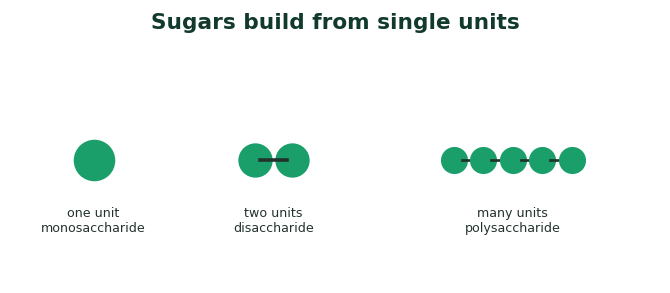
Carbohydrates are sugars and their polymers. A monosaccharide such as glucose is a single unit, a disaccharide such as sucrose is two joined, and a polysaccharide such as starch or cellulose is many joined. Starch and glycogen store energy, while cellulose gives plants their structure.
|
Core idea Living things build large molecules by joining small units, losing a water molecule at each join, and break them down again by adding water back.
|
|
Diagram 1 – Sugar Units
Fig 1. One unit is a monosaccharide, two make a disaccharide, and many make a polysaccharide. |
2. Proteins and Amino Acids |
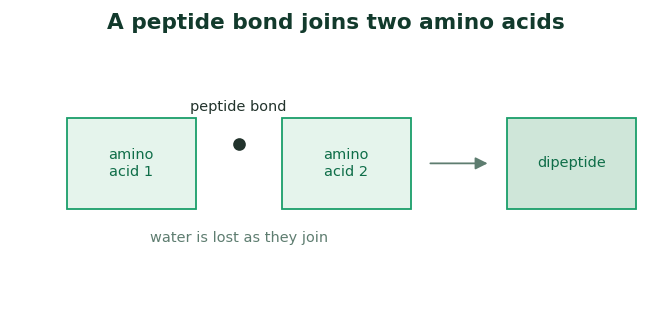
Proteins are chains of amino acids. Each amino acid carries an amino group and a carboxyl group, and two of them join through a peptide bond, losing water. A long chain of these bonds is a protein, and the order of the amino acids is set by the body’s own code.
|
Diagram 2 – The Peptide Bond
Fig 2. The carboxyl of one amino acid joins the amino group of the next, losing water and forming a peptide bond. |
3. Structure of Proteins |
A protein has levels of structure. The primary structure is the order of amino acids. The secondary is local coiling and folding held by hydrogen bonds. The tertiary is the overall three dimensional shape, and some proteins have a quaternary structure of several chains together. Heat or acid can denature a protein, destroying its shape and its function.
4. Enzymes |
Enzymes are proteins that act as biological catalysts. They speed reactions by lowering the activation energy, and each is highly specific, working only on its own substrate, which fits its active site like a key in a lock. They are not used up, so a small amount can process a great deal.
5. Nucleic Acids |
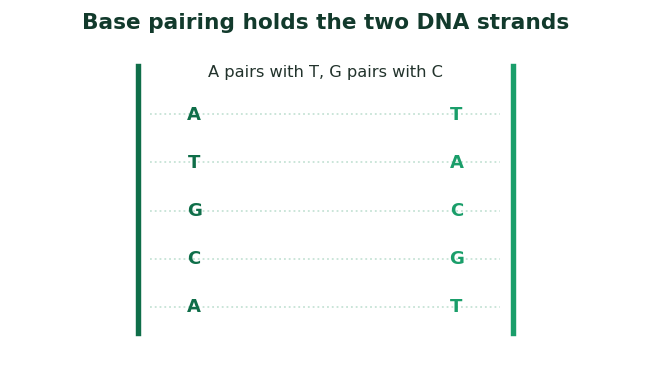
Nucleic acids, DNA and RNA, store and carry the code of life. They are chains of nucleotides, each a sugar, a phosphate and a base. In DNA two strands wind into a double helix, held together by base pairing, where adenine pairs with thymine and guanine pairs with cytosine. This pairing lets the code be copied faithfully.
|
Diagram 3 – Base Pairing
Fig 3. The two strands are held together by base pairs, A with T and G with C, which is the key to copying the code. |
6. Vitamins and Hormones |
Vitamins are small molecules the body needs in tiny amounts. Some, such as vitamins A, D, E and K, dissolve in fat and can be stored, while others, such as the B group and vitamin C, dissolve in water and are not stored, so they are needed regularly. A lack of a vitamin causes a specific deficiency disease. Hormones are chemical messengers that control body processes.
7. Key Reasoning (Principles) |
|
Principle 1: Small units build large polymers Carbohydrates, proteins and nucleic acids are all made by joining small units, losing water at each join and adding it back to break them down. |
|
Principle 2: Shape decides function A protein works only in its proper folded shape, so heat or acid that denatures it and destroys the shape also destroys its function. |
|
Principle 3: Base pairing copies the code Because adenine always pairs with thymine and guanine with cytosine, each DNA strand is a template for building an exact new partner. |
8. Worked Examples |
| Example 1 |
|
Q: What is a monosaccharide? Show SolutionA single sugar unit. Answer: A single sugar unit such as glucose. |
| Example 2 |
|
Q: What bond joins two amino acids? Show SolutionThey lose water as they join. Answer: A peptide bond. |
| Example 3 |
|
Q: What is lost when a peptide bond forms? Show SolutionA small molecule leaves. Answer: A water molecule. |
| Example 4 |
|
Q: What does denaturation do to a protein? Show SolutionIt destroys the shape. Answer: It destroys its shape and function. |
| Example 5 |
|
Q: How does an enzyme speed a reaction? Show SolutionIt offers a lower barrier. Answer: By lowering the activation energy. |
| Example 6 |
|
Q: With which base does adenine pair? Show SolutionBase pairing rule. Answer: Thymine. |
| Example 7 |
|
Q: With which base does guanine pair? Show SolutionBase pairing rule. Answer: Cytosine. |
| Example 8 |
|
Q: Name one fat soluble vitamin. Show SolutionIt can be stored in the body. Answer: Vitamin A (or D, E or K). |
| Example 9 |
|
Q: Why must vitamin C be taken regularly? Show SolutionIt dissolves in water. Answer: It is water soluble and not stored. |
| Example 10 |
|
Q: What three parts make a nucleotide? Show SolutionThe unit of a nucleic acid. Answer: A sugar, a phosphate and a base. |
9. Practice Sets A to D |
| Set A – Multiple Choice (Basic) |
|
1. Glucose is a: (a) disaccharide (b) monosaccharide (c) polysaccharide (d) protein 2. Amino acids join by a: (a) peptide bond (b) ionic bond (c) metallic bond (d) double bond 3. Enzymes work by lowering the: (a) temperature (b) activation energy (c) mass (d) pressure 4. Adenine pairs with: (a) guanine (b) cytosine (c) thymine (d) adenine 5. A fat soluble vitamin is: (a) vitamin C (b) vitamin B (c) vitamin D (d) none Reveal Answers1. (b) monosaccharide. 2. (a) peptide bond. 3. (b) activation energy. 4. (c) thymine. 5. (c) vitamin D. |
| Set B – Short Answer (Understanding) |
|
1. Classify carbohydrates by size. 2. How is a peptide bond formed? 3. List the levels of protein structure. 4. Why are enzymes specific? 5. State the DNA base pairing rule. Reveal Answers1. As monosaccharides, disaccharides and polysaccharides, by how many sugar units are joined. 2. The carboxyl group of one amino acid joins the amino group of another, losing a water molecule. 3. Primary, secondary, tertiary and, for some, quaternary. 4. The substrate must fit the active site like a key in a lock, so each enzyme works on only its own reaction. 5. Adenine pairs with thymine and guanine pairs with cytosine. |
| Set C – Application and Reasoning |
|
1. Why does cooking an egg change it so completely? 2. Why can a small amount of enzyme process a great deal of substrate? 3. Why does base pairing let DNA be copied exactly? 4. Why is cellulose useful to a plant but not digestible by humans? 5. Why must water soluble vitamins be eaten regularly? Reveal Answers1. The heat denatures the proteins, destroying their shape, so the clear runny egg sets solid and cannot return. 2. The enzyme is a catalyst and is not used up, so it works again and again on molecule after molecule. 3. Each strand is a template, and the fixed pairing means only the correct partner base fits at each place. 4. Its linked units give strong fibres for support, but humans lack the enzyme to break those particular links. 5. They are not stored in the body and are lost steadily, so a fresh supply is needed each day. |
| Set D – Higher Order (Challenge) |
|
1. Explain how the loss of water links all three biopolymers. 2. Explain how the levels of protein structure build on one another. 3. Explain how the specificity of enzymes underlies all body chemistry. 4. Explain how the double helix suits DNA to its job. 5. Explain why a single change in an amino acid can harm a protein. Reveal Answers1. Carbohydrates, proteins and nucleic acids all form by joining units with the loss of water, and all break down by adding it back. 2. The order of amino acids sets the local folding, which sets the overall shape, which in some proteins combines several chains. 3. Each enzyme handles one reaction, so the thousands of reactions in a cell are each controlled without interfering. 4. Two paired strands store the code twice over, so it is protected and each can act as a template to copy it exactly. 5. The order of amino acids fixes the shape, so a single wrong one can misfold the protein and stop it working. |
|
Chapter Summary
|
|||||||||||||||||||||||||||||||
| Eight Point Exam Quick Check | ||||||||||||||||||||||||||||||||
|
||||||||||||||||||||||||||||||||
|
School Revise Virtual Lab Explore these ideas with interactive simulations and visual tools.
|
|
Class 12 Chemistry Chapter 10: Biomolecules, Complete Notes and Practice These free Class 12 Chemistry notes on Biomolecules follow the NCERT syllabus and cover carbohydrates, proteins and amino acids, enzymes, nucleic acids and DNA base pairing, and vitamins, with clear diagrams, worked examples and graded practice, free on SchoolRevise.com. |
 Google