Curriculum
Grade XII Chemistry
Chemistry lessons
0/10
-
CH-1 Solutions
 Preview
 -
CH-2 Electro Chemistry
Preview
-
CH_3 Chemical Kinetics
Preview
-
CH-4 D and F Block
Preview
-
CH-5 Coordination Compounds
Preview
-
CH-6-Haloalkanes-Haloarenes
Preview
-
CH-7-Alcohols-Phenols-Ethers
Preview
-
CH-8-Aldehydes-Ketones-Acids
Preview
-
CH-9 Amines
Preview
-
CH-10 Biomolecules
Preview
Work Sheets
0/10

CH-5 Coordination Compounds
|
Grade 12 Science | Chapter 6 Haloalkanes and HaloarenesHaloalkanes and haloarenes carry a halogen on a carbon chain or a benzene ring. This chapter builds their naming, the polar carbon halogen bond, their preparation, nucleophilic substitution and elimination, and why haloarenes resist substitution.
|
|
Contents
|
1. Classification and Naming |
A haloalkane has a halogen joined to a carbon chain, while a haloarene has it joined directly to a benzene ring. Haloalkanes are called primary, secondary or tertiary by how many carbons are attached to the carbon bearing the halogen. In naming, the halogen is shown by a prefix such as chloro or bromo.
|
Core idea The halogen sits on a carbon that carries a small positive charge, and this makes the carbon the target for reactions with electron rich species.
|
|
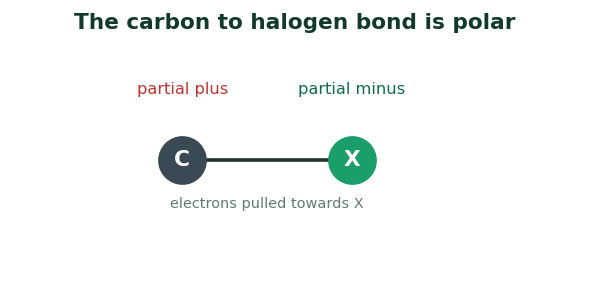
Diagram 1 – The Carbon Halogen Bond
Fig 1. The halogen pulls the shared electrons towards itself, leaving the carbon slightly positive and open to attack. |
2. The Carbon Halogen Bond |
The carbon halogen bond is polar, because the halogen is more electronegative than carbon. This leaves the carbon slightly positive, which is why these compounds react with electron rich species. The bond also grows weaker from fluorine down to iodine, so iodides are the most reactive and fluorides the least.
3. Preparation |
Haloalkanes are made in several ways. The commonest is from an alcohol, by replacing the hydroxyl group with a halogen using a reagent such as a hydrogen halide or phosphorus halide. They can also be made by adding a hydrogen halide across a double bond, or by the direct halogenation of an alkane in sunlight.
4. Nucleophilic Substitution |
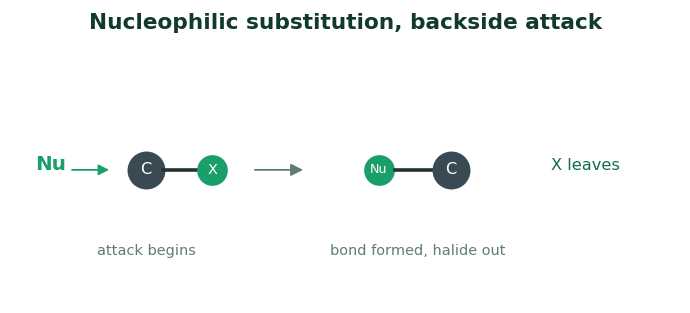
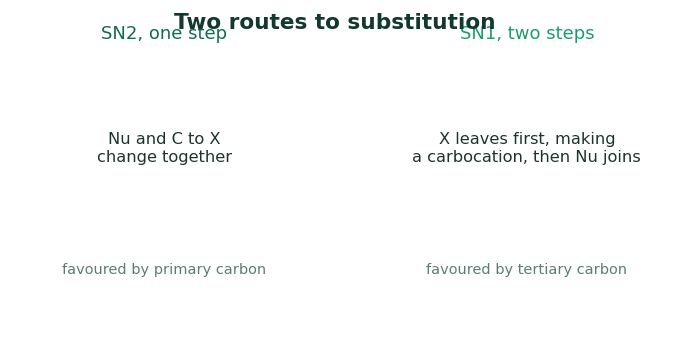
The main reaction is nucleophilic substitution, in which an electron rich nucleophile replaces the halogen. In the SN2 route the nucleophile attacks from the side opposite the halogen in a single step, which flips the molecule. In the SN1 route the halogen leaves first to give a carbocation, which the nucleophile then joins. Primary carbons favour SN2 and tertiary carbons favour SN1.
|
Diagram 2 – Substitution
Fig 2. The nucleophile comes in from the far side as the halide leaves, so the halogen is swapped for the new group. |
5. Elimination Reactions |
Haloalkanes can also undergo elimination, losing a hydrogen halide to form a double bond. This gives an alkene. When more than one alkene is possible, the more substituted, more stable one usually forms in greater amount, a pattern known as Saytzeff’s rule.
|
Diagram 3 – SN1 and SN2
Fig 3. Substitution can go in one concerted step or in two steps through a carbocation, depending on the carbon. |
6. Haloarenes and Uses |
Haloarenes, with the halogen on a benzene ring, resist nucleophilic substitution. The lone pairs on the halogen share into the ring, giving the carbon halogen bond partial double bond character that is hard to break. Halogen compounds are widely used as solvents and in medicines, though some, such as the old refrigerant gases, harm the ozone layer and are being phased out.
7. Key Reasoning (Principles) |
|
Principle 1: The carbon is the reactive site Because the halogen pulls electrons away, the carbon it sits on is slightly positive and is the point attacked by electron rich nucleophiles. |
|
Principle 2: The route depends on the carbon A primary carbon is open to a one step backside attack, SN2, while a tertiary carbon forms a stable carbocation and goes by the two step SN1 route. |
|
Principle 3: Haloarenes resist substitution On a ring the halogen lone pairs share into the system, strengthening the bond, so the ring holds the halogen far more tightly than a chain does. |
8. Worked Examples |
| Example 1 |
|
Q: What makes the carbon in a haloalkane open to attack? Show SolutionThe halogen pulls electrons away. Answer: It carries a small positive charge. |
| Example 2 |
|
Q: Which is more reactive, an iodoalkane or a fluoroalkane? Show SolutionThe bond weakens down the group. Answer: The iodoalkane. |
| Example 3 |
|
Q: From what are haloalkanes most commonly prepared? Show SolutionThe hydroxyl group is replaced. Answer: From alcohols. |
| Example 4 |
|
Q: In an SN2 reaction, from which side does the nucleophile attack? Show SolutionIt comes in opposite the leaving group. Answer: From the side opposite the halogen. |
| Example 5 |
|
Q: Which carbon favours the SN1 route? Show SolutionIt forms a stable carbocation. Answer: A tertiary carbon. |
| Example 6 |
|
Q: What is formed when a haloalkane undergoes elimination? Show SolutionA hydrogen halide is lost. Answer: An alkene. |
| Example 7 |
|
Q: Which alkene forms in greater amount by Saytzeff’s rule? Show SolutionThe more stable one. Answer: The more substituted alkene. |
| Example 8 |
|
Q: Why do haloarenes resist substitution? Show SolutionLone pairs share into the ring. Answer: The carbon halogen bond gains double bond character. |
| Example 9 |
|
Q: Name one everyday use of halogen compounds. Show SolutionThey dissolve many substances. Answer: As solvents. |
| Example 10 |
|
Q: Why are the old refrigerant gases being phased out? Show SolutionThey reach the upper atmosphere. Answer: They damage the ozone layer. |
9. Practice Sets A to D |
| Set A – Multiple Choice (Basic) |
|
1. In a haloalkane the carbon bearing the halogen is: (a) slightly negative (b) slightly positive (c) neutral (d) aromatic 2. The most reactive carbon halogen bond is with: (a) fluorine (b) chlorine (c) bromine (d) iodine 3. SN2 attack comes from the: (a) same side as X (b) opposite side to X (c) above (d) below only 4. SN1 goes through a: (a) carbanion (b) carbocation (c) radical only (d) double bond 5. Haloarenes are: (a) very reactive to substitution (b) resistant to substitution (c) explosive (d) ionic Reveal Answers1. (b) slightly positive. 2. (d) iodine. 3. (b) opposite side to X. 4. (b) carbocation. 5. (b) resistant to substitution. |
| Set B – Short Answer (Understanding) |
|
1. Classify haloalkanes as primary, secondary and tertiary. 2. Why is the carbon halogen bond polar? 3. How is a haloalkane made from an alcohol? 4. Describe the SN2 mechanism in one line. 5. Why do haloarenes resist substitution? Reveal Answers1. By how many carbons are attached to the carbon carrying the halogen, one, two or three. 2. The halogen is more electronegative than carbon, so it pulls the shared electrons towards itself. 3. The hydroxyl group is replaced by a halogen using a hydrogen halide or a phosphorus halide. 4. The nucleophile attacks from the side opposite the halogen in one step, flipping the molecule. 5. The halogen lone pairs share into the ring, giving the bond partial double bond character. |
| Set C – Application and Reasoning |
|
1. Why does a tertiary haloalkane react faster by SN1 than a primary one? 2. Why does SN2 flip the arrangement at the carbon? 3. Why is an iodoalkane more reactive than a chloroalkane? 4. Why does elimination compete with substitution? 5. Why is chlorobenzene far less reactive than chloroethane? Reveal Answers1. It forms a more stable carbocation, so the slow first step is easier and the SN1 route speeds up. 2. The nucleophile arrives opposite the leaving group and pushes the other bonds through, like an umbrella in wind. 3. The carbon iodine bond is weaker, so the iodine leaves more readily during the reaction. 4. A base can pull off a hydrogen instead of attacking the carbon, giving an alkene rather than a substitution product. 5. In chlorobenzene the lone pairs share into the ring and strengthen the bond, so the chlorine is held tightly. |
| Set D – Higher Order (Challenge) |
|
1. Explain how the structure of the carbon decides between SN1 and SN2. 2. Explain why an SN1 reaction can give a mixture of mirror image products. 3. Explain how bond strength across the halogens affects reactivity. 4. Explain Saytzeff’s rule in terms of stability. 5. Explain why some halogen compounds are an environmental concern. Reveal Answers1. A primary carbon is open and forms an unstable cation, so it goes SN2; a tertiary carbon is crowded but forms a stable cation, so it goes SN1. 2. The flat carbocation can be joined by the nucleophile from either face, giving both mirror image forms. 3. The bond weakens from fluorine to iodine, so the halide leaves more easily and reactivity rises down the group. 4. The more substituted alkene is more stable, so it forms in greater amount when there is a choice. 5. Compounds such as the old refrigerant gases drift up and break down ozone, so they are being phased out. |
|
Chapter Summary
|
|||||||||||||||||||||||||||||||
| Eight Point Exam Quick Check | ||||||||||||||||||||||||||||||||
|
||||||||||||||||||||||||||||||||
|
School Revise Virtual Lab Explore these ideas with interactive simulations and visual tools.
|
|
Class 12 Chemistry Chapter 6: Haloalkanes and Haloarenes, Complete Notes and Practice These free Class 12 Chemistry notes on Haloalkanes and Haloarenes follow the NCERT syllabus and cover classification, the carbon halogen bond, preparation, nucleophilic substitution, elimination and the low reactivity of haloarenes, with worked examples and graded practice, free on SchoolRevise.com. |
 Google