Curriculum
Grade XII Chemistry
Chemistry lessons
0/10
-
CH-1 Solutions
 Preview
 -
CH-2 Electro Chemistry
Preview
-
CH_3 Chemical Kinetics
Preview
-
CH-4 D and F Block
Preview
-
CH-5 Coordination Compounds
Preview
-
CH-6-Haloalkanes-Haloarenes
Preview
-
CH-7-Alcohols-Phenols-Ethers
Preview
-
CH-8-Aldehydes-Ketones-Acids
Preview
-
CH-9 Amines
Preview
-
CH-10 Biomolecules
Preview
Work Sheets
0/10

CH-7-Alcohols-Phenols-Ethers
|
Grade 12 Science | Chapter 7 Alcohols, Phenols and EthersThese three families all contain oxygen joined to carbon. This chapter builds their naming and preparation, the hydrogen bonding that shapes their properties, the special acidity of phenol, the making of ethers and the reactions that matter most.
|
|
Contents
|
1. Classification and Naming |
An alcohol has a hydroxyl group joined to a carbon chain, and is primary, secondary or tertiary by how many carbons touch that carbon. A phenol has the hydroxyl joined directly to a benzene ring. An ether has an oxygen between two carbon groups. Alcohol names end in ol, while an ether is named as an alkoxy group on a chain.
|
Core idea The hydroxyl group can form hydrogen bonds, which lifts boiling points and helps these compounds dissolve in water, while ethers, lacking a bonded hydrogen on oxygen, cannot do this.
|
|
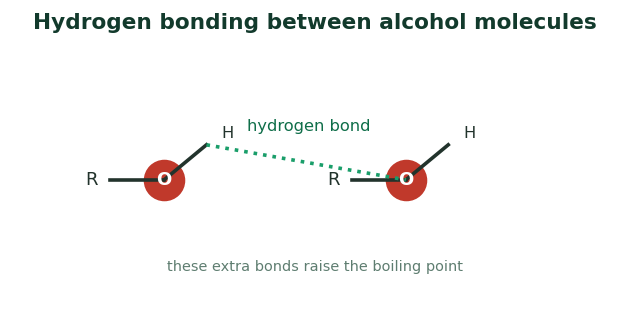
Diagram 1 – Hydrogen Bonding
Fig 1. The hydroxyl hydrogen of one molecule is drawn to the oxygen of the next, and these extra bonds raise the boiling point. |
2. Preparation of Alcohols |
Alcohols are made in several ways. Adding water across a double bond, following Markovnikov’s rule, puts the hydroxyl on the more substituted carbon. Reducing an aldehyde gives a primary alcohol, and reducing a ketone gives a secondary alcohol. Grignard reagents added to carbonyl compounds give alcohols too.
3. Properties of Alcohols |
Alcohols form hydrogen bonds, so they boil far higher than similar sized alkanes and the smaller ones mix freely with water. They are also weakly acidic, reacting with sodium to release hydrogen. Their class controls how they are oxidised, which is set out in the reactions section.
4. Phenols |
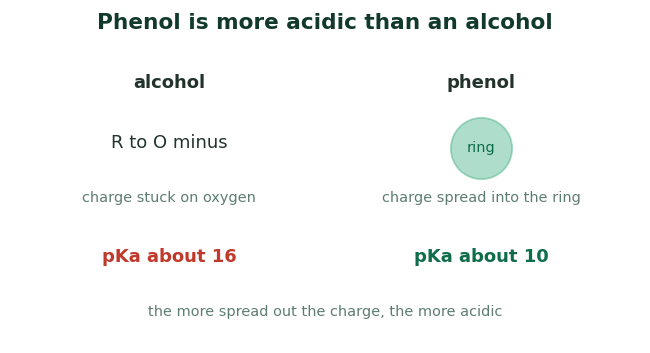
Phenol is more acidic than an ordinary alcohol. When it loses its proton, the resulting negative charge is spread out over the ring rather than stuck on one oxygen, so the ion is more stable and the proton leaves more readily. The ring is also made more reactive towards electrophilic substitution by the hydroxyl group.
|
Diagram 2 – Acidity
Fig 2. Spreading the negative charge into the ring stabilises the phenoxide ion, so phenol gives up its proton more easily than an alcohol. |
5. Ethers |
Ethers have an oxygen linking two carbon groups. They are commonly made by the Williamson synthesis, in which an alkoxide reacts with a haloalkane. Ethers are fairly unreactive and mix poorly with water, which makes them useful and gentle solvents in the laboratory.
|
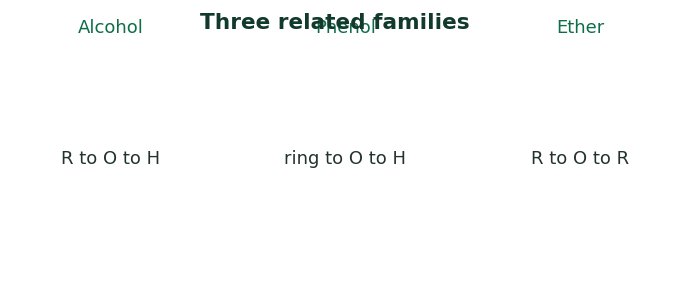
Diagram 3 – The Three Families
Fig 3. An alcohol, a phenol and an ether, each built around oxygen joined to carbon in a different way. |
6. Key Reactions and Uses |
A primary alcohol oxidises to an aldehyde and then to a carboxylic acid, a secondary alcohol oxidises to a ketone, and a tertiary alcohol resists oxidation. Alcohols also lose water to form alkenes when heated with acid. Ethanol is used in drinks and fuels, methanol as an industrial solvent, glycerol in medicines, and phenol as an early antiseptic.
7. Key Reasoning (Principles) |
|
Principle 1: Hydrogen bonding lifts boiling points The hydroxyl group lets these molecules bond to one another, so alcohols boil much higher than alkanes of similar size and the smaller ones dissolve in water. |
|
Principle 2: Phenol is more acidic than an alcohol Losing the proton spreads the charge over the ring, so the phenoxide ion is more stable and the proton leaves more readily than from an alcohol. |
|
Principle 3: Oxidation depends on the class A primary alcohol oxidises to an aldehyde then an acid, a secondary to a ketone, and a tertiary resists, because of how many hydrogens sit on the carbon. |
8. Worked Examples |
| Example 1 |
|
Q: Why does ethanol boil higher than ethane? Show SolutionEthanol forms hydrogen bonds. Answer: Because of hydrogen bonding. |
| Example 2 |
|
Q: Where does the hydroxyl go when water adds across a double bond? Show SolutionFollow Markovnikov’s rule. Answer: On the more substituted carbon. |
| Example 3 |
|
Q: What alcohol is formed by reducing a ketone? Show SolutionA ketone has the carbonyl in the middle. Answer: A secondary alcohol. |
| Example 4 |
|
Q: Why is phenol more acidic than ethanol? Show SolutionThe charge on the ion spreads into the ring. Answer: Its ion is stabilised by the ring. |
| Example 5 |
|
Q: Which is more acidic, phenol or ethanol? Show SolutionCompare the pKa values. Answer: Phenol. |
| Example 6 |
|
Q: How is an ether made by the Williamson synthesis? Show SolutionAn alkoxide meets a haloalkane. Answer: An alkoxide reacts with a haloalkane. |
| Example 7 |
|
Q: What does a primary alcohol oxidise to first? Show SolutionIt has two hydrogens on the carbon. Answer: An aldehyde. |
| Example 8 |
|
Q: What does a secondary alcohol oxidise to? Show SolutionIt has one hydrogen on the carbon. Answer: A ketone. |
| Example 9 |
|
Q: Why does a tertiary alcohol resist oxidation? Show SolutionNo hydrogen sits on the carbon bearing the hydroxyl. Answer: It has no hydrogen on that carbon. |
| Example 10 |
|
Q: Why are ethers used as solvents? Show SolutionThey are fairly unreactive. Answer: Because they are gentle and unreactive. |
9. Practice Sets A to D |
| Set A – Multiple Choice (Basic) |
|
1. A phenol has the hydroxyl joined to a: (a) chain (b) benzene ring (c) metal (d) halogen 2. Alcohols boil high because of: (a) ionic bonds (b) hydrogen bonding (c) their mass (d) colour 3. Phenol compared with ethanol is: (a) less acidic (b) more acidic (c) equally acidic (d) neutral 4. A secondary alcohol oxidises to a: (a) acid (b) ketone (c) aldehyde (d) ether 5. The Williamson synthesis makes: (a) alcohols (b) ethers (c) acids (d) amines Reveal Answers1. (b) benzene ring. 2. (b) hydrogen bonding. 3. (b) more acidic. 4. (b) ketone. 5. (b) ethers. |
| Set B – Short Answer (Understanding) |
|
1. Classify alcohols as primary, secondary and tertiary. 2. Why do alcohols dissolve in water? 3. Why is phenol more acidic than an alcohol? 4. Give the Williamson synthesis in one line. 5. What does a primary alcohol oxidise to? Reveal Answers1. By how many carbons are joined to the carbon bearing the hydroxyl, one, two or three. 2. The hydroxyl forms hydrogen bonds with water, so the smaller alcohols mix freely with it. 3. Its ion spreads the negative charge over the ring, so it is more stable and the proton leaves more easily. 4. An alkoxide reacts with a haloalkane to give an ether. 5. An aldehyde first, and then a carboxylic acid on further oxidation. |
| Set C – Application and Reasoning |
|
1. Why does a small alcohol mix with water but a large one does not? 2. Why does phenol turn towards electrophilic substitution more readily than benzene? 3. Why does a tertiary alcohol dehydrate more easily than a primary one? 4. Why are ethers stored away from air and light? 5. Why does oxidation stop at a ketone for a secondary alcohol? Reveal Answers1. The hydroxyl bonds to water, but a long carbon tail does not, so large alcohols become insoluble. 2. The hydroxyl pushes electron density into the ring, making it richer and more open to electrophiles. 3. It forms a more stable carbocation on losing water, so the more substituted alkene forms readily. 4. They slowly form peroxides in air and light, which can be dangerous, so they are kept sealed and dark. 5. There is no further hydrogen on the carbonyl carbon to remove, so oxidation cannot go on to an acid. |
| Set D – Higher Order (Challenge) |
|
1. Explain how hydrogen bonding shapes both boiling point and solubility. 2. Explain the acidity order of alcohol, water and phenol. 3. Explain why the class of an alcohol decides its oxidation product. 4. Explain why an ether is a good solvent yet forms hazardous peroxides. 5. Explain how Markovnikov’s rule places the hydroxyl during hydration. Reveal Answers1. The hydroxyl bonds molecules together, lifting the boiling point, and bonds to water, giving solubility for small alcohols. 2. Phenol is most acidic as its ion is ring stabilised, water is next, and an alcohol is least, as its ion is least stabilised. 3. The number of hydrogens on the carbon bearing the hydroxyl limits how far oxidation can go. 4. Its unreactive nature dissolves many substances, but slow reaction with air makes explosive peroxides over time. 5. The proton adds to give the more stable carbocation, so the hydroxyl ends up on the more substituted carbon. |
|
Chapter Summary
|
|||||||||||||||||||||||||||||||
| Eight Point Exam Quick Check | ||||||||||||||||||||||||||||||||
|
||||||||||||||||||||||||||||||||
|
School Revise Virtual Lab Explore these ideas with interactive simulations and visual tools.
|
|
Class 12 Chemistry Chapter 7: Alcohols, Phenols and Ethers, Complete Notes and Practice These free Class 12 Chemistry notes on Alcohols, Phenols and Ethers follow the NCERT syllabus and cover naming, preparation, hydrogen bonding, the acidity of phenol, ether synthesis and key reactions, with worked examples and graded practice, free on SchoolRevise.com. |
 Google