Curriculum
Science Grade XI Chemistry
Science Grade XI Chemistry
0/9
-
Chapter 1: Some Basic Concepts of Chemistry
 Preview
 -
Chapter 2: Structure of Atom
Preview
-
Chapter 3: Classification of Elements and Periodicity in Properties
Preview
-
Chapter 4: Chemical Bonding and Molecular Structure
Preview
-
Chapter 5: Chemical Thermodynamics
Preview
-
Chapter 6: Equilibrium
Preview
-
Chapter 7: Redox Reactions
Preview
-
Chapter 8: Organic Chemistry: Some Basic Principles and Techniques
Preview
-
Chapter 9: Hydrocarbons
Preview
Work Sheets
0/9

Chapter 1: Some Basic Concepts of Chemistry
|
Grade 11 Science | Chapter 1 Some Basic Concepts of ChemistryChemistry begins with counting and weighing matter. This chapter builds the laws of chemical combination, the mole concept and the stoichiometry that underpins every calculation in the subject.
|
|
Contents
|
1. Introduction: Measuring Matter |
Chemistry studies matter and its changes, and almost every change is described by how much of each substance takes part. Because atoms are far too small and too numerous to count, chemists weigh matter and convert mass into number using a counting unit called the mole. This chapter sets up that bridge between the mass we can weigh and the number of particles actually reacting.
We begin with the experimental laws of chemical combination that revealed how elements combine, then build atomic and molecular masses, the mole, and the stoichiometry that lets us predict the amounts in a reaction.
|
Core idea Atoms combine in fixed, whole-number ratios. The mole links the mass we weigh to the number of particles, so a balanced equation can be read in moles, masses or particles.
|
2. Laws of Chemical Combination |
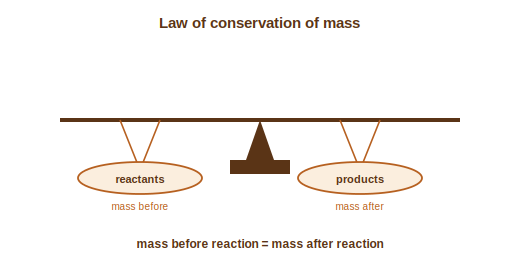
Several laws, found by careful weighing, describe how substances combine. The law of conservation of mass states that mass is neither created nor destroyed in a chemical change. The law of definite proportions states that a pure compound always contains the same elements in the same fixed proportion by mass, so water is always one part hydrogen to eight parts oxygen by mass.
|
Diagram 1 – Conservation of Mass
Fig 1. In a chemical reaction the total mass of the reactants equals the total mass of the products; nothing is gained or lost. |
3. Atomic and Molecular Mass |
The relative atomic mass compares the mass of an atom with a standard, so hydrogen is about 1, carbon 12 and oxygen 16. The molecular mass is the sum of the atomic masses in a formula, so water (H two O) is 1 + 1 + 16 = 18. For substances that are not simple molecules the same sum is called the formula mass.
| Substance | Formula | Molecular or Formula Mass |
| Water | H2O | 18 |
| Carbon dioxide | CO2 | 44 |
| Methane | CH4 | 16 |
| Sodium chloride | NaCl | 58.5 |
4. The Mole Concept |
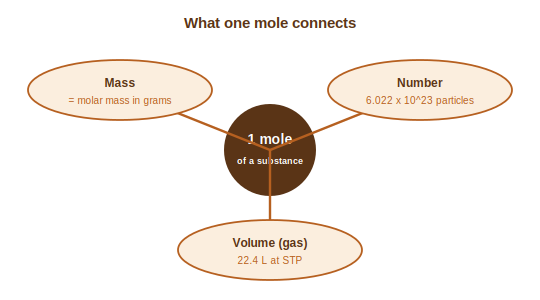
One mole of any substance contains Avogadro’s number of particles, about 6.022 × 10²³, and has a mass in grams equal to its molecular or formula mass. The link is simple: number of moles = mass ÷ molar mass. For a gas, one mole occupies about 22.4 litres at standard temperature and pressure.
|
Diagram 2 – What One Mole Connects
Fig 2. One mole links three things: a mass equal to the molar mass in grams, Avogadro’s number of particles, and for a gas a volume of about 22.4 litres at STP. |
5. Percentage Composition and Formulae |
The percentage composition gives the mass of each element as a percentage of the whole. From it we find the empirical formula, the simplest whole-number ratio of atoms, by dividing each element’s mass percentage by its atomic mass and simplifying. The molecular formula is a whole-number multiple of the empirical formula, found using the molecular mass.
6. Stoichiometry and Concentration |
Stoichiometry uses the balanced equation to relate the amounts of reactants and products in moles, and hence in mass. The concentration of a solution is often given as molarity, the number of moles of solute per litre of solution. These tools let a chemist predict exactly how much product a reaction will give.
|
Watch out Always balance the equation before doing a stoichiometry calculation. The coefficients give the mole ratio, and the whole calculation rests on that ratio being correct.
|
7. Key Reasoning (Principles) |
|
Principle 1: Mass is conserved In any chemical change the total mass stays the same, so a chemical equation must balance, with equal numbers of each kind of atom on both sides. |
|
Principle 2: The mole links mass and number Number of moles = mass ÷ molar mass, and one mole always holds Avogadro’s number of particles. This is the bridge between the laboratory and the particle world. |
|
Principle 3: Equations are read in moles The coefficients of a balanced equation give the ratio of moles, which can then be turned into masses or volumes. Stoichiometry always starts from this ratio. |
8. Worked Examples |
| Example 1 |
|
Q: Find the molar mass of water, H two O. (H = 1, O = 16) ▶ Show Solution1 + 1 + 16. = 18 g/mol. Answer: 18 g/mol. |
| Example 2 |
|
Q: How many moles are in 36 g of water? ▶ Show SolutionMoles = mass ÷ molar mass = 36 ÷ 18. = 2 mol. Answer: 2 mol. |
| Example 3 |
|
Q: How many molecules are there in 2 mol of water? ▶ Show SolutionMolecules = moles × Avogadro’s number = 2 × 6.022 × 1023. = 1.204 × 1024 molecules. Answer: 1.204 × 1024 molecules. |
| Example 4 |
|
Q: Find the percentage by mass of hydrogen in water. ▶ Show SolutionMass of H = 2; total = 18. (2 ÷ 18) × 100 = 11.1%. Answer: 11.1%. |
| Example 5 |
|
Q: Find the percentage by mass of oxygen in water. ▶ Show Solution(16 ÷ 18) × 100. = 88.9%. Answer: 88.9%. |
| Example 6 |
|
Q: Find the molar mass of carbon dioxide, CO two. (C = 12, O = 16) ▶ Show Solution12 + 16 + 16. = 44 g/mol. Answer: 44 g/mol. |
| Example 7 |
|
Q: How many moles are in 88 g of carbon dioxide? ▶ Show Solution88 ÷ 44. = 2 mol. Answer: 2 mol. |
| Example 8 |
|
Q: Find the mass of 0.5 mol of sodium chloride. (NaCl = 58.5) ▶ Show SolutionMass = moles × molar mass = 0.5 × 58.5. = 29.25 g. Answer: 29.25 g. |
| Example 9 |
|
Q: Find the molarity of a solution with 1 mol of solute in 2 litres. ▶ Show SolutionMolarity = moles ÷ litres = 1 ÷ 2. = 0.5 M. Answer: 0.5 M. |
| Example 10 |
|
Q: A compound is 40% C, 6.7% H and 53.3% O by mass. Find its empirical formula. (C = 12, H = 1, O = 16) ▶ Show SolutionDivide by atomic masses: C 40 ÷ 12 = 3.33, H 6.7 ÷ 1 = 6.7, O 53.3 ÷ 16 = 3.33. Divide by the smallest (3.33): C 1, H 2, O 1, giving CH2O. Answer: CH2O. |
9. Practice Sets A to D |
| Set A – Multiple Choice (Basic) |
|
1. Avogadro’s number is about: (a) 6.022 × 10²³ (b) 3 × 10⁸ (c) 9.1 × 10⁻³¹ (d) 1.6 × 10⁻¹⁹ 2. The molar mass of CO2 is: (a) 28 (b) 32 (c) 44 (d) 56 3. Number of moles equals: (a) mass × molar mass (b) mass ÷ molar mass (c) molar mass ÷ mass (d) mass + molar mass 4. One mole of a gas at STP occupies about: (a) 1 L (b) 22.4 L (c) 100 L (d) 6 L 5. Molarity is moles of solute per: (a) gram (b) mole (c) litre of solution (d) kilogram ▶ Reveal Answers1. (a) 6.022 × 10²³. 2. (c) 44. 3. (b) mass ÷ molar mass. 4. (b) 22.4 L. 5. (c) litre of solution. |
| Set B – Short Answer (Understanding) |
|
1. State the law of conservation of mass. 2. Define one mole of a substance. 3. What is the difference between empirical and molecular formula? 4. Write the relationship between moles, mass and molar mass. 5. Why must an equation be balanced before a stoichiometry calculation? ▶ Reveal Answers1. Mass is neither created nor destroyed in a chemical reaction. 2. The amount of a substance containing Avogadro’s number of particles, about 6.022 × 10²³. 3. The empirical formula is the simplest whole-number ratio of atoms; the molecular formula is a whole-number multiple of it. 4. Number of moles = mass ÷ molar mass. 5. Because the coefficients give the mole ratio on which the whole calculation depends. |
| Set C – Application and Reasoning |
|
1. Find the molar mass of methane, CH four. (C = 12, H = 1) 2. How many moles are in 90 g of water? 3. How many molecules are in 0.5 mol of any substance? 4. Find the percentage by mass of carbon in CO2. 5. Find the molarity of 2 mol of solute in 4 litres of solution. ▶ Reveal Answers1. 12 + 4 = 16 g/mol. 2. 90 ÷ 18 = 5 mol. 3. 0.5 × 6.022 × 1023 = 3.011 × 10²³ molecules. 4. (12 ÷ 44) × 100 = 27.3%. 5. 2 ÷ 4 = 0.5 M. |
| Set D – Higher Order (Challenge) |
|
1. A compound has empirical formula CH2O and molecular mass 180. Find its molecular formula. 2. Find the mass of 3 mol of carbon dioxide. 3. A solution contains 49 g of H2SO4 (molar mass 98) in 0.5 L. Find its molarity. 4. Calculate the percentage by mass of nitrogen in ammonia, NH3. (N = 14, H = 1) 5. Explain why the molecular formula is always a whole-number multiple of the empirical formula. ▶ Reveal Answers1. Empirical mass = 12 + 2 + 16 = 30; 180 ÷ 30 = 6, so the molecular formula is C6H12O6. 2. 3 × 44 = 132 g. 3. Moles = 49 ÷ 98 = 0.5 mol; molarity = 0.5 ÷ 0.5 = 1 M. 4. Mass of N = 14; total = 17; (14 ÷ 17) × 100 = 82.4%. 5. Because a molecule contains whole atoms, the actual atom counts must be a whole-number multiple of the simplest ratio. |
|
Chapter Summary
|
|||||||||||||||||||||||||||||||
| 8-Point Exam Quick-Check | ||||||||||||||||||||||||||||||||
|
||||||||||||||||||||||||||||||||
|
School Revise Virtual Lab Explore these ideas with interactive simulations and visual tools.
|
|
Class 11 Chemistry Chapter 1: Some Basic Concepts of Chemistry, Complete Notes and Practice This revision guide follows the current NCERT Class 11 Chemistry syllabus and covers the laws of chemical combination, conservation of mass, atomic and molecular mass, the mole concept and Avogadro’s number, percentage composition, empirical and molecular formulae, and stoichiometry and molarity, with two diagrams, ten worked examples and graded practice. Visit SchoolRevise.com to revise, practise and excel. |
 Google