Curriculum
Science Grade XI Chemistry
Science Grade XI Chemistry
0/9
-
Chapter 1: Some Basic Concepts of Chemistry
 Preview
 -
Chapter 2: Structure of Atom
Preview
-
Chapter 3: Classification of Elements and Periodicity in Properties
Preview
-
Chapter 4: Chemical Bonding and Molecular Structure
Preview
-
Chapter 5: Chemical Thermodynamics
Preview
-
Chapter 6: Equilibrium
Preview
-
Chapter 7: Redox Reactions
Preview
-
Chapter 8: Organic Chemistry: Some Basic Principles and Techniques
Preview
-
Chapter 9: Hydrocarbons
Preview
Work Sheets
0/9

Chapter 8: Organic Chemistry: Some Basic Principles and Techniques
|
Grade 11 Science | Chapter 8 Organic Chemistry: Some Basic Principles and TechniquesOrganic chemistry is the chemistry of carbon. This chapter explains why carbon forms so many compounds, how they are represented and named, and the idea of isomerism.
|
|
Contents
|
1. Introduction: The Chemistry of Carbon |
Carbon forms more compounds than all other elements combined. Organic chemistry is the study of these carbon compounds. This chapter explains the special properties of carbon that make this possible, the ways organic molecules are drawn, the system used to name them, and how different molecules can share the same formula.
|
Core idea Carbon is tetravalent and can bond to itself (catenation), giving endless chains and rings. Compounds are grouped into homologous series by functional group and named by IUPAC rules.
|
2. Tetravalency and Catenation |
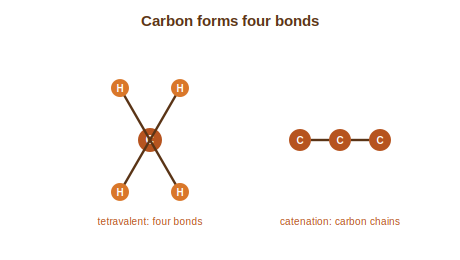
Carbon has four outer electrons, so it forms four covalent bonds, a property called tetravalency. It can also bond strongly to other carbon atoms, forming long chains, branches and rings, a property called catenation. Together these allow an enormous variety of stable carbon compounds.
|
Diagram 1 – Carbon Forms Four Bonds
Fig 1. Carbon is tetravalent, forming four bonds, and can bond to other carbons (catenation) to build chains and rings. |
3. Representing Organic Molecules |
Organic molecules can be drawn in several ways. The structural formula shows every atom and bond; the condensed formula groups atoms to save space, such as CH3CH2OH for ethanol; and the molecular formula gives only the totals. Each representation tells us something different about the molecule.
4. Functional Groups and Homologous Series |
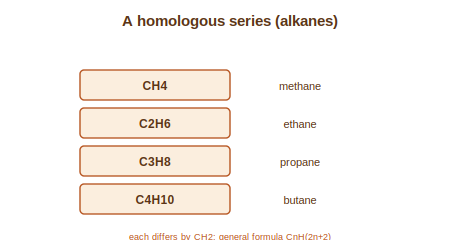
A functional group is an atom or group that gives a molecule its characteristic chemistry, such as the hydroxyl group of alcohols. A homologous series is a family of compounds with the same functional group, differing by one CH2 unit and following a single general formula. Members of a series have similar chemistry and a gradual change in physical properties.
|
Diagram 2 – A Homologous Series
Fig 2. The alkanes form a homologous series: each member differs from the next by one CH2 unit and follows the formula CnH(2n+2). |
5. IUPAC Nomenclature |
The IUPAC system gives every organic compound a unique name. The name is built from a root showing the number of carbons in the longest chain (meth, eth, prop, but), a suffix showing the functional group (such as -ane for alkanes or -ol for alcohols), and prefixes with numbers showing any branches. This systematic scheme replaces the confusing common names.
6. Isomerism |
Isomers are different compounds that share the same molecular formula but differ in structure. Structural isomers differ in the order in which atoms are joined, such as butane and its branched form. Because the arrangement of atoms decides properties, isomers can behave quite differently despite their identical formulae.
7. Key Reasoning (Principles) |
|
Principle 1: Carbon is tetravalent and catenates Carbon’s four bonds and its ability to bond to itself allow chains, branches and rings, which is why so many carbon compounds exist. |
|
Principle 2: A series shares a formula and a group Members of a homologous series share a functional group and a general formula, differing by CH2, so they have similar chemistry. |
|
Principle 3: Structure decides identity Isomers with the same formula but different structures are different compounds, because the arrangement of atoms determines the properties. |
8. Worked Examples |
| Example 1 |
|
Q: How many bonds does a carbon atom form? ▶ Show SolutionCarbon has four outer electrons and is tetravalent. So four bonds. Answer: Four. |
| Example 2 |
|
Q: What is the property of carbon bonding to itself in chains called? ▶ Show SolutionBonding to other carbons in chains and rings is catenation. Answer: Catenation. |
| Example 3 |
|
Q: Write the general formula of an alkane. ▶ Show SolutionThe alkane series follows CnH2n+2. Answer: CnH2n+2. |
| Example 4 |
|
Q: Using the general formula, find the formula of the alkane with 3 carbons. ▶ Show SolutionCnH2n+2 with n = 3 gives 2(3) + 2 = 8 hydrogens. C3H8. Answer: C3H8. |
| Example 5 |
|
Q: By how much do successive members of a homologous series differ? ▶ Show SolutionEach differs from the next by one CH2 unit. Answer: By CH2. |
| Example 6 |
|
Q: What are isomers? ▶ Show SolutionDifferent compounds with the same molecular formula but different structures. Answer: Same formula, different structure. |
| Example 7 |
|
Q: Find the formula of the alkane with 5 carbons. ▶ Show Solution2(5) + 2 = 12 hydrogens. C5H12. Answer: C5H12. |
| Example 8 |
|
Q: What gives a molecule its characteristic chemistry? ▶ Show SolutionThe functional group gives a molecule its characteristic chemistry. Answer: The functional group. |
| Example 9 |
|
Q: What does the root ‘but’ indicate in an IUPAC name? ▶ Show SolutionThe root ‘but’ indicates four carbons in the chain. Answer: Four carbons. |
| Example 10 |
|
Q: How many structural isomers does butane (C4H10) have? ▶ Show SolutionThe straight chain and the branched chain. So two isomers. Answer: Two. |
9. Practice Sets A to D |
| Set A – Multiple Choice (Basic) |
|
1. Carbon forms: (a) one (b) two (c) three (d) four bonds 2. Carbon bonding to itself in chains is called: (a) ionisation (b) catenation (c) oxidation (d) hydration 3. The general formula of an alkane is: (a) CnH2n (b) CnH(2n+2) (c) CnH(2n-2) (d) CnHn 4. Members of a homologous series differ by: (a) CH4 (b) CH2 (c) H2 (d) C2 5. Isomers have the same: (a) structure (b) molecular formula (c) boiling point (d) name ▶ Reveal Answers1. (d) four. 2. (b) catenation. 3. (b) CnH(2n+2). 4. (b) CH2. 5. (b) molecular formula. |
| Set B – Short Answer (Understanding) |
|
1. What is meant by the tetravalency of carbon? 2. Define catenation. 3. Define a functional group. 4. What is a homologous series? 5. Define structural isomers. ▶ Reveal Answers1. Carbon forms four covalent bonds, since it has four outer electrons. 2. The ability of carbon to bond to other carbon atoms, forming chains and rings. 3. An atom or group that gives a molecule its characteristic chemistry. 4. A family of compounds with the same functional group, differing by CH2 and one general formula. 5. Different compounds with the same molecular formula but a different arrangement of atoms. |
| Set C – Application and Reasoning |
|
1. Find the alkane formula for 2 carbons. 2. Find the alkane formula for 6 carbons. 3. What root names a chain of two carbons? 4. Why do members of a homologous series have similar chemistry? 5. Why can carbon form so many compounds? ▶ Reveal Answers1. C2H6. 2. C6H14. 3. The root ‘eth’. 4. Because they share the same functional group. 5. Because it is tetravalent and catenates, forming endless chains, branches and rings. |
| Set D – Higher Order (Challenge) |
|
1. Explain why butane and its branched isomer have the same formula but different properties. 2. Find the molecular formula of the seventh alkane. 3. Why is the IUPAC system preferred over common names? 4. How many hydrogens are in the alkane with 10 carbons? 5. Explain how a functional group can be identified within a homologous series. ▶ Reveal Answers1. They share C4H10 but differ in how the carbons are joined, and structure decides properties such as boiling point. 2. n = 7 gives 2(7) + 2 = 16 hydrogens, so C7H16. 3. Because it gives every compound a single unambiguous name based on its structure. 4. 2(10) + 2 = 22 hydrogens. 5. The same functional group appears in every member, attached to chains of increasing length, so its characteristic reactions recur. |
|
Chapter Summary
|
|||||||||||||||||||||||||||||||
| 8-Point Exam Quick-Check | ||||||||||||||||||||||||||||||||
|
||||||||||||||||||||||||||||||||
|
School Revise Virtual Lab Explore these ideas with interactive simulations and visual tools.
|
|
Class 11 Chemistry Chapter 8: Organic Chemistry Basic Principles, Complete Notes and Practice This revision guide follows the current NCERT Class 11 Chemistry syllabus and develops the basics of organic chemistry, covering the tetravalency and catenation of carbon, ways of representing organic molecules, functional groups and homologous series, IUPAC nomenclature, and structural isomerism, with two diagrams, ten worked examples and graded practice. Visit SchoolRevise.com to revise, practise and excel. |
 Google