Curriculum
Science Grade XI Chemistry
Science Grade XI Chemistry
0/9
-
Chapter 1: Some Basic Concepts of Chemistry
 Preview
 -
Chapter 2: Structure of Atom
Preview
-
Chapter 3: Classification of Elements and Periodicity in Properties
Preview
-
Chapter 4: Chemical Bonding and Molecular Structure
Preview
-
Chapter 5: Chemical Thermodynamics
Preview
-
Chapter 6: Equilibrium
Preview
-
Chapter 7: Redox Reactions
Preview
-
Chapter 8: Organic Chemistry: Some Basic Principles and Techniques
Preview
-
Chapter 9: Hydrocarbons
Preview
Work Sheets
0/9

Chapter 4: Chemical Bonding and Molecular Structure
|
Grade 11 Science | Chapter 4 Chemical Bonding and Molecular StructureWhy do atoms join, and what shapes do molecules take? This chapter develops ionic and covalent bonding, the octet rule, Lewis structures and the VSEPR theory of molecular shape.
|
|
Contents
|
1. Introduction: Why Atoms Bond |
Atoms join into compounds because doing so lowers their energy and gives a stable outer electron arrangement. A chemical bond is the force that holds atoms together. This chapter explains the two main kinds of bond, ionic and covalent, the rule that guides them, and how the arrangement of electron pairs decides the shape of a molecule.
|
Core idea Atoms bond to achieve a stable outer shell, usually an octet. They either transfer electrons (ionic) or share them (covalent), and the repulsion of electron pairs (VSEPR) fixes the molecular shape.
|
2. The Octet Rule |
The octet rule states that atoms tend to gain, lose or share electrons so as to have eight electrons in their outer shell, the stable arrangement of a noble gas. Hydrogen is an exception, needing only two. Although some molecules break the rule, it is a powerful guide to how atoms combine.
3. Ionic Bonding |
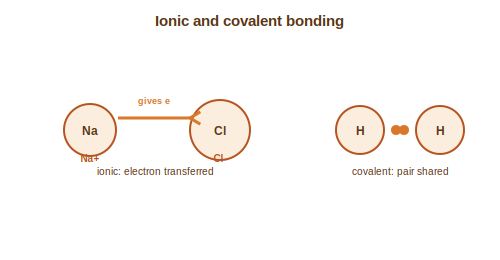
An ionic bond forms when one atom transfers electrons to another, creating oppositely charged ions that attract. A metal such as sodium loses an electron to become a positive ion, while a non-metal such as chlorine gains it to become a negative ion. The strong electrostatic attraction between the ions holds the compound together in a giant lattice.
|
Diagram 1 – Ionic and Covalent Bonding
Fig 1. In ionic bonding an electron is transferred to form ions; in covalent bonding a pair of electrons is shared between atoms. |
4. Covalent Bonding and Lewis Structures |
A covalent bond forms when two atoms share a pair of electrons, common between non-metals. A single bond shares one pair, a double bond two and a triple bond three. Lewis structures show the bonding and non-bonding (lone) pairs as dots and lines, making it easy to check that each atom has its octet.
5. Molecular Shape (VSEPR) |
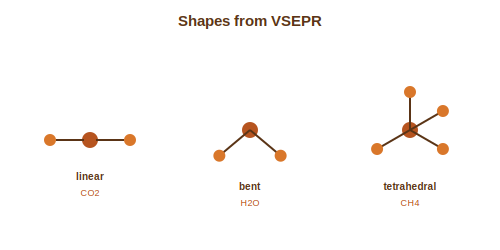
The VSEPR theory (valence shell electron pair repulsion) predicts molecular shape from the idea that electron pairs around an atom repel and spread out as far apart as possible. Two pairs give a linear shape, three a trigonal shape, and four a tetrahedral shape. Lone pairs push more strongly than bonding pairs, so water, with two lone pairs, is bent rather than straight.
|
Diagram 2 – Shapes from VSEPR
Fig 2. Electron pairs spread out to minimise repulsion, giving linear, bent and tetrahedral molecules such as carbon dioxide, water and methane. |
6. Bond Polarity |
When two different atoms share electrons unequally, the bond is polar: the more electronegative atom pulls the shared pair toward itself, gaining a small negative charge. A large electronegativity difference gives an ionic bond, a small one a polar covalent bond, and none a pure covalent bond. The shape of a molecule decides whether these bond polarities cancel or make the whole molecule polar.
7. Key Reasoning (Principles) |
|
Principle 1: Atoms seek a stable octet Bonding lets atoms reach a full outer shell of eight electrons, the stable noble-gas arrangement, by transferring or sharing electrons. |
|
Principle 2: Transfer gives ionic, sharing gives covalent A large electronegativity difference leads to electron transfer and an ionic bond; a small difference leads to sharing and a covalent bond. |
|
Principle 3: Electron pairs repel (VSEPR) Electron pairs around an atom arrange themselves as far apart as possible, which fixes the molecular shape, with lone pairs repelling most strongly. |
8. Worked Examples |
| Example 1 |
|
Q: How many electrons does the octet rule favour in the outer shell? ▶ Show SolutionThe octet rule favours eight outer electrons. Answer: Eight. |
| Example 2 |
|
Q: What kind of bond forms when an electron is transferred between atoms? ▶ Show SolutionTransfer of electrons creates oppositely charged ions. This is an ionic bond. Answer: An ionic bond. |
| Example 3 |
|
Q: What kind of bond forms when atoms share a pair of electrons? ▶ Show SolutionSharing a pair gives a covalent bond. Answer: A covalent bond. |
| Example 4 |
|
Q: How many electron pairs are shared in a double bond? ▶ Show SolutionA double bond shares two pairs. Answer: Two pairs. |
| Example 5 |
|
Q: Predict the shape of a molecule with two bonding pairs and no lone pairs. ▶ Show SolutionTwo pairs spread to opposite sides. The shape is linear. Answer: Linear. |
| Example 6 |
|
Q: Predict the shape of methane, with four bonding pairs. ▶ Show SolutionFour pairs spread to the corners of a tetrahedron. The shape is tetrahedral. Answer: Tetrahedral. |
| Example 7 |
|
Q: Why is a water molecule bent rather than linear? ▶ Show SolutionIts two lone pairs repel strongly and push the bonds together. Answer: Because of lone pair repulsion. |
| Example 8 |
|
Q: What makes a covalent bond polar? ▶ Show SolutionAn unequal sharing of electrons due to different electronegativities. Answer: Unequal sharing of electrons. |
| Example 9 |
|
Q: Which atom in a polar bond gains the small negative charge? ▶ Show SolutionThe more electronegative atom, which pulls the shared pair toward itself. Answer: The more electronegative atom. |
| Example 10 |
|
Q: A very large electronegativity difference between two atoms gives which kind of bond? ▶ Show SolutionA very large difference leads to electron transfer. So an ionic bond. Answer: An ionic bond. |
9. Practice Sets A to D |
| Set A – Multiple Choice (Basic) |
|
1. The octet rule favours an outer shell of: (a) 2 (b) 4 (c) 6 (d) 8 electrons 2. An ionic bond forms by: (a) sharing (b) transfer of electrons (c) melting (d) heating 3. A covalent bond forms by: (a) transfer (b) sharing electrons (c) attraction of ions (d) friction 4. A molecule with four bonding pairs is: (a) linear (b) bent (c) tetrahedral (d) planar 5. A polar bond has electrons shared: (a) equally (b) unequally (c) not at all (d) in threes ▶ Reveal Answers1. (d) 8. 2. (b) transfer of electrons. 3. (b) sharing electrons. 4. (c) tetrahedral. 5. (b) unequally. |
| Set B – Short Answer (Understanding) |
|
1. State the octet rule. 2. How does an ionic bond form? 3. How does a covalent bond form? 4. State the main idea of VSEPR theory. 5. What makes a bond polar? ▶ Reveal Answers1. Atoms gain, lose or share electrons to reach eight in their outer shell. 2. By transfer of electrons, forming oppositely charged ions that attract. 3. By the sharing of one or more pairs of electrons between atoms. 4. Electron pairs around an atom repel and spread out as far apart as possible. 5. Unequal sharing of the bonding electrons due to different electronegativities. |
| Set C – Application and Reasoning |
|
1. Predict the shape of carbon dioxide, with two bonding regions. 2. How many pairs are shared in a triple bond? 3. Which kind of bond joins two non-metals? 4. Why does sodium chloride form an ionic bond? 5. Why is the octet rule useful even with exceptions? ▶ Reveal Answers1. Linear. 2. Three pairs. 3. A covalent bond. 4. Sodium loses an electron and chlorine gains it, forming ions that attract. 5. Because it correctly guides how most atoms combine, even though a few molecules do not obey it. |
| Set D – Higher Order (Challenge) |
|
1. Explain why water is polar but carbon dioxide is not, although both have polar bonds. 2. Predict and explain the shape of ammonia, which has three bonds and one lone pair. 3. Explain why a metal and a non-metal usually form an ionic bond. 4. Compare the number of shared pairs in single, double and triple bonds. 5. Explain how electronegativity difference decides the type of bond. ▶ Reveal Answers1. Water is bent, so its bond polarities do not cancel and the molecule is polar; carbon dioxide is linear, so its two equal polarities cancel. 2. The lone pair repels the bonds, pushing the three bonds into a pyramidal shape rather than flat. 3. The metal loses electrons and the non-metal gains them, so electrons transfer and ions form. 4. Single shares one pair, double shares two pairs and triple shares three pairs. 5. A large difference causes transfer (ionic), a small difference causes unequal sharing (polar covalent), and none gives pure covalent. |
|
Chapter Summary
|
|||||||||||||||||||||||||||||||
| 8-Point Exam Quick-Check | ||||||||||||||||||||||||||||||||
|
||||||||||||||||||||||||||||||||
|
School Revise Virtual Lab Explore these ideas with interactive simulations and visual tools.
|
|
Class 11 Chemistry Chapter 4: Chemical Bonding and Molecular Structure, Complete Notes and Practice This revision guide follows the current NCERT Class 11 Chemistry syllabus and develops chemical bonding, covering the octet rule, ionic bonding by electron transfer, covalent bonding and Lewis structures, the VSEPR theory of molecular shape, and bond polarity, with two diagrams, ten worked examples and graded practice. Visit SchoolRevise.com to revise, practise and excel. |
 Google