Curriculum
Science Grade XI Chemistry
Science Grade XI Chemistry
0/9
-
Chapter 1: Some Basic Concepts of Chemistry
 Preview
 -
Chapter 2: Structure of Atom
Preview
-
Chapter 3: Classification of Elements and Periodicity in Properties
Preview
-
Chapter 4: Chemical Bonding and Molecular Structure
Preview
-
Chapter 5: Chemical Thermodynamics
Preview
-
Chapter 6: Equilibrium
Preview
-
Chapter 7: Redox Reactions
Preview
-
Chapter 8: Organic Chemistry: Some Basic Principles and Techniques
Preview
-
Chapter 9: Hydrocarbons
Preview
Work Sheets
0/9

Chapter 5: Chemical Thermodynamics
|
Grade 11 Science | Chapter 5 Chemical ThermodynamicsEvery reaction exchanges energy. This chapter develops internal energy and enthalpy, the first law, Hess’s law, and the Gibbs energy that decides whether a change is spontaneous.
|
|
Contents
|
1. Introduction: Energy in Reactions |
Chemical reactions absorb or release energy, usually as heat. Thermodynamics studies these energy changes and uses them to predict whether a reaction can happen on its own. This chapter builds the ideas of internal energy and enthalpy, the law that conserves energy, and the Gibbs energy that determines spontaneity.
|
Core idea Energy is conserved (first law). A reaction releases heat (exothermic) or absorbs it (endothermic), and the sign of the Gibbs energy ΔG = ΔH minus TΔS decides whether it is spontaneous.
|
2. System and Surroundings |
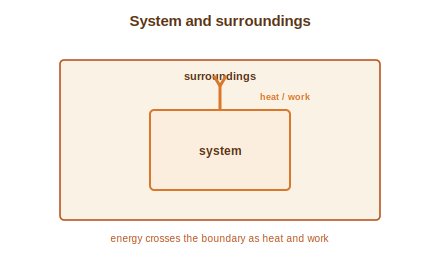
The system is the part of the universe under study, such as the reacting chemicals, and the surroundings is everything else. Energy crosses the boundary between them as heat and work. A system may be open, closed or isolated, depending on whether matter and energy can cross its boundary.
|
Diagram 1 – System and Surroundings
Fig 1. The system is the part under study; energy crosses its boundary to the surroundings as heat and work. |
3. Internal Energy and the First Law |
The internal energy U is the total energy stored in a system. The first law of thermodynamics states that energy is conserved: the change in internal energy equals the heat added to the system plus the work done on it, ΔU = q + w. Energy can move between system and surroundings but is never created or destroyed.
4. Enthalpy and Reaction Heat |
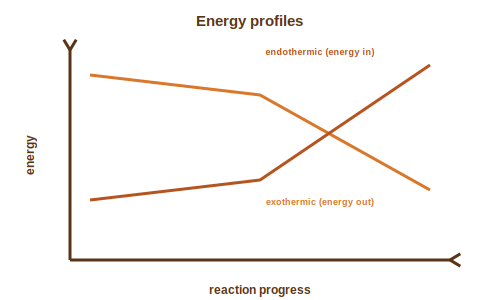
Most reactions occur at constant pressure, where the heat exchanged is the change in enthalpy, ΔH. A reaction with negative ΔH releases heat and is exothermic; one with positive ΔH absorbs heat and is endothermic. The enthalpy of a reaction is found from the difference between the enthalpies of the products and the reactants.
|
Diagram 2 – Energy Profiles
Fig 2. An exothermic reaction ends at lower energy, releasing heat; an endothermic reaction ends at higher energy, absorbing heat. |
5. Hess’s Law |
Hess’s law states that the total enthalpy change of a reaction is the same whether it happens in one step or several, because enthalpy is a state function that depends only on the start and end points. So the enthalpy of a reaction can be found by adding the enthalpies of any set of steps that lead from the reactants to the products.
6. Entropy and Spontaneity |
Entropy S measures the disorder of a system, and nature tends toward greater disorder. Whether a reaction is spontaneous depends on both energy and disorder, combined in the Gibbs energy: ΔG = ΔH minus TΔS. A reaction is spontaneous when ΔG is negative, at equilibrium when it is zero, and non-spontaneous when it is positive.
7. Key Reasoning (Principles) |
|
Principle 1: Energy is conserved (first law) The change in internal energy equals the heat added plus the work done on the system, ΔU = q + w; energy is only transferred, never created or destroyed. |
|
Principle 2: Enthalpy is a state function (Hess’s law) Because enthalpy depends only on the initial and final states, the total enthalpy change is the same by any route, so reaction enthalpies can be added. |
|
Principle 3: Gibbs energy decides spontaneity A reaction is spontaneous when ΔG = ΔH minus TΔS is negative, balancing the drive to lower energy against the drive to greater disorder. |
8. Worked Examples |
| Example 1 |
|
Q: A system absorbs 100 J of heat and has 40 J of work done on it. Find the change in internal energy. ▶ Show SolutionΔU = q + w = 100 + 40. = 140 J. Answer: 140 J. |
| Example 2 |
|
Q: A reaction has ΔH = minus 200 kJ. Is it exothermic or endothermic? ▶ Show SolutionA negative ΔH releases heat. So it is exothermic. Answer: Exothermic. |
| Example 3 |
|
Q: Find ΔH for a reaction where products have enthalpy 150 kJ and reactants 250 kJ. ▶ Show SolutionΔH = products minus reactants = 150 minus 250. = minus 100 kJ. Answer: minus 100 kJ. |
| Example 4 |
|
Q: A reaction has ΔH = +80 kJ. Is it exothermic or endothermic? ▶ Show SolutionA positive ΔH absorbs heat. So it is endothermic. Answer: Endothermic. |
| Example 5 |
|
Q: Using Hess’s law, find ΔH if step 1 is minus 100 kJ and step 2 is minus 50 kJ. ▶ Show SolutionAdd the steps: minus 100 + (minus 50). = minus 150 kJ. Answer: minus 150 kJ. |
| Example 6 |
|
Q: Find ΔG for ΔH = minus 100 kJ, T = 300 K, ΔS = 0.2 kJ/K. ▶ Show SolutionΔG = ΔH minus TΔS = minus 100 minus (300 × 0.2). = minus 160 kJ. Answer: minus 160 kJ. |
| Example 7 |
|
Q: A reaction has ΔG = minus 50 kJ. Is it spontaneous? ▶ Show SolutionA negative ΔG means the reaction is spontaneous. Answer: Yes, spontaneous. |
| Example 8 |
|
Q: A system gives out 60 J of heat and 20 J of work is done on it. Find ΔU. ▶ Show SolutionΔU = q + w = (minus 60) + 20. = minus 40 J. Answer: minus 40 J. |
| Example 9 |
|
Q: Find ΔG for ΔH = +40 kJ, T = 200 K, ΔS = 0.1 kJ/K. ▶ Show SolutionΔG = 40 minus (200 × 0.1) = 40 minus 20. = +20 kJ (non-spontaneous). Answer: +20 kJ. |
| Example 10 |
|
Q: Why can reaction enthalpies be added by Hess’s law? ▶ Show SolutionBecause enthalpy is a state function, depending only on the start and end states. Answer: Because enthalpy is a state function. |
9. Practice Sets A to D |
| Set A – Multiple Choice (Basic) |
|
1. The first law of thermodynamics is: (a) ΔU = q + w (b) ΔH = 0 (c) S = 0 (d) ΔG = 0 2. An exothermic reaction has ΔH that is: (a) positive (b) negative (c) zero (d) infinite 3. Hess’s law works because enthalpy is a: (a) path function (b) state function (c) force (d) rate 4. Entropy is a measure of: (a) energy (b) disorder (c) mass (d) pressure 5. A reaction is spontaneous when ΔG is: (a) positive (b) zero (c) negative (d) large ▶ Reveal Answers1. (a) ΔU = q + w. 2. (b) negative. 3. (b) state function. 4. (b) disorder. 5. (c) negative. |
| Set B – Short Answer (Understanding) |
|
1. Define a system and its surroundings. 2. State the first law of thermodynamics. 3. What is the difference between exothermic and endothermic? 4. State Hess’s law. 5. Write the Gibbs energy equation and the condition for spontaneity. ▶ Reveal Answers1. The system is the part under study; the surroundings is everything else. 2. The change in internal energy equals the heat added plus the work done, ΔU = q + w. 3. Exothermic releases heat (negative ΔH); endothermic absorbs heat (positive ΔH). 4. The total enthalpy change is the same by any route, since enthalpy is a state function. 5. ΔG = ΔH minus TΔS; spontaneous when ΔG is negative. |
| Set C – Application and Reasoning |
|
1. A system absorbs 80 J and has 30 J of work done on it. Find ΔU. 2. Find ΔH if products are 100 kJ and reactants 180 kJ. 3. Using Hess’s law, add steps of minus 40 and minus 70 kJ. 4. Find ΔG for ΔH = minus 50, T = 400 K, ΔS = 0.1 kJ/K. 5. Is a reaction with ΔG = +30 kJ spontaneous? ▶ Reveal Answers1. ΔU = 80 + 30 = 110 J. 2. ΔH = 100 minus 180 = minus 80 kJ. 3. minus 40 + (minus 70) = minus 110 kJ. 4. ΔG = minus 50 minus (400 × 0.1) = minus 90 kJ. 5. No, a positive ΔG is non-spontaneous. |
| Set D – Higher Order (Challenge) |
|
1. A reaction has ΔH = +60 kJ and ΔS = 0.3 kJ/K. Find the temperature at which it just becomes spontaneous. 2. Explain why energy is conserved even in an endothermic reaction. 3. Find ΔU if a system releases 120 J of heat and does 50 J of work on the surroundings. 4. Explain how a reaction can be endothermic yet still spontaneous. 5. Use Hess’s law to explain why a reaction enthalpy does not depend on the route. ▶ Reveal Answers1. Spontaneous when ΔG = 0: 60 = T × 0.3, so T = 200 K; above this it is spontaneous. 2. Because the absorbed heat is taken from the surroundings, so the total energy of system plus surroundings is unchanged. 3. Heat released means q = minus 120; work done by the system means w = minus 50; ΔU = minus 120 + (minus 50) = minus 170 J. 4. If ΔS is large and positive and T is high, TΔS can outweigh a positive ΔH, making ΔG negative. 5. Enthalpy is a state function, so its change depends only on the initial and final states, not on the steps in between. |
|
Chapter Summary
|
|||||||||||||||||||||||||||||||
| 8-Point Exam Quick-Check | ||||||||||||||||||||||||||||||||
|
||||||||||||||||||||||||||||||||
|
School Revise Virtual Lab Explore these ideas with interactive simulations and visual tools.
|
|
Class 11 Chemistry Chapter 5: Chemical Thermodynamics, Complete Notes and Practice This revision guide follows the current NCERT Class 11 Chemistry syllabus and develops chemical thermodynamics, covering system and surroundings, internal energy and the first law, enthalpy and reaction heat, exothermic and endothermic changes, Hess’s law, and entropy and the Gibbs energy that decides spontaneity, with two diagrams, ten worked examples and graded practice. Visit SchoolRevise.com to revise, practise and excel. |
 Google