Curriculum
Science Grade XI Chemistry
Science Grade XI Chemistry
0/9
-
Chapter 1: Some Basic Concepts of Chemistry
 Preview
 -
Chapter 2: Structure of Atom
Preview
-
Chapter 3: Classification of Elements and Periodicity in Properties
Preview
-
Chapter 4: Chemical Bonding and Molecular Structure
Preview
-
Chapter 5: Chemical Thermodynamics
Preview
-
Chapter 6: Equilibrium
Preview
-
Chapter 7: Redox Reactions
Preview
-
Chapter 8: Organic Chemistry: Some Basic Principles and Techniques
Preview
-
Chapter 9: Hydrocarbons
Preview
Work Sheets
0/9

Chapter 2: Structure of Atom
|
Grade 11 Science | Chapter 2 Structure of AtomWhat is an atom made of, and how are its electrons arranged? This chapter traces the atomic models, builds the shell and subshell picture, and writes electronic configurations.
|
|
Contents
|
1. Introduction: Inside the Atom |
The atom was once thought indivisible, but experiments revealed a tiny dense nucleus surrounded by electrons. This chapter follows how the picture developed, from the discovery of the electron to the modern arrangement of electrons in shells and subshells, and shows how to write the electronic configuration that underlies all chemical behaviour.
|
Core idea An atom has a central nucleus of protons and neutrons, with electrons arranged in shells and subshells. The configuration of these electrons determines how an element reacts.
|
2. Subatomic Particles |
An atom contains three subatomic particles: the positively charged proton and the neutral neutron, both in the nucleus, and the negatively charged electron outside it. The atomic number Z is the number of protons, and the mass number A is the number of protons plus neutrons. A neutral atom has equal numbers of protons and electrons.
| Particle | Charge | Location |
| Proton | positive | nucleus |
| Neutron | neutral | nucleus |
| Electron | negative | shells outside the nucleus |
3. Models of the Atom |
The model of the atom changed as evidence grew. Thomson pictured electrons embedded in a sphere of positive charge. Rutherford’s scattering experiment showed instead a tiny, dense, positive nucleus with electrons around it. Bohr then proposed that electrons move in fixed energy levels, explaining why atoms emit light of definite colours. Each model kept what worked and corrected what did not.
4. Bohr’s Shell Model |
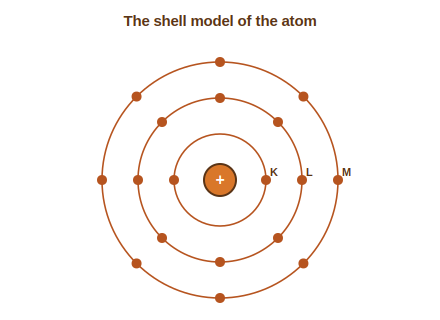
In Bohr’s model, electrons occupy fixed circular shells of definite energy, labelled K, L, M and so on. An electron does not radiate energy while in a shell, but absorbs or emits a definite amount when it jumps between shells. The maximum number of electrons a shell can hold is 2n², so the first holds 2, the second 8 and the third 18.
|
Diagram 1 – The Shell Model
Fig 1. Electrons occupy shells K, L and M around the nucleus, each holding up to 2n squared electrons. |
5. Quantum Numbers and Orbitals |
The modern picture refines the shells into subshells (s, p, d, f) made of orbitals, regions where an electron is most likely to be found. An s subshell holds 2 electrons, p holds 6, d holds 10 and f holds 14. Quantum numbers label the shell, subshell, orientation and spin of each electron, giving every electron a unique address.
6. Electronic Configuration |
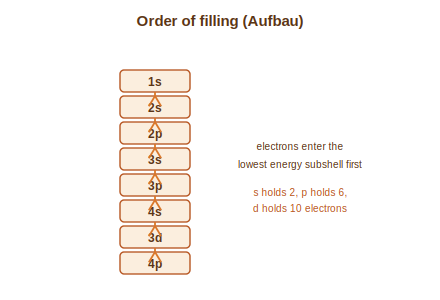
The electronic configuration lists how electrons fill the subshells. Three rules govern it: the Aufbau principle fills the lowest energy subshell first; Pauli’s exclusion principle allows at most two electrons per orbital, with opposite spins; and Hund’s rule fills each orbital of a subshell singly before pairing. So oxygen, with 8 electrons, is 1s² 2s² 2p⁴.
|
Diagram 2 – Order of Filling
Fig 2. Electrons enter the lowest energy subshell first, following the Aufbau order 1s, 2s, 2p, 3s and so on. |
7. Key Reasoning (Principles) |
|
Principle 1: Energy is quantised in shells Electrons occupy fixed energy levels and change energy only by definite jumps, which is why each element emits light of particular colours. |
|
Principle 2: A shell holds up to 2n squared electrons The capacity of each shell follows 2n², giving 2, 8 and 18 for the first three shells, which sets the pattern of the periodic table. |
|
Principle 3: Aufbau, Pauli and Hund fix the configuration Electrons fill the lowest subshell first, no more than two per orbital with opposite spins, and singly before pairing, giving a unique configuration for each atom. |
8. Worked Examples |
| Example 1 |
|
Q: How many electrons does a neutral atom of atomic number 11 have? ▶ Show SolutionA neutral atom has electrons equal to its atomic number. So 11 electrons. Answer: 11 electrons. |
| Example 2 |
|
Q: Find the number of neutrons in an atom with mass number 23 and atomic number 11. ▶ Show SolutionNeutrons = A minus Z = 23 minus 11. = 12 neutrons. Answer: 12 neutrons. |
| Example 3 |
|
Q: What is the maximum number of electrons in the third shell? ▶ Show SolutionMaximum = 2n² with n = 3 = 2 × 9. = 18 electrons. Answer: 18 electrons. |
| Example 4 |
|
Q: Write the electronic configuration of oxygen (Z = 8). ▶ Show SolutionFill 1s then 2s then 2p: 2, 2, 4. 1s² 2s² 2p⁴. Answer: 1s² 2s² 2p⁴. |
| Example 5 |
|
Q: How many electrons can a p subshell hold? ▶ Show SolutionA p subshell has three orbitals, each holding 2. So 6 electrons. Answer: 6 electrons. |
| Example 6 |
|
Q: What is the maximum number of electrons in the second shell? ▶ Show Solution2n² with n = 2 = 2 × 4. = 8 electrons. Answer: 8 electrons. |
| Example 7 |
|
Q: Write the electronic configuration of sodium (Z = 11). ▶ Show SolutionFill in order: 2, 2, 6, 1. 1s² 2s² 2p⁶ 3s¹. Answer: 1s² 2s² 2p⁶ 3s¹. |
| Example 8 |
|
Q: Two atoms have the same atomic number but different mass numbers. What are they called? ▶ Show SolutionSame protons, different neutrons. They are isotopes. Answer: Isotopes. |
| Example 9 |
|
Q: How many protons and electrons are in a neutral atom of Z = 17? ▶ Show SolutionProtons = Z = 17; electrons = 17 (neutral). Answer: 17 protons and 17 electrons. |
| Example 10 |
|
Q: State the rule that fills orbitals singly before pairing. ▶ Show SolutionHund’s rule fills each orbital of a subshell with one electron before any pairing. Answer: Hund’s rule. |
9. Practice Sets A to D |
| Set A – Multiple Choice (Basic) |
|
1. The particle with a positive charge is the: (a) electron (b) proton (c) neutron (d) photon 2. The atomic number equals the number of: (a) neutrons (b) protons (c) electrons plus neutrons (d) shells 3. The maximum electrons in a shell is: (a) 2n (b) n² (c) 2n² (d) 8 4. A p subshell holds at most: (a) 2 (b) 6 (c) 10 (d) 14 electrons 5. Atoms with the same protons but different neutrons are: (a) isobars (b) isotopes (c) ions (d) isomers ▶ Reveal Answers1. (b) proton. 2. (b) protons. 3. (c) 2n². 4. (b) 6. 5. (b) isotopes. |
| Set B – Short Answer (Understanding) |
|
1. Name the three subatomic particles and their charges. 2. Define atomic number and mass number. 3. State the maximum capacity of a shell. 4. State the Aufbau principle. 5. State Hund’s rule. ▶ Reveal Answers1. Proton (positive), neutron (neutral) and electron (negative). 2. Atomic number is the number of protons; mass number is protons plus neutrons. 3. A shell holds at most 2n² electrons. 4. Electrons fill the lowest energy subshell first. 5. Each orbital of a subshell is filled singly before any pairing. |
| Set C – Application and Reasoning |
|
1. Find the neutrons in an atom of mass number 35 and atomic number 17. 2. Write the configuration of carbon (Z = 6). 3. How many electrons fill the first two shells fully? 4. Find the electrons in a neutral atom of Z = 19. 5. Why do atoms emit light of definite colours? ▶ Reveal Answers1. 35 minus 17 = 18 neutrons. 2. 1s² 2s² 2p². 3. 2 + 8 = 10 electrons. 4. 19 electrons. 5. Because electrons jump between fixed energy levels, emitting definite amounts of energy as light. |
| Set D – Higher Order (Challenge) |
|
1. Write the configuration of calcium (Z = 20) and name its outer subshell. 2. Explain why the third shell can hold 18 electrons. 3. An ion has 10 electrons and 11 protons. Find its charge. 4. Using the rules, write the configuration of nitrogen (Z = 7) and state how many unpaired electrons it has. 5. Explain how Rutherford’s experiment changed the model of the atom. ▶ Reveal Answers1. 1s² 2s² 2p⁶ 3s² 3p⁶ 4s²; the outer subshell is 4s. 2. Because 2n² with n = 3 gives 2 × 9 = 18. 3. Charge = protons minus electrons = 11 minus 10 = plus 1. 4. 1s² 2s² 2p³; by Hund’s rule the three 2p electrons are unpaired, so 3 unpaired electrons. 5. The scattering of particles showed a tiny dense positive nucleus, replacing Thomson’s evenly spread positive charge. |
|
Chapter Summary
|
|||||||||||||||||||||||||||||||
| 8-Point Exam Quick-Check | ||||||||||||||||||||||||||||||||
|
||||||||||||||||||||||||||||||||
|
School Revise Virtual Lab Explore these ideas with interactive simulations and visual tools.
|
|
Class 11 Chemistry Chapter 2: Structure of Atom, Complete Notes and Practice This revision guide follows the current NCERT Class 11 Chemistry syllabus and develops atomic structure, covering the subatomic particles, atomic and mass number, the models of Thomson, Rutherford and Bohr, the shell and subshell picture, quantum numbers and orbitals, and electronic configuration by the Aufbau, Pauli and Hund rules, with two diagrams, ten worked examples and graded practice. Visit SchoolRevise.com to revise, practise and excel. |
 Google