Curriculum
Science Grade XI Chemistry
Science Grade XI Chemistry
0/9
-
Chapter 1: Some Basic Concepts of Chemistry
 Preview
 -
Chapter 2: Structure of Atom
Preview
-
Chapter 3: Classification of Elements and Periodicity in Properties
Preview
-
Chapter 4: Chemical Bonding and Molecular Structure
Preview
-
Chapter 5: Chemical Thermodynamics
Preview
-
Chapter 6: Equilibrium
Preview
-
Chapter 7: Redox Reactions
Preview
-
Chapter 8: Organic Chemistry: Some Basic Principles and Techniques
Preview
-
Chapter 9: Hydrocarbons
Preview
Work Sheets
0/9

Chapter 9: Hydrocarbons
|
Grade 11 Science | Chapter 9 HydrocarbonsHydrocarbons contain only carbon and hydrogen. This chapter classifies them as alkanes, alkenes, alkynes and aromatics, and contrasts their saturation, formulae and reactions.
|
|
Contents
|
1. Introduction: Carbon and Hydrogen Only |
A hydrocarbon is a compound of carbon and hydrogen only, and hydrocarbons are the basis of fuels and of much of organic chemistry. This chapter classifies them by the kind of carbon to carbon bonds they contain, gives their general formulae, and contrasts the characteristic reactions of saturated and unsaturated hydrocarbons.
|
Core idea Hydrocarbons are saturated (only single bonds, alkanes) or unsaturated (double or triple bonds, alkenes and alkynes). Saturated hydrocarbons react by substitution, unsaturated ones by addition.
|
2. Classifying Hydrocarbons |
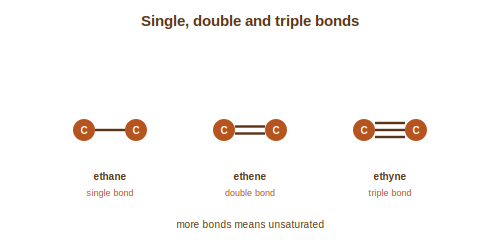
Hydrocarbons fall into families by their bonding. Alkanes have only single carbon to carbon bonds and are saturated. Alkenes have at least one double bond and alkynes at least one triple bond, both unsaturated. Aromatic hydrocarbons contain a special stable ring, such as benzene. The bond type sets the family’s chemistry.
|
Diagram 1 – Single, Double and Triple Bonds
Fig 1. Alkanes have single bonds (saturated); alkenes have a double bond and alkynes a triple bond (unsaturated). |
3. Alkanes |
Alkanes are saturated hydrocarbons with the general formula CnH2n+2, such as methane CH4 and ethane C2H6. Their single bonds make them relatively unreactive, though they burn readily as fuels. Because they have no double or triple bonds, they cannot add atoms across a bond.
4. Alkenes and Alkynes |
Alkenes contain a carbon to carbon double bond and have the general formula CnH2n, such as ethene C2H4. Alkynes contain a triple bond and have the formula CnH2n-2, such as ethyne C2H2. The extra bonds make them unsaturated and far more reactive than alkanes.
5. Reactions: Substitution and Addition |
The reactions of a hydrocarbon follow from its bonds. Saturated alkanes react by substitution, where one atom replaces another, since there is no double bond to react across. Unsaturated alkenes and alkynes react by addition, where atoms add across the multiple bond, turning it into a single bond. All hydrocarbons also undergo combustion, burning in oxygen to give carbon dioxide and water.
6. Aromatic Hydrocarbons |
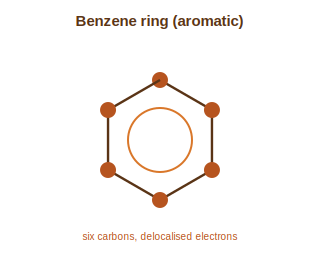
Aromatic hydrocarbons contain a benzene ring, six carbon atoms in a ring with electrons shared, or delocalised, around it. This delocalisation makes the ring unusually stable, so benzene tends to react by substitution rather than addition, despite appearing unsaturated. Aromatic compounds are widespread in dyes, medicines and plastics.
|
Diagram 2 – The Benzene Ring
Fig 2. Benzene is a ring of six carbons with delocalised electrons, which makes it unusually stable. |
7. Key Reasoning (Principles) |
|
Principle 1: Bond type sets saturation Only single bonds make a hydrocarbon saturated (alkane); a double or triple bond makes it unsaturated (alkene or alkyne), with a different general formula. |
|
Principle 2: Saturated substitutes, unsaturated adds Alkanes react by substitution because they have no multiple bond, while alkenes and alkynes react by addition across their multiple bond. |
|
Principle 3: Delocalisation stabilises aromatics In benzene the shared, delocalised electrons make the ring especially stable, so it reacts by substitution rather than addition. |
8. Worked Examples |
| Example 1 |
|
Q: Write the general formula of an alkene. ▶ Show SolutionAlkenes have one double bond and the formula CnH2n. Answer: CnH2n. |
| Example 2 |
|
Q: Write the general formula of an alkyne. ▶ Show SolutionAlkynes have one triple bond and the formula CnH2n-2. Answer: CnH2n-2. |
| Example 3 |
|
Q: Find the formula of the alkene with 3 carbons. ▶ Show SolutionCnH2n with n = 3 gives 6 hydrogens. C3H6. Answer: C3H6. |
| Example 4 |
|
Q: Find the formula of the alkyne with 2 carbons. ▶ Show SolutionCnH2n-2 with n = 2 gives 2 hydrogens. C2H2. Answer: C2H2. |
| Example 5 |
|
Q: Which family is saturated? ▶ Show SolutionOnly single bonds means saturated. The alkanes. Answer: Alkanes. |
| Example 6 |
|
Q: How do alkenes typically react? ▶ Show SolutionTheir double bond allows atoms to add across it. By addition. Answer: By addition. |
| Example 7 |
|
Q: How do alkanes typically react? ▶ Show SolutionWith no double bond, one atom replaces another. By substitution. Answer: By substitution. |
| Example 8 |
|
Q: Find the formula of the alkane with 4 carbons. ▶ Show SolutionCnH2n+2 with n = 4 gives 10 hydrogens. C4H10. Answer: C4H10. |
| Example 9 |
|
Q: What makes benzene unusually stable? ▶ Show SolutionIts delocalised, shared ring electrons. Answer: Delocalised electrons. |
| Example 10 |
|
Q: What do all hydrocarbons give on complete combustion? ▶ Show SolutionBurning in oxygen gives carbon dioxide and water. Answer: Carbon dioxide and water. |
9. Practice Sets A to D |
| Set A – Multiple Choice (Basic) |
|
1. A hydrocarbon contains only: (a) C and O (b) C and H (c) H and O (d) C and N 2. Alkanes have the general formula: (a) CnH2n (b) CnH(2n+2) (c) CnH(2n-2) (d) CnHn 3. A double bond is found in: (a) alkanes (b) alkenes (c) noble gases (d) salts 4. Alkanes react mainly by: (a) addition (b) substitution (c) neutralisation (d) precipitation 5. Benzene is an example of a hydrocarbon that is: (a) ionic (b) aromatic (c) saturated chain (d) metallic ▶ Reveal Answers1. (b) C and H. 2. (b) CnH(2n+2). 3. (b) alkenes. 4. (b) substitution. 5. (b) aromatic. |
| Set B – Short Answer (Understanding) |
|
1. Define a hydrocarbon. 2. State the difference between saturated and unsaturated hydrocarbons. 3. Write the general formulae of alkanes, alkenes and alkynes. 4. How do alkenes and alkynes react, and why? 5. Why is benzene unusually stable? ▶ Reveal Answers1. A compound of carbon and hydrogen only. 2. Saturated hydrocarbons have only single bonds; unsaturated ones have double or triple bonds. 3. Alkanes CnH2n+2, alkenes CnH2n, alkynes CnH2n-2. 4. By addition across their multiple bond, since the extra bond can open up. 5. Because its ring electrons are delocalised, which gives extra stability. |
| Set C – Application and Reasoning |
|
1. Find the alkene formula for 4 carbons. 2. Find the alkyne formula for 3 carbons. 3. Which is more reactive, ethane or ethene, and why? 4. Find the alkane formula for 5 carbons. 5. Why can an alkane not undergo addition? ▶ Reveal Answers1. C4H8. 2. C3H4. 3. Ethene, because its double bond lets atoms add across it. 4. C5H12. 5. Because it has no double or triple bond for atoms to add across. |
| Set D – Higher Order (Challenge) |
|
1. Balance the combustion of methane: CH4 plus O2 gives CO2 plus H2O. 2. Explain why an alkene decolourises bromine water but an alkane does not. 3. Find the molecular formula of the alkene with 6 carbons. 4. Explain why benzene reacts by substitution despite appearing unsaturated. 5. Compare the number of hydrogens in the 4-carbon alkane, alkene and alkyne. ▶ Reveal Answers1. CH4 + 2O2 gives CO2 + 2H2O. 2. The alkene adds bromine across its double bond, removing the colour; the alkane has no double bond to react. 3. CnH2n with n = 6 gives C6H12. 4. Its delocalised electrons make the ring so stable that substitution, which keeps the ring intact, is preferred over addition. 5. Alkane C4H10 (10 H), alkene C4H8 (8 H), alkyne C4H6 (6 H); each extra bond removes two hydrogens. |
|
Chapter Summary
|
|||||||||||||||||||||||||||||||
| 8-Point Exam Quick-Check | ||||||||||||||||||||||||||||||||
|
||||||||||||||||||||||||||||||||
|
School Revise Virtual Lab Explore these ideas with interactive simulations and visual tools.
|
|
Class 11 Chemistry Chapter 9: Hydrocarbons, Complete Notes and Practice This revision guide follows the current NCERT Class 11 Chemistry syllabus and develops hydrocarbons, covering their classification, saturated alkanes and unsaturated alkenes and alkynes with their general formulae, the substitution and addition reactions, combustion, and aromatic hydrocarbons such as benzene, with two diagrams, ten worked examples and graded practice. Visit SchoolRevise.com to revise, practise and excel. |
 Google