Curriculum
Science Grade XI Chemistry
Science Grade XI Chemistry
0/9
-
Chapter 1: Some Basic Concepts of Chemistry
 Preview
 -
Chapter 2: Structure of Atom
Preview
-
Chapter 3: Classification of Elements and Periodicity in Properties
Preview
-
Chapter 4: Chemical Bonding and Molecular Structure
Preview
-
Chapter 5: Chemical Thermodynamics
Preview
-
Chapter 6: Equilibrium
Preview
-
Chapter 7: Redox Reactions
Preview
-
Chapter 8: Organic Chemistry: Some Basic Principles and Techniques
Preview
-
Chapter 9: Hydrocarbons
Preview
Work Sheets
0/9

Chapter 3: Classification of Elements and Periodicity in Properties
|
Grade 11 Science | Chapter 3 Classification of Elements and Periodicity in PropertiesThe periodic table organises every element. This chapter explains the periodic law, the blocks, and the trends in size, ionisation enthalpy and electronegativity that follow from electron arrangement.
|
|
Contents
|
1. Introduction: Order Among Elements |
With over a hundred elements, chemistry needs an organising scheme. The periodic table arranges elements so that those with similar properties fall together. This chapter explains the law behind the table, how it is divided into periods, groups and blocks, and the regular trends in properties that arise from the arrangement of electrons.
|
Core idea Element properties are a periodic function of atomic number. Reading the table by period and group reveals clear trends in atomic size, ionisation enthalpy and electronegativity.
|
2. The Modern Periodic Law |
The modern periodic law states that the properties of elements are a periodic function of their atomic number. Mendeleev first arranged elements by atomic mass and even predicted undiscovered ones, but the modern table orders them by atomic number, which removed the irregularities of the earlier scheme.
3. Periods, Groups and Blocks |
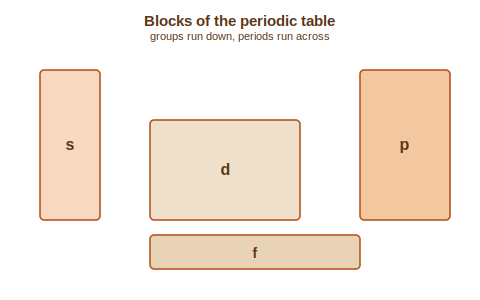
The table has horizontal periods and vertical groups. Elements in the same group have the same number of outer electrons and so behave similarly. The table is also divided into blocks, s, p, d and f, according to which subshell is being filled. This block structure follows directly from the order in which electrons occupy subshells.
|
Diagram 1 – Blocks of the Periodic Table
Fig 1. The table divides into s, p, d and f blocks according to the subshell being filled, with periods across and groups down. |
4. Atomic Radius |
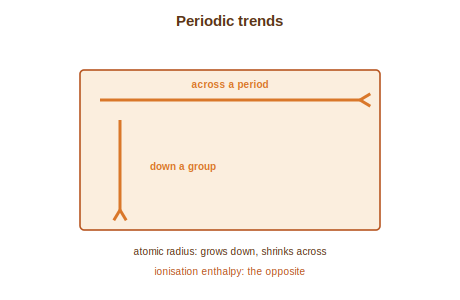
The atomic radius measures the size of an atom. Across a period it decreases, because the growing nuclear charge pulls the electrons in more tightly. Down a group it increases, because each element has an extra shell. So the largest atoms lie at the bottom left of the table and the smallest at the top right.
|
Diagram 2 – Periodic Trends
Fig 2. Atomic radius grows down a group and shrinks across a period; ionisation enthalpy follows the opposite pattern. |
5. Ionisation Enthalpy |
The ionisation enthalpy is the energy needed to remove an electron from a gaseous atom. It increases across a period, as electrons are held more tightly, and decreases down a group, as the outer electron is farther from the nucleus and easier to remove. It therefore follows the opposite trend to atomic radius.
6. Electronegativity and Other Trends |
Electronegativity measures an atom’s tendency to attract a shared pair of electrons in a bond. It increases across a period and decreases down a group, so fluorine, at the top right, is the most electronegative element. Metallic character shows the reverse trend, increasing down and to the left, while electron gain enthalpy generally becomes more negative across a period.
7. Key Reasoning (Principles) |
|
Principle 1: Properties repeat with atomic number Because outer electron arrangements repeat as atomic number rises, so do chemical properties; this is the periodic law that the table expresses. |
|
Principle 2: Trends follow nuclear pull and shells Across a period the rising nuclear charge pulls electrons in, shrinking the atom and raising ionisation enthalpy; down a group an extra shell does the opposite. |
|
Principle 3: Group decides chemistry Elements in the same group share the same number of outer electrons, so they react in similar ways, which is why the table groups them together. |
8. Worked Examples |
| Example 1 |
|
Q: On what quantity does the modern periodic law base the order of elements? ▶ Show SolutionThe modern law orders elements by atomic number. Answer: Atomic number. |
| Example 2 |
|
Q: How does atomic radius change across a period? ▶ Show SolutionThe growing nuclear charge pulls electrons in. So the radius decreases. Answer: It decreases. |
| Example 3 |
|
Q: How does atomic radius change down a group? ▶ Show SolutionEach element gains an extra shell. So the radius increases. Answer: It increases. |
| Example 4 |
|
Q: How does ionisation enthalpy change across a period? ▶ Show SolutionElectrons are held more tightly across a period. So ionisation enthalpy increases. Answer: It increases. |
| Example 5 |
|
Q: Which element is the most electronegative? ▶ Show SolutionElectronegativity rises across and up the table; the extreme is fluorine. Answer: Fluorine. |
| Example 6 |
|
Q: Elements of the same group are similar because they share the same number of what? ▶ Show SolutionThey share the same number of outer (valence) electrons. Answer: Outer electrons. |
| Example 7 |
|
Q: Which subshell is being filled in the p block? ▶ Show SolutionThe p block fills the p subshell. Answer: The p subshell. |
| Example 8 |
|
Q: Where in the table are the largest atoms found? ▶ Show SolutionRadius grows down and to the left. So the largest atoms are at the bottom left. Answer: At the bottom left. |
| Example 9 |
|
Q: How does metallic character change down a group? ▶ Show SolutionMetallic character increases down a group. Answer: It increases. |
| Example 10 |
|
Q: State how ionisation enthalpy relates to atomic radius across a period. ▶ Show SolutionThey follow opposite trends; as radius decreases, ionisation enthalpy increases. Answer: Opposite trends. |
9. Practice Sets A to D |
| Set A – Multiple Choice (Basic) |
|
1. The modern periodic law orders elements by: (a) mass (b) atomic number (c) density (d) colour 2. Across a period, atomic radius: (a) increases (b) decreases (c) stays same (d) doubles 3. Down a group, ionisation enthalpy: (a) increases (b) decreases (c) stays same (d) is zero 4. The most electronegative element is: (a) oxygen (b) chlorine (c) fluorine (d) sodium 5. Elements in the same group have the same number of: (a) shells (b) outer electrons (c) neutrons (d) protons ▶ Reveal Answers1. (b) atomic number. 2. (b) decreases. 3. (b) decreases. 4. (c) fluorine. 5. (b) outer electrons. |
| Set B – Short Answer (Understanding) |
|
1. State the modern periodic law. 2. Define ionisation enthalpy. 3. How does atomic radius vary down a group and why? 4. Define electronegativity. 5. Why do elements in a group behave similarly? ▶ Reveal Answers1. The properties of elements are a periodic function of their atomic number. 2. The energy needed to remove an electron from a gaseous atom. 3. It increases, because each element has an extra electron shell. 4. The tendency of an atom to attract a shared pair of electrons in a bond. 5. Because they have the same number of outer electrons. |
| Set C – Application and Reasoning |
|
1. Which is larger, an atom at the top or bottom of a group? 2. Which has the higher ionisation enthalpy, an element on the left or right of a period? 3. Name the block that fills the d subshell. 4. Why does atomic radius decrease across a period? 5. Compare the electronegativity of an element at the top right and bottom left. ▶ Reveal Answers1. The atom at the bottom, since radius increases down a group. 2. The element on the right, since ionisation enthalpy increases across a period. 3. The d block. 4. Because the rising nuclear charge pulls the electrons in more tightly. 5. The top right is far more electronegative than the bottom left. |
| Set D – Higher Order (Challenge) |
|
1. Explain why ionisation enthalpy and atomic radius show opposite trends across a period. 2. Predict whether a group 1 or group 17 element has higher electronegativity. 3. Explain why Mendeleev’s table left gaps for undiscovered elements. 4. An element is in period 3, group 1. Suggest its outer electron arrangement. 5. Explain why metallic character increases down a group. ▶ Reveal Answers1. A smaller radius means the outer electron is closer to the nucleus and harder to remove, so as radius falls, ionisation enthalpy rises. 2. The group 17 element, since electronegativity increases across a period toward the right. 3. Because he ordered by properties and left spaces where the pattern predicted an element not yet found. 4. It has one electron in the outer (third) shell, 3s¹. 5. Because the outer electron is farther from the nucleus and more easily lost, which is the mark of metallic behaviour. |
|
Chapter Summary
|
|||||||||||||||||||||||||||||||
| 8-Point Exam Quick-Check | ||||||||||||||||||||||||||||||||
|
||||||||||||||||||||||||||||||||
|
School Revise Virtual Lab Explore these ideas with interactive simulations and visual tools.
|
|
Class 11 Chemistry Chapter 3: Classification of Elements and Periodicity, Complete Notes and Practice This revision guide follows the current NCERT Class 11 Chemistry syllabus and develops the periodic table, covering the modern periodic law, periods, groups and the s, p, d and f blocks, and the periodic trends in atomic radius, ionisation enthalpy, electronegativity and metallic character, with two diagrams, ten worked examples and graded practice. Visit SchoolRevise.com to revise, practise and excel. |
 Google