Curriculum
Science Grade XI Chemistry
Science Grade XI Chemistry
0/9
-
Chapter 1: Some Basic Concepts of Chemistry
 Preview
 -
Chapter 2: Structure of Atom
Preview
-
Chapter 3: Classification of Elements and Periodicity in Properties
Preview
-
Chapter 4: Chemical Bonding and Molecular Structure
Preview
-
Chapter 5: Chemical Thermodynamics
Preview
-
Chapter 6: Equilibrium
Preview
-
Chapter 7: Redox Reactions
Preview
-
Chapter 8: Organic Chemistry: Some Basic Principles and Techniques
Preview
-
Chapter 9: Hydrocarbons
Preview
Work Sheets
0/9

Chapter 7: Redox Reactions
|
Grade 11 Science | Chapter 7 Redox ReactionsCountless reactions are transfers of electrons. This chapter defines oxidation and reduction, the rules for oxidation numbers, and how to identify and balance redox changes.
|
|
Contents
|
1. Introduction: Giving and Taking Electrons |
A huge range of reactions, from rusting to respiration, are redox reactions, in which electrons pass from one substance to another. This chapter defines oxidation and reduction in terms of electron transfer, introduces oxidation numbers to track that transfer, and shows how to identify the agents and balance the equation.
|
Core idea Oxidation is the loss of electrons and reduction is the gain (OIL RIG). The two always occur together, and oxidation numbers let us track the electrons transferred.
|
2. Oxidation and Reduction |
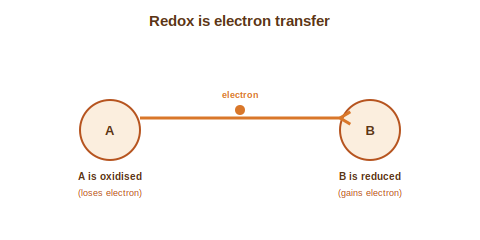
Oxidation is the loss of electrons and reduction is the gain of electrons, summarised by the phrase OIL RIG (oxidation is loss, reduction is gain). The two always happen together, since electrons lost by one substance are gained by another. A reaction in which both occur is a redox reaction.
|
Diagram 1 – Redox Is Electron Transfer
Fig 1. One substance loses electrons (oxidation) and another gains them (reduction); the two always occur together. |
3. Oxidation Numbers |
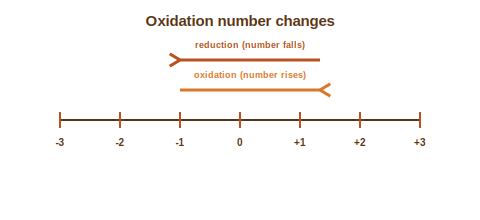
The oxidation number is a charge assigned to an atom as if its bonds were fully ionic; it tracks how many electrons an atom has gained or lost. When the oxidation number of an atom rises, it has been oxidised; when it falls, it has been reduced. Oxidation numbers turn a redox reaction into a simple bookkeeping of electrons.
|
Diagram 2 – Oxidation Number Changes
Fig 2. A rise in oxidation number is oxidation; a fall is reduction. |
4. Rules for Oxidation Numbers |
Simple rules assign oxidation numbers. The oxidation number of a free element is zero; of a simple ion, its charge; of hydrogen, usually +1; and of oxygen, usually minus 2. The sum of the oxidation numbers in a neutral compound is zero, and in an ion it equals the ion’s charge. These rules let any atom’s oxidation number be found.
| Atom | Usual Oxidation Number |
| Free element | 0 |
| Hydrogen (in compounds) | +1 |
| Oxygen (in compounds) | minus 2 |
| Simple ion | its charge |
5. Oxidising and Reducing Agents |
The substance that gains electrons is reduced and is called the oxidising agent, because it oxidises the other. The substance that loses electrons is oxidised and is the reducing agent. So the oxidising agent is itself reduced, and the reducing agent is itself oxidised, which often confuses learners until the electron view is kept in mind.
6. Balancing Redox Reactions |
A redox equation is balanced by ensuring that the electrons lost equal the electrons gained, as well as balancing atoms and charge. In the oxidation number method, the rise in oxidation number of the oxidised atom is matched against the fall of the reduced atom, and coefficients are chosen so the changes cancel. This guarantees that no electrons are created or lost.
7. Key Reasoning (Principles) |
|
Principle 1: Oxidation and reduction occur together Electrons lost by one substance are gained by another, so oxidation and reduction always happen at the same time in a redox reaction. |
|
Principle 2: Oxidation number tracks electrons A rise in oxidation number means electrons lost (oxidation); a fall means electrons gained (reduction), turning redox into electron bookkeeping. |
|
Principle 3: Electrons lost equal electrons gained Balancing a redox equation requires that the total electrons lost equal those gained, since electrons are conserved. |
8. Worked Examples |
| Example 1 |
|
Q: What is oxidation in terms of electrons? ▶ Show SolutionOxidation is the loss of electrons (the O and L of OIL RIG). Answer: Loss of electrons. |
| Example 2 |
|
Q: What is reduction in terms of electrons? ▶ Show SolutionReduction is the gain of electrons (the R and G of OIL RIG). Answer: Gain of electrons. |
| Example 3 |
|
Q: What is the oxidation number of a free element such as O2? ▶ Show SolutionA free element has oxidation number zero. Answer: Zero. |
| Example 4 |
|
Q: Find the oxidation number of sulphur in H2SO4. (H +1, O minus 2) ▶ Show Solution2(+1) + S + 4(minus 2) = 0, so 2 + S minus 8 = 0. S = +6. Answer: +6. |
| Example 5 |
|
Q: Find the oxidation number of manganese in KMnO4. (K +1, O minus 2) ▶ Show Solution+1 + Mn + 4(minus 2) = 0, so 1 + Mn minus 8 = 0. Mn = +7. Answer: +7. |
| Example 6 |
|
Q: If an atom’s oxidation number rises, has it been oxidised or reduced? ▶ Show SolutionA rise in oxidation number means electrons lost. So it has been oxidised. Answer: Oxidised. |
| Example 7 |
|
Q: The substance that gains electrons is the oxidising or reducing agent? ▶ Show SolutionGaining electrons means it is reduced, so it is the oxidising agent. Answer: The oxidising agent. |
| Example 8 |
|
Q: Find the oxidation number of carbon in CO2. (O minus 2) ▶ Show SolutionC + 2(minus 2) = 0, so C minus 4 = 0. C = +4. Answer: +4. |
| Example 9 |
|
Q: What must be equal when a redox equation is balanced? ▶ Show SolutionThe electrons lost must equal the electrons gained. Answer: Electrons lost equal electrons gained. |
| Example 10 |
|
Q: Find the oxidation number of nitrogen in NO3–. (O minus 2, ion charge minus 1) ▶ Show SolutionN + 3(minus 2) = minus 1, so N minus 6 = minus 1. N = +5. Answer: +5. |
9. Practice Sets A to D |
| Set A – Multiple Choice (Basic) |
|
1. Oxidation is the: (a) gain of electrons (b) loss of electrons (c) gain of protons (d) loss of neutrons 2. Reduction is the: (a) loss of electrons (b) gain of electrons (c) gain of protons (d) loss of mass 3. The oxidation number of a free element is: (a) +1 (b) minus 1 (c) 0 (d) +2 4. Oxygen usually has an oxidation number of: (a) +2 (b) minus 2 (c) +1 (d) 0 5. The oxidising agent is itself: (a) oxidised (b) reduced (c) unchanged (d) destroyed ▶ Reveal Answers1. (b) loss of electrons. 2. (b) gain of electrons. 3. (c) 0. 4. (b) minus 2. 5. (b) reduced. |
| Set B – Short Answer (Understanding) |
|
1. State the meaning of OIL RIG. 2. Define oxidation number. 3. Why do oxidation and reduction always occur together? 4. What is an oxidising agent? 5. What must be equal when balancing a redox reaction? ▶ Reveal Answers1. Oxidation Is Loss, Reduction Is Gain of electrons. 2. A charge assigned to an atom as if its bonds were fully ionic, tracking electrons gained or lost. 3. Because electrons lost by one substance are gained by another. 4. A substance that gains electrons and so oxidises another; it is itself reduced. 5. The number of electrons lost must equal the number gained. |
| Set C – Application and Reasoning |
|
1. Find the oxidation number of sulphur in SO2. (O minus 2) 2. Find the oxidation number of chlorine in NaCl. (Na +1) 3. If an atom’s oxidation number falls, has it been oxidised or reduced? 4. Find the oxidation number of nitrogen in NH3. (H +1) 5. Why is the reducing agent itself oxidised? ▶ Reveal Answers1. S + 2(minus 2) = 0, so S = +4. 2. Na is +1, so Cl is minus 1. 3. Reduced, since a fall means electrons gained. 4. N + 3(+1) = 0, so N = minus 3. 5. Because it loses electrons to the other substance, which is the definition of being oxidised. |
| Set D – Higher Order (Challenge) |
|
1. Find the oxidation number of chromium in Cr2O72-. (O minus 2, charge minus 2) 2. Identify the oxidising and reducing agents when zinc displaces copper from copper sulphate. 3. Explain why combustion is a redox reaction. 4. Find the oxidation number of phosphorus in PO43-. (O minus 2) 5. Explain why balancing electrons guarantees a balanced redox equation. ▶ Reveal Answers1. 2Cr + 7(minus 2) = minus 2, so 2Cr minus 14 = minus 2, 2Cr = 12, Cr = +6. 2. Zinc loses electrons (reducing agent, oxidised); copper ions gain electrons (oxidising agent, reduced). 3. Because the fuel loses electrons to oxygen, which gains them, so both oxidation and reduction occur. 4. P + 4(minus 2) = minus 3, so P minus 8 = minus 3, P = +5. 5. Because electrons are conserved, matching electrons lost to electrons gained ensures charge and atoms also balance. |
|
Chapter Summary
|
|||||||||||||||||||||||||||||||
| 8-Point Exam Quick-Check | ||||||||||||||||||||||||||||||||
|
||||||||||||||||||||||||||||||||
|
School Revise Virtual Lab Explore these ideas with interactive simulations and visual tools.
|
|
Class 11 Chemistry Chapter 7: Redox Reactions, Complete Notes and Practice This revision guide follows the current NCERT Class 11 Chemistry syllabus and develops redox chemistry, covering oxidation and reduction as electron transfer, oxidation numbers and the rules for assigning them, oxidising and reducing agents, and balancing redox equations by the oxidation number method, with two diagrams, ten worked examples and graded practice. Visit SchoolRevise.com to revise, practise and excel. |
 Google