Curriculum
Science Grade XI Chemistry
Science Grade XI Chemistry
0/9
-
Chapter 1: Some Basic Concepts of Chemistry
 Preview
 -
Chapter 2: Structure of Atom
Preview
-
Chapter 3: Classification of Elements and Periodicity in Properties
Preview
-
Chapter 4: Chemical Bonding and Molecular Structure
Preview
-
Chapter 5: Chemical Thermodynamics
Preview
-
Chapter 6: Equilibrium
Preview
-
Chapter 7: Redox Reactions
Preview
-
Chapter 8: Organic Chemistry: Some Basic Principles and Techniques
Preview
-
Chapter 9: Hydrocarbons
Preview
Work Sheets
0/9

Chapter 6: Equilibrium
|
Grade 11 Science | Chapter 6 EquilibriumMany reactions reach a balance rather than finishing. This chapter develops dynamic equilibrium, the equilibrium constant, Le Chatelier’s principle, and acids, bases and the pH scale.
|
|
Contents
|
1. Introduction: A Reversible Balance |
Many reactions are reversible: products can re-form reactants. In a closed container such a reaction reaches a balance called equilibrium, where the forward and reverse reactions continue at equal rates. This chapter explains that balance, how it is measured by the equilibrium constant, how it shifts, and how the same ideas describe acids and bases.
|
Core idea At dynamic equilibrium the forward and reverse rates are equal, so concentrations stay constant. The equilibrium constant measures the balance, and Le Chatelier’s principle predicts how it shifts.
|
2. Dynamic Equilibrium |
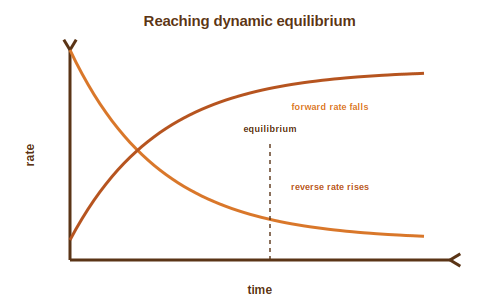
As a reversible reaction proceeds, the forward rate falls while the reverse rate rises, until the two become equal. At this point the reaction has reached dynamic equilibrium: the concentrations of reactants and products no longer change, yet both reactions are still occurring, in balance. Equilibrium can only be reached in a closed system.
|
Diagram 1 – Reaching Dynamic Equilibrium
Fig 1. The forward rate falls and the reverse rate rises until they become equal; from then on the concentrations stay constant. |
3. The Equilibrium Constant |
The law of mass action gives the equilibrium constant Kc, the ratio of the product concentrations to the reactant concentrations, each raised to the power of its coefficient. A large Kc means the products are favoured, a small one means the reactants are favoured. The constant depends only on temperature.
4. Le Chatelier’s Principle |
Le Chatelier’s principle states that if a system at equilibrium is disturbed, it shifts to oppose the change. Adding a reactant shifts the balance toward products; raising the pressure shifts it toward the side with fewer gas molecules; and changing the temperature shifts it in the direction that absorbs the added heat. This lets chemists control the yield of a reaction.
5. Acids and Bases |
An acid donates a hydrogen ion and a base accepts one, in the Bronsted definition. In water, acids increase the hydrogen ion concentration and bases decrease it. The product of the hydrogen and hydroxide ion concentrations, the constant Kw, is fixed at a given temperature, so the two are linked: as one rises, the other falls.
6. The pH Scale |
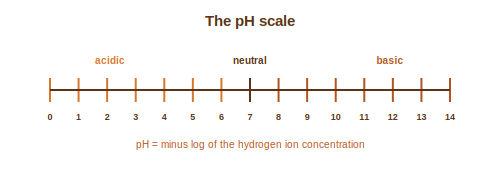
The pH measures acidity as the negative logarithm of the hydrogen ion concentration, pH = minus log[H+]. A pH below 7 is acidic, 7 is neutral and above 7 is basic. Because the scale is logarithmic, each unit represents a tenfold change in hydrogen ion concentration.
|
Diagram 2 – The pH Scale
Fig 2. The pH scale runs from acidic below 7, through neutral at 7, to basic above 7, with each unit a tenfold change. |
7. Key Reasoning (Principles) |
|
Principle 1: Equilibrium is a balance of equal rates At dynamic equilibrium the forward and reverse reactions continue at equal rates, so the concentrations stay constant while both reactions still occur. |
|
Principle 2: A disturbed equilibrium shifts to oppose it Le Chatelier’s principle says a change in concentration, pressure or temperature shifts the equilibrium in the direction that reduces the change. |
|
Principle 3: pH measures acidity logarithmically Since pH = minus log[H+], each pH unit is a tenfold change in hydrogen ion concentration, and pH plus pOH is constant in water. |
8. Worked Examples |
| Example 1 |
|
Q: Find the pH of a solution with [H+] = 1 × 10⁻³ mol/L. ▶ Show SolutionpH = minus log[H+] = minus log(10-3). = 3. Answer: 3. |
| Example 2 |
|
Q: Find the pH of a neutral solution with [H+] = 1 × 10⁻⁷. ▶ Show SolutionpH = minus log(10-7). = 7. Answer: 7. |
| Example 3 |
|
Q: Is a solution of pH 4 acidic or basic? ▶ Show SolutionA pH below 7 is acidic. So it is acidic. Answer: Acidic. |
| Example 4 |
|
Q: If pH = 9, find pOH (given pH + pOH = 14). ▶ Show SolutionpOH = 14 minus pH = 14 minus 9. = 5. Answer: 5. |
| Example 5 |
|
Q: Find the pH of [H+] = 1 × 10⁻⁵. ▶ Show SolutionpH = minus log(10-5). = 5. Answer: 5. |
| Example 6 |
|
Q: Adding more reactant to an equilibrium shifts it toward which side? ▶ Show SolutionBy Le Chatelier, the system opposes the change. It shifts toward the products. Answer: Toward the products. |
| Example 7 |
|
Q: A large value of Kc means which side is favoured? ▶ Show SolutionA large Kc means more products. The products are favoured. Answer: The products. |
| Example 8 |
|
Q: By how much does [H+] change for each pH unit? ▶ Show SolutionThe scale is logarithmic, so each unit is a factor of ten. Answer: Tenfold. |
| Example 9 |
|
Q: In the Bronsted sense, what does an acid do? ▶ Show SolutionAn acid donates a hydrogen ion. Answer: It donates a hydrogen ion. |
| Example 10 |
|
Q: On what does the equilibrium constant depend? ▶ Show SolutionThe equilibrium constant depends only on temperature. Answer: Only on temperature. |
9. Practice Sets A to D |
| Set A – Multiple Choice (Basic) |
|
1. At dynamic equilibrium the forward and reverse rates are: (a) zero (b) equal (c) increasing (d) opposite 2. The equilibrium constant depends only on: (a) pressure (b) volume (c) temperature (d) catalyst 3. Le Chatelier’s principle predicts the equilibrium will: (a) stop (b) oppose the change (c) reverse fully (d) vanish 4. A pH of 7 is: (a) acidic (b) neutral (c) basic (d) impossible 5. pH equals: (a) log[H+] (b) minus log[H+] (c) [H+] (d) 1/[H+] ▶ Reveal Answers1. (b) equal. 2. (c) temperature. 3. (b) oppose the change. 4. (b) neutral. 5. (b) minus log[H+]. |
| Set B – Short Answer (Understanding) |
|
1. Define dynamic equilibrium. 2. What does the equilibrium constant measure? 3. State Le Chatelier’s principle. 4. Define an acid and a base in the Bronsted sense. 5. Write the formula for pH. ▶ Reveal Answers1. A balance where forward and reverse reactions occur at equal rates, keeping concentrations constant. 2. The ratio of product to reactant concentrations at equilibrium, showing which side is favoured. 3. A system at equilibrium shifts to oppose any change imposed on it. 4. An acid donates a hydrogen ion; a base accepts one. 5. pH = minus log[H+]. |
| Set C – Application and Reasoning |
|
1. Find the pH of [H+] = 1 × 10⁻². 2. If pH = 11, find pOH. 3. Raising pressure shifts equilibrium toward which side for gases? 4. Is pH 6 acidic, neutral or basic? 5. Why does the equilibrium constant not change when a catalyst is added? ▶ Reveal Answers1. pH = 2. 2. pOH = 14 minus 11 = 3. 3. Toward the side with fewer gas molecules. 4. Acidic, since it is below 7. 5. A catalyst speeds both forward and reverse reactions equally, so the balance, and Kc, is unchanged. |
| Set D – Higher Order (Challenge) |
|
1. A solution has pH 3. Find its [H+]. 2. Explain why raising the temperature of an exothermic equilibrium lowers the yield. 3. Compare the [H+] of a pH 2 and a pH 5 solution. 4. Explain why equilibrium is described as dynamic, not static. 5. Adding a product to a system at equilibrium has what effect? ▶ Reveal Answers1. [H+] = 1 × 10⁻³ mol/L. 2. Added heat shifts the exothermic equilibrium backward (to absorb the heat), reducing the amount of product. 3. pH 2 has [H+] = 10-2 and pH 5 has 10-5, so pH 2 is a thousand times more concentrated. 4. Because both forward and reverse reactions continue at equal rates, even though the concentrations stay constant. 5. By Le Chatelier, it shifts the equilibrium back toward the reactants. |
|
Chapter Summary
|
|||||||||||||||||||||||||||||||
| 8-Point Exam Quick-Check | ||||||||||||||||||||||||||||||||
|
||||||||||||||||||||||||||||||||
|
School Revise Virtual Lab Explore these ideas with interactive simulations and visual tools.
|
|
Class 11 Chemistry Chapter 6: Equilibrium, Complete Notes and Practice This revision guide follows the current NCERT Class 11 Chemistry syllabus and develops chemical equilibrium, covering reversible reactions and dynamic equilibrium, the equilibrium constant and law of mass action, Le Chatelier’s principle, Bronsted acids and bases, and the pH scale, with two diagrams, ten worked examples and graded practice. Visit SchoolRevise.com to revise, practise and excel. |
 Google