Curriculum
GRADE VIII SCIENCE
Chapters
0/13
-
Investigative Science
 Preview
 -
Invisible Living World
Preview
-
Health
Preview
-
Electricity
Preview
-
Exploring Forces
Preview
-
Pressure Cyclones
Preview
-
Pariculate Matter
Preview
-
Elements-Compounds-Mixtures
Preview
-
Solutes-Solvents-Solutions
Preview
-
Light-Mirrors-Lenses
Preview
-
Keeping-Time-Skies
Preview
-
Nature Harmony
Preview
-
Our-Home-Earth
Preview
Curiosity Work Sheets
0/13

Investigative Science
School Revise · Grade 8 · Science · Chapter 1 · Curiosity
Exploring the Investigative World of Science
Science, Class 8, Curiosity. Science is a way of finding things out, not just a set of facts. This chapter shows how scientists investigate, by observing carefully, asking questions and testing ideas with fair experiments.
|
|
||
|
|
What this chapter is about
Every discovery begins with curiosity and careful investigation. In this chapter we follow how scientists observe, question, test and conclude, what makes a test fair, and why careful measurement and honest recording matter.
1. How scientists investigate
|
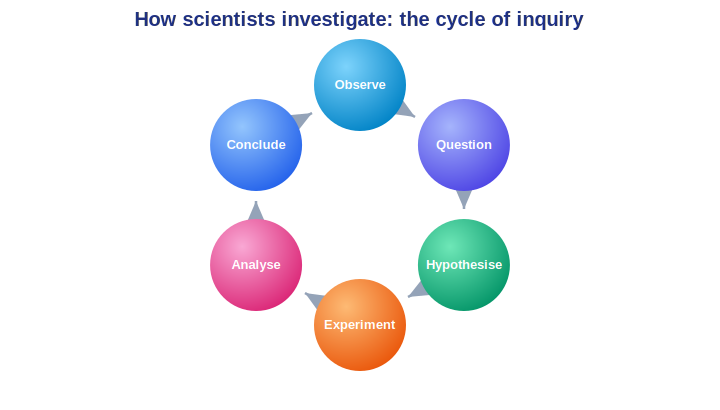
Scientific investigation science investigates by observing, asking a question, making a testable guess (a hypothesis), doing an experiment, studying the results, and drawing a conclusion The experiment checks the guess. The results are studied, and the conclusion says whether the guess held. If it did not, the investigation begins again with a better question. In real life: A doctor investigates the same way, observing symptoms, forming an idea of the illness, testing it and adjusting the treatment. |
|
Worked example 1 Question. A student notices plants near a window grow taller. What question and guess could start an investigation?
Answer: Question: does more light give taller plants? Hypothesis: brighter light makes plants taller. |
2. A fair test and measurement
|
A fair test in a fair test only one thing (the variable) is changed at a time, while everything else is kept the same This way any difference in the result must be due to the one thing you changed. Careful measurement with the right units, and honest recording, keep an investigation reliable. In real life: Comparing two torches is only fair if the bulbs and switches are the same, so only the battery being tested differs. |
|
Worked example 2 Question. Why change only the light in the plant investigation?
Answer: So the result can be linked to the one thing changed, which makes the test fair. |
|
Worked example 3 Question. A leaf reads 4.5 cm at one end of a ruler and 12.5 cm at the other. How long is it?
Answer: The leaf is 8.0 cm long. |
Explore with the interactive
Explore it: step through the investigation cycle, then run a fair test by changing just one variable and watching the result. The interactive opens right here in the lesson.
Practice set A, multiple choice
1. A testable guess is called a …
A hypothesis, which the experiment is designed to check.
2. In a fair test you change …
Only one variable at a time, keeping everything else the same.
3. The step after the experiment is to …
Study the results, then draw a conclusion.
4. Honest recording matters because …
Science depends on trustworthy evidence; changing results to fit a guess is not science.
Practice set B, short answer
1. Put in order: experiment, observe, conclude, question.
Observe, question, experiment, conclude.
2. Give one thing to keep the same when testing fertiliser on plants.
The water, light, soil or pot size, so only the fertiliser differs.
3. Why repeat an experiment?
Getting the same result again shows it was not chance, making the conclusion more reliable.
Quick summary
| Idea | The idea |
| Investigate | observe, question, test, conclude. |
| Hypothesis | a testable guess. |
| Experiment | tests the guess. |
| Fair test | change one variable only. |
| Measure | with correct units. |
| Record | honestly. |
| Open the Virtual Lab |
These free Grade 8 Science revision notes explain how scientists investigate the world through observation, questions and experiments, with clear step by step explanations and detailed labelled diagrams for every student following the new NCERT Curiosity book.
© 2026 School Revise. All rights reserved. This lesson is original content written by School Revise, aligned to the CBSE and NCERT Class 8 Science (Curiosity) syllabus. Unauthorised copying, reproduction or redistribution is not permitted. Curriculum names are used only to indicate alignment.
 Google