Curriculum
GRADE VIII SCIENCE
Chapters
0/13
-
Investigative Science
 Preview
 -
Invisible Living World
Preview
-
Health
Preview
-
Electricity
Preview
-
Exploring Forces
Preview
-
Pressure Cyclones
Preview
-
Pariculate Matter
Preview
-
Elements-Compounds-Mixtures
Preview
-
Solutes-Solvents-Solutions
Preview
-
Light-Mirrors-Lenses
Preview
-
Keeping-Time-Skies
Preview
-
Nature Harmony
Preview
-
Our-Home-Earth
Preview
Curiosity Work Sheets
0/13

Pariculate Matter
School Revise · Grade 8 · Science · Chapter 7 · Curiosity
Particulate Nature of Matter
Science, Class 8, Curiosity. Everything is built from particles far too small to see, held together by forces of attraction. This chapter shows how those forces set the arrangement of solids, liquids and gases.
|
|
||
|
|
What this chapter is about
Why can you pour water but not a stone, and squeeze a gas but not a solid? The answer is the force of attraction between particles. In this chapter we picture the particles of matter and how strongly they pull on each other.
1. Particles and the forces between them
|
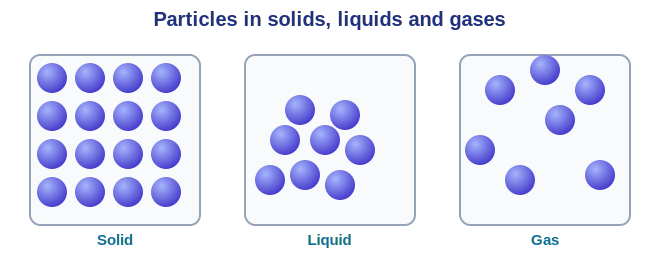
Interparticle forces of attraction all matter is made of tiny particles held together by forces of attraction between them; these forces are strongest in solids, weaker in liquids, and weakest in gases Because the attraction is strong in a solid, its particles are closely packed with little space and cannot move about, so a solid keeps a fixed shape and size. Weaker attraction in liquids and gases leaves more space and freedom. In real life: Ice, water and steam are the same substance; only the strength of attraction and the spacing of their particles differ. |
|
Worked example 1 Question. Why does a solid keep a fixed shape and size?
Answer: Because strong interparticle attraction holds its particles tightly in fixed places. |
2. The three states
|
Solids, liquids and gases a solid has a fixed shape and volume; a liquid has a fixed volume but no fixed shape; a gas has neither a fixed shape nor a fixed volume In a liquid the attraction is a little weaker, so particles can move within a space, giving a fixed volume but no fixed shape. In a gas the attraction is very weak, so particles move freely with large spaces, filling any container. In real life: A gas can be squeezed into a small cylinder because its particles have large spaces between them. |
|
Worked example 2 Question. Why can a gas be compressed but a solid cannot?
Answer: Because a gas has large interparticle spaces, while a solid’s particles are already tightly packed. |
|
Worked example 3 Question. Why does a liquid take the shape of its container but keep the same volume?
Answer: The particles can move to fit the shape but stay close, so the volume stays the same. |
Explore with the interactive
Explore it: change the state and watch the particles move from tightly packed to loosely spaced to free, as the attraction weakens. The interactive opens right here in the lesson.
Practice set A, multiple choice
1. The force that holds particles together is strongest in a …
Solid; it is weaker in liquids and weakest in gases.
2. A liquid has …
A fixed volume but no fixed shape.
3. A gas fills its container because its particles …
Have very weak attraction and large spaces, so they move freely and spread out.
4. A solid keeps its shape because its particles …
Are held tightly in fixed places by strong attraction.
Practice set B, short answer
1. Which state has the most space between particles?
A gas, because the attraction between its particles is weakest.
2. Why can a liquid flow but a solid cannot?
A liquid’s particles can move within a space, while a solid’s are held in fixed places.
3. Order the three states by strength of attraction, strongest first.
Solid, then liquid, then gas.
Quick summary
| Idea | The idea |
| Matter | tiny particles. |
| Held by | forces of attraction. |
| Strongest | in solids. |
| Solid | fixed shape and volume. |
| Liquid | fixed volume, no fixed shape. |
| Gas | neither fixed; large spaces. |
| Open the Virtual Lab |
These free Grade 8 Science revision notes explain how particles and interparticle forces give matter its three states, with clear step by step explanations and detailed labelled diagrams for every student following the new NCERT Curiosity book.
© 2026 School Revise. All rights reserved. This lesson is original content written by School Revise, aligned to the CBSE and NCERT Class 8 Science (Curiosity) syllabus. Unauthorised copying, reproduction or redistribution is not permitted. Curriculum names are used only to indicate alignment.
 Google