Curriculum
GRADE VIII SCIENCE
Chapters
0/13
-
Investigative Science
 Preview
 -
Invisible Living World
Preview
-
Health
Preview
-
Electricity
Preview
-
Exploring Forces
Preview
-
Pressure Cyclones
Preview
-
Pariculate Matter
Preview
-
Elements-Compounds-Mixtures
Preview
-
Solutes-Solvents-Solutions
Preview
-
Light-Mirrors-Lenses
Preview
-
Keeping-Time-Skies
Preview
-
Nature Harmony
Preview
-
Our-Home-Earth
Preview
Curiosity Work Sheets
0/13

Exploring Forces
School Revise · Grade 8 · Science · Chapter 5 · Curiosity
Exploring Forces
Science, Class 8, Curiosity. A force is a push or a pull, and it shapes the whole moving world. This chapter sorts forces into types, meets friction and gravity, and studies what forces do.
|
|
||
|
|
What this chapter is about
Every time something starts, stops, speeds up or changes shape, a force is at work. In this chapter we learn contact and non-contact forces, meet friction, gravity and weight, and see the effects a force produces.
1. Types of force
|
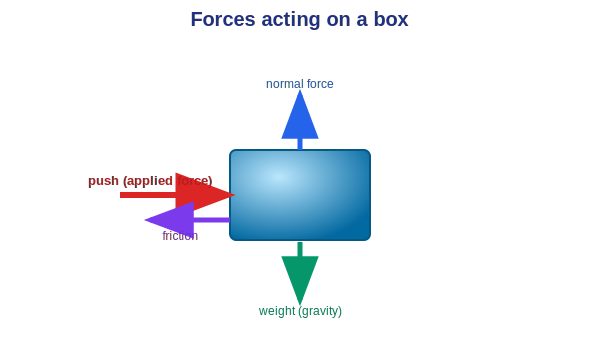
Force, contact and non-contact a force is a push or a pull from one object on another; its SI unit is the newton (N); contact forces act by touching (muscular, friction), non-contact forces act from a distance (magnetic, gravitational, electrostatic) Gravity is the Earth’s pull on an object, always attractive, and the pull that gives an object its weight, also measured in newtons. A magnet attracts iron without touching, and a charged body pulls another by electrostatic force. In real life: Kicking a ball is a contact force; the Earth pulling the ball back down is the non-contact force of gravity. |
|
Worked example 1 Question. A magnet attracts a pin without touching it. What type of force is this?
Answer: It is a non-contact force, the magnetic force. |
2. Friction and the effects of force
|
Effects of force and friction a force can change an object’s speed, its direction or its shape; friction is the force that opposes motion between surfaces in contact, acting opposite to the motion Friction lets us walk and lets brakes stop a car, but it also wears parts out and wastes energy as heat. Oil and smooth surfaces reduce unwanted friction. In real life: The grip of shoes on the ground is friction; without it we would slip, and a car could not start or stop. |
|
Worked example 2 Question. What happens to a moving ball when you kick it sideways?
Answer: The force of the kick changes the ball’s direction of motion. |
|
Worked example 3 Question. Give one useful and one harmful effect of friction.
Answer: Useful: brakes and grip. Harmful: it wears machine parts and wastes energy as heat. |
Explore with the interactive
Explore it: apply a force to a box and see it move, then add friction and watch it slow, seeing the effects of force. The interactive opens right here in the lesson.
Practice set A, multiple choice
1. The SI unit of force is the …
Newton (N).
2. Gravity is a …
Non-contact force, always attractive, pulling objects towards the Earth.
3. Friction always acts …
Opposite to the motion, opposing the sliding of surfaces.
4. The weight of an object is …
The force with which the Earth pulls it, measured in newtons (N).
Practice set B, short answer
1. Classify: pushing a trolley, Earth pulling an apple.
Pushing a trolley is a contact (muscular) force; Earth pulling an apple is a non-contact (gravitational) force.
2. Why do tyres have a rough tread?
To increase friction with the road, giving grip so the vehicle can move and stop safely.
3. Name three non-contact forces.
Magnetic force, gravitational force and electrostatic force.
Quick summary
| Idea | The idea |
| Force | a push or a pull. |
| Unit | the newton (N). |
| Contact | muscular, friction. |
| Non-contact | magnetic, gravity, electrostatic. |
| Weight | the Earth’s pull, in newtons. |
| Friction | opposes motion. |
| Open the Virtual Lab |
These free Grade 8 Science revision notes explain forces, their types, friction, gravity and the effects they produce, with clear step by step explanations and detailed labelled diagrams for every student following the new NCERT Curiosity book.
© 2026 School Revise. All rights reserved. This lesson is original content written by School Revise, aligned to the CBSE and NCERT Class 8 Science (Curiosity) syllabus. Unauthorised copying, reproduction or redistribution is not permitted. Curriculum names are used only to indicate alignment.
 Google