Curriculum
GRADE VIII SCIENCE
Chapters
0/13
-
Investigative Science
 Preview
 -
Invisible Living World
Preview
-
Health
Preview
-
Electricity
Preview
-
Exploring Forces
Preview
-
Pressure Cyclones
Preview
-
Pariculate Matter
Preview
-
Elements-Compounds-Mixtures
Preview
-
Solutes-Solvents-Solutions
Preview
-
Light-Mirrors-Lenses
Preview
-
Keeping-Time-Skies
Preview
-
Nature Harmony
Preview
-
Our-Home-Earth
Preview
Curiosity Work Sheets
0/13

Light-Mirrors-Lenses
School Revise · Grade 8 · Science · Chapter 10 · Curiosity
Light: Mirrors and Lenses
Science, Class 8, Curiosity. Light travels straight until a mirror or a lens changes its path. This chapter gives the laws of reflection, the images made by mirrors, and how lenses bend light to form images.
|
|
||
|
|
What this chapter is about
A mirror throws light back, a lens bends it through. In this chapter we learn the two laws of reflection, the images formed by concave and convex mirrors, and how convex and concave lenses form their images.
1. Reflection and mirrors
|
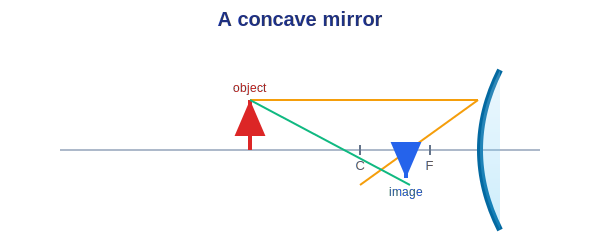
The laws of reflection first, the angle of incidence equals the angle of reflection; second, the incident ray, the normal and the reflected ray all lie in the same plane; these hold for all mirrors A concave mirror converges light and can form images that are enlarged, same size or diminished, and erect or inverted, depending on the object’s distance. A convex mirror diverges light and always gives an erect, diminished image. In real life: A concave mirror in a torch gathers light into a beam, while a convex mirror gives a driver a wide view behind. |
|
Worked example 1 Question. Light hits a mirror at 30° to the normal. At what angle does it reflect?
Answer: It reflects at 30° to the normal. |
2. Refraction and lenses
|
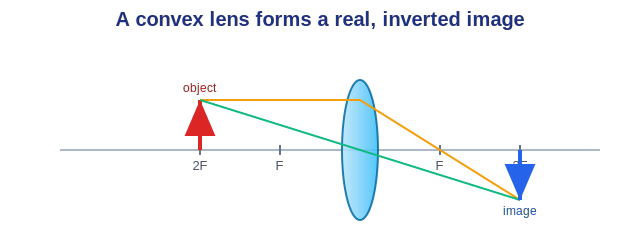
Lenses light bends, or refracts, when it passes into a new material; a convex lens converges rays and can form images that are enlarged, same size or diminished, erect or inverted; a concave lens diverges rays and always gives an erect, diminished image When an object is beyond the focus of a convex lens, the rays meet on the far side to form a real, inverted image, as the ray diagram shows. This is how a camera and the eye form their images. In real life: A magnifying glass is a convex lens; held close, it makes a larger, upright image of small print. |
|
Worked example 2 Question. An object is placed far in front of a convex lens. What kind of image forms?
Answer: A real, inverted image forms on the other side of the lens. |
|
Worked example 3 Question. What kind of image does a convex mirror always form?
Answer: A convex mirror always forms an erect, diminished image, giving a wide view. |
Explore with the interactive
Explore it: move the object along the axis of a lens or mirror and watch the image change size, position and direction. The interactive opens right here in the lesson.
Practice set A, multiple choice
1. The first law of reflection says the angle of incidence …
Equals the angle of reflection.
2. A convex mirror always forms an image that is …
Erect and diminished, giving a wide field of view.
3. A convex lens …
Converges light rays to a focus.
4. A concave lens always forms an image that is …
Erect and diminished.
Practice set B, short answer
1. State the two laws of reflection.
The angle of incidence equals the angle of reflection; and the incident ray, normal and reflected ray lie in one plane.
2. Light strikes a mirror at 40° to the normal. Find the angle of reflection.
40°, because the angle of reflection equals the angle of incidence.
3. Which mirror converges light and which diverges it?
A concave mirror converges light; a convex mirror diverges it.
Quick summary
| Idea | The idea |
| Reflection | light bounces off a mirror. |
| Law 1 | angle in = angle out. |
| Concave mirror | converges; images vary. |
| Convex mirror | diverges; erect, diminished. |
| Convex lens | converges; images vary. |
| Concave lens | diverges; erect, diminished. |
| Open the Virtual Lab |
These free Grade 8 Science revision notes explain how mirrors reflect and lenses bend light to form images, with clear step by step explanations and detailed labelled diagrams for every student following the new NCERT Curiosity book.
© 2026 School Revise. All rights reserved. This lesson is original content written by School Revise, aligned to the CBSE and NCERT Class 8 Science (Curiosity) syllabus. Unauthorised copying, reproduction or redistribution is not permitted. Curriculum names are used only to indicate alignment.
 Google