Curriculum
GRADE VIII SCIENCE
Chapters
0/13
-
Investigative Science
 Preview
 -
Invisible Living World
Preview
-
Health
Preview
-
Electricity
Preview
-
Exploring Forces
Preview
-
Pressure Cyclones
Preview
-
Pariculate Matter
Preview
-
Elements-Compounds-Mixtures
Preview
-
Solutes-Solvents-Solutions
Preview
-
Light-Mirrors-Lenses
Preview
-
Keeping-Time-Skies
Preview
-
Nature Harmony
Preview
-
Our-Home-Earth
Preview
Curiosity Work Sheets
0/13

Electricity
School Revise · Grade 8 · Science · Chapter 4 · Curiosity
Electricity: Magnetic and Heating Effects
Science, Class 8, Curiosity. An electric current does more than light a bulb. This chapter shows how current heats a wire and turns iron into a magnet, and how a cell makes current in the first place.
|
|
||
|
|
What this chapter is about
When current flows it can make heat and it can make magnetism. In this chapter we meet the heating effect that runs heaters and bulbs, the magnetic effect that gives the electromagnet, and how a cell or battery produces the current.
1. The heating effect
|
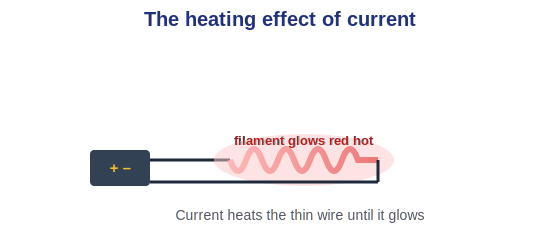
The heating effect when current flows through a conductor it heats up; a thin, high resistance wire heats most and can glow The narrower and more resistant the wire, the more it heats for the same current. A cell or battery produces the current through chemical reactions inside it, and a rechargeable battery can be recharged and reused many times. In real life: An electric iron, heater, toaster and kettle all use the heating effect of current to do their work. |
|
Worked example 1 Question. Why does a bulb filament glow but the connecting wires do not?
Answer: Because the thin, high resistance filament heats far more than the thick connecting wires. |
2. The magnetic effect and the electromagnet
|
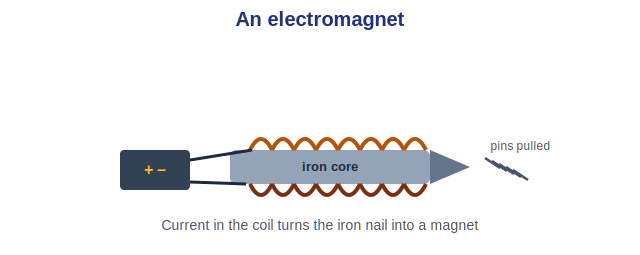
The magnetic effect a current in a wire makes a magnetic field around it; a coil wound on an iron core becomes an electromagnet, whose strength grows with more turns and more current Unlike a permanent magnet, an electromagnet can be switched on and off, and made stronger or weaker. Its magnetism disappears when the current stops. In real life: Huge electromagnets in scrapyards lift and drop heavy iron just by switching the current on and off. |
|
Worked example 2 Question. How can you make an electromagnet stronger?
Answer: Use more turns of wire and a larger current. |
|
Worked example 3 Question. How does a cell produce electric current?
Answer: A chemical reaction inside the cell drives the current through the circuit. |
Explore with the interactive
Explore it: add coil turns and raise the current, and watch the electromagnet grow stronger and lift more pins. The interactive opens right here in the lesson.
Practice set A, multiple choice
1. The heating effect is strongest in a wire that is …
Thin and of high resistance, which is why filaments and heater elements are made that way.
2. An electromagnet is made by winding a coil around …
An iron core, such as an iron nail.
3. A cell produces current by …
A chemical reaction taking place inside it.
4. More turns in the coil make the electromagnet …
Stronger.
Practice set B, short answer
1. Give two appliances that use the heating effect.
Any two of: electric heater, iron, toaster, kettle, geyser, bulb.
2. Give one advantage of an electromagnet over a permanent magnet.
It can be switched on and off, and its strength can be changed.
3. What is special about a rechargeable battery?
It can be recharged and reused many times, instead of being thrown away after one use.
Quick summary
| Idea | The idea |
| Heating effect | current heats a wire. |
| Thin wire | heats most, can glow. |
| Magnetic effect | current makes a magnetic field. |
| Electromagnet | coil on iron core. |
| Stronger | more turns, more current. |
| Cell | chemical reaction makes current. |
| Open the Virtual Lab |
These free Grade 8 Science revision notes explain the heating and magnetic effects of current and the electromagnet, with clear step by step explanations and detailed labelled diagrams for every student following the new NCERT Curiosity book.
© 2026 School Revise. All rights reserved. This lesson is original content written by School Revise, aligned to the CBSE and NCERT Class 8 Science (Curiosity) syllabus. Unauthorised copying, reproduction or redistribution is not permitted. Curriculum names are used only to indicate alignment.
 Google