Curriculum
GRADE VIII SCIENCE
Chapters
0/13
-
Investigative Science
 Preview
 -
Invisible Living World
Preview
-
Health
Preview
-
Electricity
Preview
-
Exploring Forces
Preview
-
Pressure Cyclones
Preview
-
Pariculate Matter
Preview
-
Elements-Compounds-Mixtures
Preview
-
Solutes-Solvents-Solutions
Preview
-
Light-Mirrors-Lenses
Preview
-
Keeping-Time-Skies
Preview
-
Nature Harmony
Preview
-
Our-Home-Earth
Preview
Curiosity Work Sheets
0/13

Solutes-Solvents-Solutions
School Revise · Grade 8 · Science · Chapter 9 · Curiosity
The Amazing World of Solutes, Solvents and Solutions
Science, Class 8, Curiosity. When sugar vanishes into tea, where does it go? This chapter explains solutions, solubility and saturation, and the ideas of mass, volume and density.
|
|
||
|
|
What this chapter is about
Stir sugar into water and it seems to disappear, yet the water tastes sweet. In this chapter we learn what a solution is, how much will dissolve, and how mass and volume give us density.
1. Solutions and solubility
|
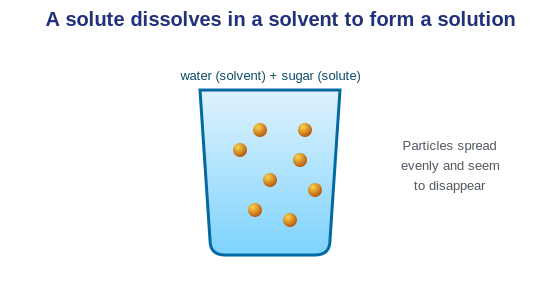
Solution, solubility and saturation a solution is a uniform mixture; the dissolving substance is the solute and the one it dissolves in is the solvent; a saturated solution can hold no more solute, an unsaturated one can hold more Solubility is the maximum solute that dissolves in a fixed amount (100 mL) at a given temperature. For solids, solubility usually increases with temperature, but for gases it decreases as the liquid warms. In real life: More sugar dissolves in hot tea than in cold water, while a warm fizzy drink loses its gas faster because gas solubility falls. |
|
Worked example 1 Question. In salt water, name the solute and the solvent.
Answer: Salt is the solute and water is the solvent. |
2. Mass, volume and density
|
Density mass is the amount of matter in an object, volume is the space it takes up, and density is the mass in each unit of volume: density = mass ÷ volume Mass is measured with a weighing balance and volume with a measuring cylinder. Density usually decreases as a substance is warmed, because it expands. Density decides whether something floats or sinks. In real life: A small stone sinks while a large log floats, because the log’s density is less than water’s, not because of size. |
|
Worked example 2 Question. A block has mass 200 g and volume 100 cm³. Find its density.
Answer: The density is 2 g/cm³. |
|
Worked example 3 Question. Why does more sugar dissolve in hot water than in cold?
Answer: Because the solubility of a solid usually rises with temperature, so hot water holds more sugar. |
Explore with the interactive
Explore it: add solute and raise the temperature to see how much dissolves, then compare the density of different blocks. The interactive opens right here in the lesson.
Practice set A, multiple choice
1. The substance that dissolves is the …
Solute.
2. A solution that can dissolve no more solute is …
Saturated.
3. As temperature rises, the solubility of a gas in a liquid …
Decreases.
4. Density is …
Mass divided by volume.
Practice set B, short answer
1. Define solubility.
The maximum amount of solute that dissolves in a fixed quantity (100 mL) of solvent at a given temperature.
2. A body has mass 300 g and volume 150 cm³. Find its density.
| 1 | density = mass ÷ volume = 300 ÷ 150. = 2. |
| 2 | So. 2 g/cm³. |
3. Which devices measure mass and volume?
A weighing balance measures mass; a measuring cylinder measures volume.
Quick summary
| Idea | The idea |
| Solution | a uniform mixture. |
| Solute | dissolves in the solvent. |
| Saturated | no more dissolves. |
| Solubility | max per 100 mL at a temperature. |
| Density | mass ÷ volume. |
| Warming | usually lowers density. |
| Open the Virtual Lab |
These free Grade 8 Science revision notes explain solutions, solute, solvent, solubility, saturation and the idea of density, with clear step by step explanations and detailed labelled diagrams for every student following the new NCERT Curiosity book.
© 2026 School Revise. All rights reserved. This lesson is original content written by School Revise, aligned to the CBSE and NCERT Class 8 Science (Curiosity) syllabus. Unauthorised copying, reproduction or redistribution is not permitted. Curriculum names are used only to indicate alignment.
 Google