Curriculum
GRADE VIII SCIENCE
Chapters
0/13
-
Investigative Science
 Preview
 -
Invisible Living World
Preview
-
Health
Preview
-
Electricity
Preview
-
Exploring Forces
Preview
-
Pressure Cyclones
Preview
-
Pariculate Matter
Preview
-
Elements-Compounds-Mixtures
Preview
-
Solutes-Solvents-Solutions
Preview
-
Light-Mirrors-Lenses
Preview
-
Keeping-Time-Skies
Preview
-
Nature Harmony
Preview
-
Our-Home-Earth
Preview
Curiosity Work Sheets
0/13

Nature Harmony
School Revise · Grade 8 · Science · Chapter 12 · Curiosity
How Nature Works in Harmony
Science, Class 8, Curiosity. Living and non-living things depend on one another in a delicate balance. This chapter explores habitats and ecosystems, food chains and webs, and the ways organisms live together.
|
|
||
|
|
What this chapter is about
A forest is a web of life where every organism has a place. In this chapter we learn what a habitat and an ecosystem are, follow food chains and webs, and meet the relationships through which organisms live together.
1. Habitats and ecosystems
|
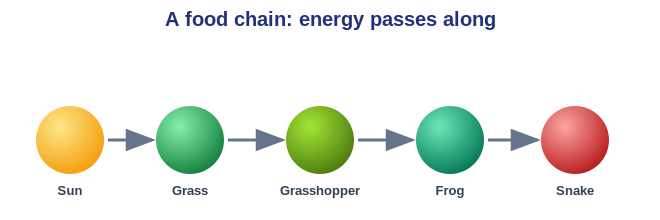
Habitat and ecosystem a habitat gives an organism the right conditions to live; an ecosystem is the interaction of biotic components (plants, animals, microbes) with abiotic components (air, water, soil, temperature) Ecosystems may be terrestrial, like forests and grasslands, or aquatic, like ponds and seas. Within them, producers (plants) make food, consumers (animals) eat others, and decomposers (bacteria, fungi) break down dead matter. In real life: A pond is an ecosystem where fish, plants, insects and microbes interact with the water, mud and sunlight around them. |
|
Worked example 1 Question. In grass to grasshopper to frog to snake, name the producer and a consumer.
Answer: Grass is the producer; the grasshopper, frog and snake are consumers. |
2. Food webs, trophic levels and living together
|
Food webs, trophic levels and symbiosis food chains show who eats whom, and food webs link many chains; the levels organisms occupy are trophic levels, and energy falls at each higher level; organisms may live in relationships such as mutualism, commensalism or parasitism In mutualism both partners benefit, in commensalism one benefits while the other is unaffected, and in parasitism one benefits while the other is harmed. Healthy ecosystems give us clean air, water, food and medicine. In real life: A bee and a flower share mutualism: the bee gets nectar and the flower gets pollinated, so both gain. |
|
Worked example 2 Question. A bee feeds on nectar and pollinates the flower. What relationship is this?
Answer: It is mutualism, because both the bee and the flower benefit. |
|
Worked example 3 Question. What happens to energy as it passes up the trophic levels?
Answer: Energy decreases at each higher trophic level, so top predators are few. |
Explore with the interactive
Explore it: build a food chain from producer to top predator and watch the energy shrink at each level. The interactive opens right here in the lesson.
Practice set A, multiple choice
1. The living parts of an ecosystem are its …
Biotic components, such as plants, animals and microbes.
2. Plants in an ecosystem are …
Producers, making their own food from sunlight.
3. A relationship where both partners benefit is …
Mutualism.
4. Energy as it moves up trophic levels …
Decreases, so there are fewer animals at each higher level.
Practice set B, short answer
1. Name the abiotic components of an ecosystem.
Non-living parts such as air, water, soil and temperature.
2. Define parasitism.
A relationship in which one organism benefits while the other is harmed.
3. Name two things a healthy ecosystem provides for people.
Any two of: clean air, clean water, food and medicine.
Quick summary
| Idea | The idea |
| Habitat | right conditions to live. |
| Ecosystem | biotic meets abiotic. |
| Producer | plant, makes food. |
| Trophic level | a feeding level. |
| Energy | falls up the levels. |
| Symbiosis | mutualism, commensalism, parasitism. |
| Open the Virtual Lab |
These free Grade 8 Science revision notes explain habitats and ecosystems, food chains and webs, and living relationships, with clear step by step explanations and detailed labelled diagrams for every student following the new NCERT Curiosity book.
© 2026 School Revise. All rights reserved. This lesson is original content written by School Revise, aligned to the CBSE and NCERT Class 8 Science (Curiosity) syllabus. Unauthorised copying, reproduction or redistribution is not permitted. Curriculum names are used only to indicate alignment.
 Google