Curriculum
GRADE VIII SCIENCE
Chapters
0/13
-
Investigative Science
 Preview
 -
Invisible Living World
Preview
-
Health
Preview
-
Electricity
Preview
-
Exploring Forces
Preview
-
Pressure Cyclones
Preview
-
Pariculate Matter
Preview
-
Elements-Compounds-Mixtures
Preview
-
Solutes-Solvents-Solutions
Preview
-
Light-Mirrors-Lenses
Preview
-
Keeping-Time-Skies
Preview
-
Nature Harmony
Preview
-
Our-Home-Earth
Preview
Curiosity Work Sheets
0/13

Keeping-Time-Skies
School Revise · Grade 8 · Science · Chapter 11 · Curiosity
Keeping Time with the Skies
Science, Class 8, Curiosity. Long before clocks, people read time from the sky. This chapter explains the changing phases of the Moon, how calendars grew from sky cycles, and the satellites we send up today.
|
|
||
|
|
What this chapter is about
The Moon changes shape night by night, and the seasons turn year by year. In this chapter we learn why the Moon shows phases, how lunar, solar and luni-solar calendars grew from these cycles, and what artificial satellites do.
1. Phases of the Moon
|
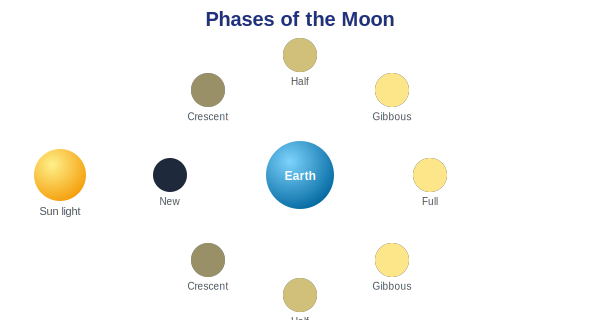
Phases of the Moon the Moon shines by reflecting sunlight; as it moves around the Earth we see different parts of its lit half, giving phases from new Moon through crescent to full Moon, over about a month At new Moon the lit side faces away, so we see darkness. At full Moon the lit side faces us fully. In between we see crescent, half and gibbous shapes. One full cycle takes roughly a month. In real life: Many Indian festivals are fixed by the Moon, such as the new Moon and full Moon days. |
|
Worked example 1 Question. Why does the Moon appear to change shape?
Answer: Because as the Moon orbits the Earth, we see different amounts of its sunlit half. |
2. Calendars and satellites
|
Calendars and satellites calendars grew from sky cycles: a lunar calendar follows the Moon’s cycle, a solar calendar follows the seasons as the Earth orbits the Sun, and a luni-solar calendar adapts to both; artificial satellites are human-made craft launched from the Earth In a lunar calendar the seasons drift, so many cultures use luni-solar calendars. Artificial satellites give us weather pictures, communication, navigation and information for space science and our daily well-being. In real life: Indian weather and communication satellites help forecast storms and connect distant villages, keeping people safe and in touch. |
|
Worked example 2 Question. How does a lunar calendar differ from a solar calendar?
Answer: A lunar calendar follows the Moon’s phases; a solar calendar follows the seasons from the Earth’s orbit. |
|
Worked example 3 Question. Give two uses of artificial satellites.
Answer: They are used for weather forecasting, communication, navigation and space science, among others. |
Explore with the interactive
Explore it: move the Moon around the Earth to see its phase change, then compare a lunar and a solar calendar. The interactive opens right here in the lesson.
Practice set A, multiple choice
1. The Moon shines because it …
Reflects sunlight; it does not make its own light.
2. One full cycle of the Moon’s phases takes about …
A month.
3. A calendar that follows the Moon’s cycle is a …
Lunar calendar.
4. Artificial satellites are …
Human-made craft launched from the Earth, used for weather, communication, navigation and space science.
Practice set B, short answer
1. Why do we see phases of the Moon?
Because as the Moon orbits the Earth, we see different amounts of its sunlit half.
2. What does a luni-solar calendar follow?
Both the Moon’s cycle and the cycle of seasons, adapting to each.
3. Name one thing a weather satellite helps us do.
Forecast storms and cyclones in advance, so people can reach safety.
Quick summary
| Idea | The idea |
| Moon | reflects sunlight. |
| Phases | new to full, about a month. |
| Lunar calendar | follows the Moon. |
| Solar calendar | follows the seasons. |
| Luni-solar | follows both. |
| Satellites | weather, communication, navigation. |
| Open the Virtual Lab |
These free Grade 8 Science revision notes explain the Moon’s phases, how calendars are made, and artificial satellites, with clear step by step explanations and detailed labelled diagrams for every student following the new NCERT Curiosity book.
© 2026 School Revise. All rights reserved. This lesson is original content written by School Revise, aligned to the CBSE and NCERT Class 8 Science (Curiosity) syllabus. Unauthorised copying, reproduction or redistribution is not permitted. Curriculum names are used only to indicate alignment.
 Google