Curriculum
GRADE VIII SCIENCE
Chapters
0/13
-
Investigative Science
 Preview
 -
Invisible Living World
Preview
-
Health
Preview
-
Electricity
Preview
-
Exploring Forces
Preview
-
Pressure Cyclones
Preview
-
Pariculate Matter
Preview
-
Elements-Compounds-Mixtures
Preview
-
Solutes-Solvents-Solutions
Preview
-
Light-Mirrors-Lenses
Preview
-
Keeping-Time-Skies
Preview
-
Nature Harmony
Preview
-
Our-Home-Earth
Preview
Curiosity Work Sheets
0/13

Elements-Compounds-Mixtures
School Revise · Grade 8 · Science · Chapter 8 · Curiosity
Nature of Matter: Elements, Compounds and Mixtures
Science, Class 8, Curiosity. All the materials around us are either pure substances or mixtures. This chapter sorts matter into mixtures, elements and compounds, and looks at the minerals of the Earth.
|
|
||
|
|
What this chapter is about
Is air a single substance? Is water? In this chapter we learn the difference between a mixture and a pure substance, and between an element and a compound, and see how minerals fit into this picture.
1. Mixtures and pure substances
|
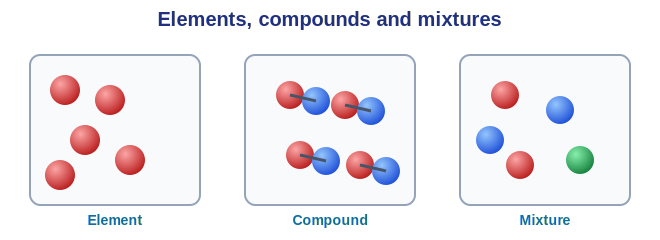
Mixture and pure substance a mixture is two or more substances mixed together that keep their own properties and do not react; a pure substance is made of only one type of particle, and can be an element or a compound The substances in a mixture are its components, and can be separated by physical means. A pure substance behaves the same throughout, because all its particles are identical. In real life: Air is a mixture of gases that can be separated, while pure oxygen is a single substance throughout. |
|
Worked example 1 Question. Is air a mixture or a pure substance?
Answer: Air is a mixture, because it is several gases mixed and can be separated. |
2. Elements, compounds and minerals
|
Elements, compounds and minerals an element is the simplest substance that cannot be broken down further; a compound is two or more elements chemically combined in a fixed ratio, with new properties; minerals are natural solids of fixed composition, usually compounds Oxygen and iron are elements, the building blocks of matter. Water is a compound of hydrogen and oxygen joined in a fixed ratio. Most minerals dug from the Earth are compounds, though a few are pure elements. In real life: Table salt is a compound of sodium and chlorine, and is also a mineral found naturally in the Earth and sea. |
|
Worked example 2 Question. Classify water, oxygen and air.
Answer: Oxygen is an element, water is a compound, and air is a mixture. |
|
Worked example 3 Question. How does a compound differ from a mixture?
Answer: A compound is chemically joined in a fixed ratio with new properties; a mixture is only mixed and easily separated. |
Explore with the interactive
Explore it: drop particles into a box and label whether you have made an element, a compound or a mixture. The interactive opens right here in the lesson.
Practice set A, multiple choice
1. A pure substance is made of …
Only one type of particle, all behaving identically.
2. An element is …
The simplest substance, which cannot be broken down into anything simpler.
3. Water is a …
Compound, of hydrogen and oxygen joined in a fixed ratio.
4. Most minerals are …
Compounds, natural solids of fixed composition, though a few are pure elements.
Practice set B, short answer
1. Give an example of an element, a compound and a mixture.
Element: oxygen (or iron). Compound: water (or salt). Mixture: air (or sand and water).
2. Why can a mixture be separated but a compound not easily?
A mixture’s parts are only mixed, while a compound’s elements are chemically joined in a fixed ratio.
3. What is a mineral?
A natural solid substance of fixed chemical composition, usually a compound and rarely a pure element.
Quick summary
| Idea | The idea |
| Mixture | substances mixed, keep properties. |
| Component | a part of a mixture. |
| Pure substance | one type of particle. |
| Element | simplest, cannot break down. |
| Compound | elements joined, fixed ratio. |
| Mineral | natural solid, usually a compound. |
| Open the Virtual Lab |
These free Grade 8 Science revision notes explain sorting matter into elements, compounds and mixtures, with clear examples, with clear step by step explanations and detailed labelled diagrams for every student following the new NCERT Curiosity book.
© 2026 School Revise. All rights reserved. This lesson is original content written by School Revise, aligned to the CBSE and NCERT Class 8 Science (Curiosity) syllabus. Unauthorised copying, reproduction or redistribution is not permitted. Curriculum names are used only to indicate alignment.
 Google