Curriculum
GRADE VIII MATHS
Chapters
0/14
-
Square And Cube
 Preview
 -
Power Play
Preview
-
Story Of Numbers
Preview
-
Quadrilaterals
Preview
-
Number Play
Preview
-
Distribute Mutiply
Preview
-
Proportional Reasoning 1
Preview
-
Fraction In Disguise
Preview
-
Baudhayana-Pythagoras
Preview
-
Proportional Reasoning 2
Preview
-
Geometric Themes
Preview
-
Dots And Lines
Preview
-
Algebra Play
Preview
-
Area
Preview
Ganita Prakash
0/14

Power Play
School Revise · Grade 8 · Maths · Chapter 2 · Ganita Prakash
Power Play
Maths, Class 8, Ganita Prakash. Folding a paper again and again, the numbers explode. This chapter writes such huge and tiny numbers neatly using powers, the laws of exponents, and standard form.
|
|
||
|
|
What this chapter is about
Repeated multiplication is clumsy to write out. In this chapter we learn what a power means, the laws that combine powers, negative powers for tiny numbers, and standard form for writing very large and very small numbers.
1. What a power means, and the laws
|
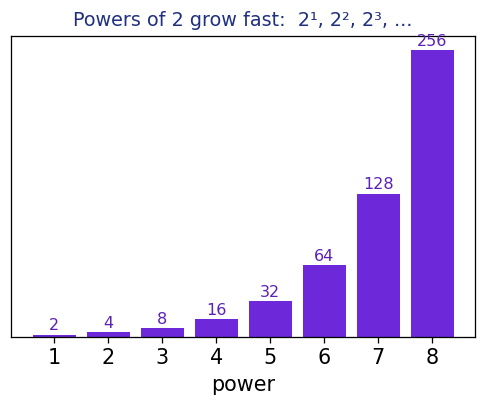
Powers and their laws a power aⁿ means the base a multiplied by itself n times; when multiplying, add the powers (aᵐ × aⁿ = aᵐ⁺ⁿ); when dividing, subtract them (aᵐ ÷ aⁿ = aᵐ⁻ⁿ); a power of a power multiplies them ((aᵐ)ⁿ = aᵐⁿ) The base stays the same in these laws; only the powers combine. A number to the power 0 is 1, and a base of 10 is specially useful for counting zeros. In real life: A single sheet folded 10 times would be 2¹⁰ = 1024 layers thick, which is why folding gets impossible fast. |
|
Worked example 1 Question. Simplify 2³ × 2⁴.
Answer: 2³ × 2⁴ = 2⁷ = 128. |
2. Negative powers and standard form
|
Negative powers and standard form a negative power means a reciprocal: a⁻ⁿ = 1 ÷ aⁿ; standard form writes a number as a single digit before the point times a power of 10, for example 4 300 = 4.3 × 10³ Standard form keeps very large and very small numbers short and easy to compare. A positive power of 10 moves the point right, a negative power moves it left. In real life: The distance to the Sun, about 1.5 × 10¹¹ metres, is far tidier in standard form than as a string of eleven zeros. |
|
Worked example 2 Question. Write 0.0006 in standard form.
Answer: 0.0006 = 6 × 10⁻⁴. |
|
Worked example 3 Question. Simplify 5⁵ ÷ 5².
Answer: 5⁵ ÷ 5² = 5⁴ = 625. |
Practise with the interactive
Practise it: set a base and a power to see the value, then combine two powers and watch the law add or subtract the exponents. The interactive opens right here in the lesson.
Practice set A, multiple choice
1. aᵐ × aⁿ equals …
aᵐ⁺ⁿ: when the base is the same, add the powers.
2. a⁻² is the same as …
1 ÷ a²: a negative power means a reciprocal.
3. Any non-zero number to the power 0 equals …
1.
4. In standard form, 52 000 is …
5.2 × 10⁴.
Practice set B, short answer
1. Simplify 3² × 3³.
| 1 | Add the powers, 2 + 3 = 5. so 3⁵. |
| 2 | Value. = 243. |
2. Write 7 500 000 in standard form.
7.5 × 10⁶.
3. Write 10⁻³ as an ordinary number.
1 ÷ 1000 = 0.001.
Quick summary
| Idea | The idea |
| Power | aⁿ = a multiplied n times. |
| Multiply | add the powers. |
| Divide | subtract the powers. |
| Power of a power | multiply them. |
| Negative power | a reciprocal. |
| Standard form | digit × a power of 10. |
| Open the Virtual Lab |
These free Grade 8 Maths revision notes explain powers, the laws of exponents, negative powers and standard form, with clear step by step worked examples and labelled diagrams for every student following the new Ganita Prakash book.
© 2026 School Revise. All rights reserved. This lesson is original content written by School Revise, aligned to the CBSE and NCERT Class 8 Mathematics (Ganita Prakash) syllabus. Unauthorised copying, reproduction or redistribution is not permitted. Curriculum names are used only to indicate alignment.
 Google