Curriculum
GRADE VIII MATHS
Chapters
0/14
-
Square And Cube
 Preview
 -
Power Play
Preview
-
Story Of Numbers
Preview
-
Quadrilaterals
Preview
-
Number Play
Preview
-
Distribute Mutiply
Preview
-
Proportional Reasoning 1
Preview
-
Fraction In Disguise
Preview
-
Baudhayana-Pythagoras
Preview
-
Proportional Reasoning 2
Preview
-
Geometric Themes
Preview
-
Dots And Lines
Preview
-
Algebra Play
Preview
-
Area
Preview
Ganita Prakash
0/14

Proportional Reasoning 2
School Revise · Grade 8 · Maths · Chapter 10 · Ganita Prakash
Proportional Reasoning 2
Maths, Class 8, Ganita Prakash. Maps, shared sweets and speeding cars all use ratios. This chapter reads scales on maps, divides a whole in a given ratio, and explores inverse proportion.
|
|
||
|
|
What this chapter is about
How far is a real road if the map shows 3 cm? How do we share 20 sweets in the ratio 2 to 3? In this chapter we use ratios in maps and scales, divide a whole in a given ratio, and meet inverse proportion.
1. Ratios in maps and dividing in a ratio
|
Scale and dividing in a ratio a map scale is a ratio linking map distance to real distance, so real distance = map distance × scale; to divide a whole in a ratio, add the ratio parts to get the total shares, then give each its share of the whole A scale of 1 to 100000 means 1 cm on the map is 100000 cm, that is 1 km, in real life. To split in a ratio, the total number of shares is the sum of the ratio numbers. In real life: On a 1 to 50000 map, two towns 4 cm apart are really 4 × 50000 cm = 2 km apart. |
|
Worked example 1 Question. Share 20 sweets between two children in the ratio 2 to 3.
Answer: The children get 8 and 12 sweets. |
2. Inverse proportion
|
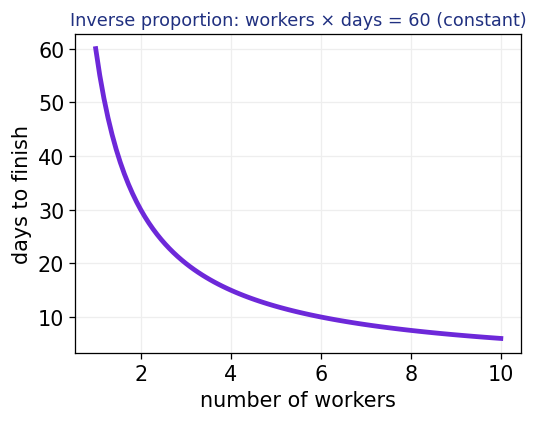
Inverse proportion two quantities are in inverse proportion when one increases as the other decreases so that their product stays constant: x × y = k This is the opposite of direct proportion. If more workers share a fixed job, each does less, so the time falls; the workers multiplied by the days stays the same. In real life: If 4 taps fill a tank in 6 hours, then 8 taps fill it in 3 hours, because 4 × 6 = 8 × 3 = 24. |
|
Worked example 2 Question. 6 workers build a wall in 8 days. How long for 12 workers, at the same rate?
Answer: 12 workers take 4 days. |
|
Worked example 3 Question. A 1 to 200000 map shows two towns 5 cm apart. Find the real distance.
Answer: The towns are 10 km apart. |
Practise with the interactive
Practise it: drag the number of workers and watch the days change so their product stays fixed, showing inverse proportion. The interactive opens right here in the lesson.
Practice set A, multiple choice
1. In inverse proportion, as one quantity rises the other …
Falls, so that their product stays constant.
2. A scale of 1 to 100000 means 1 cm on the map is …
100000 cm, that is 1 km, in real life.
3. To divide a whole in the ratio 3 to 2, the total shares are …
5 (that is 3 + 2).
4. If x × y = 24 and x = 6, then y = …
4, since 24 ÷ 6 = 4.
Practice set B, short answer
1. Share ₹60 in the ratio 1 to 3.
| 1 | Total shares 1 + 3 = 4, one share = 60 ÷ 4 = 15. so 15 and 45. |
| 2 | Answer. ₹15 and ₹45. |
2. 5 pipes fill a tank in 12 minutes. How long for 10 pipes?
| 1 | Pipes × minutes is constant, 5 × 12 = 60. so 60 ÷ 10. |
| 2 | Answer. 6 minutes. |
3. On a 1 to 50000 map, 6 cm represents how many km?
6 × 50000 = 300000 cm = 3 km.
Quick summary
| Idea | The idea |
| Scale | map distance to real distance. |
| Real distance | map distance × scale. |
| Divide in a ratio | shares add to the total. |
| Inverse proportion | one up, one down. |
| Rule | x × y = k. |
| Use | workers, taps, speeds. |
| Open the Virtual Lab |
These free Grade 8 Maths revision notes explain map scales, dividing in a given ratio, and inverse proportion, with clear step by step worked examples and labelled diagrams for every student following the new Ganita Prakash book.
© 2026 School Revise. All rights reserved. This lesson is original content written by School Revise, aligned to the CBSE and NCERT Class 8 Mathematics (Ganita Prakash) syllabus. Unauthorised copying, reproduction or redistribution is not permitted. Curriculum names are used only to indicate alignment.
 Google