Curriculum
GRADE VIII MATHS
Chapters
0/14
-
Square And Cube
 Preview
 -
Power Play
Preview
-
Story Of Numbers
Preview
-
Quadrilaterals
Preview
-
Number Play
Preview
-
Distribute Mutiply
Preview
-
Proportional Reasoning 1
Preview
-
Fraction In Disguise
Preview
-
Baudhayana-Pythagoras
Preview
-
Proportional Reasoning 2
Preview
-
Geometric Themes
Preview
-
Dots And Lines
Preview
-
Algebra Play
Preview
-
Area
Preview
Ganita Prakash
0/14

Quadrilaterals
School Revise · Grade 8 · Maths · Chapter 4 · Ganita Prakash
Quadrilaterals
Mathematics, Class 8, Ganita Prakash. A quadrilateral is any four sided shape. This chapter shows that their angles always add to 360 degrees, sorts them into a family, and studies the special properties of the parallelogram.
|
|
||
|
|
What this chapter is about
Squares, rectangles, kites and more are all quadrilaterals. In this chapter we prove their four angles always total 360 degrees, meet the whole family and how they are related, and learn the neat properties of the parallelogram.
1. The angle sum of a quadrilateral
|
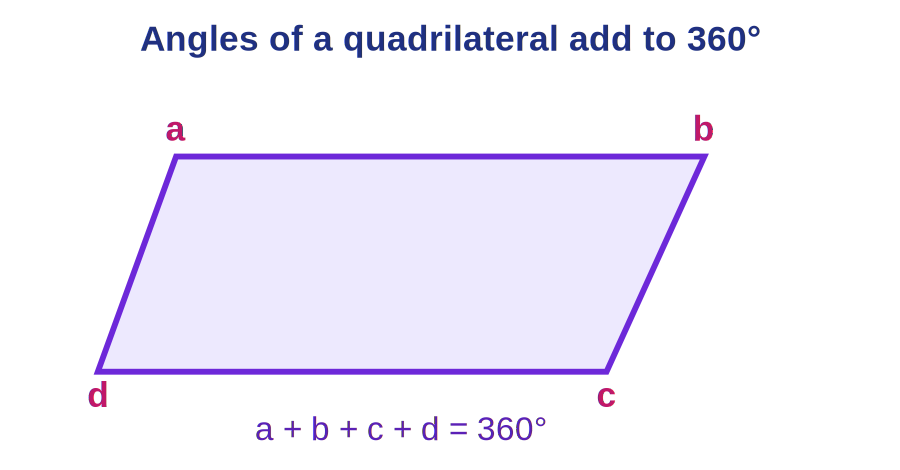
Angle sum the four interior angles of any quadrilateral add up to 360° A diagonal splits a quadrilateral into two triangles. Each triangle has angles summing to 180°, so the two together give 180° + 180° = 360°. This holds for every quadrilateral, however odd its shape. In real life: A carpenter checking a four sided frame knows the corners must total 360°, or the frame will not sit flat. |
|
Worked example 1 Question. Three angles of a quadrilateral are 90°, 85° and 70°. Find the fourth.
Answer: The fourth angle is 115°. |
2. The family of quadrilaterals
|
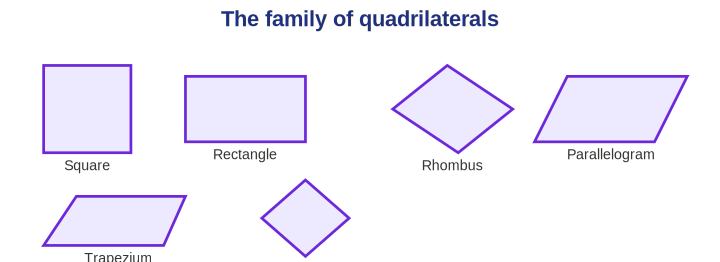
The parallelogram a parallelogram has both pairs of opposite sides parallel; then opposite sides and opposite angles are equal, and the diagonals bisect each other The square, rectangle and rhombus are all special parallelograms. A trapezium has just one pair of parallel sides, and a kite has two pairs of equal adjacent sides. In real life: A folding gate keeps its shape as a parallelogram while it opens, because opposite bars stay parallel and equal. |
|
Worked example 2 Question. One angle of a parallelogram is 70°. Find the other three.
Answer: The angles are 70°, 110°, 70° and 110°. |
|
Worked example 3 Question. In a rhombus, why are all four sides equal?
Answer: Because a rhombus is defined as a parallelogram with all sides equal. |
Practise with the interactive
Try it hands on: drag the corners of a quadrilateral and watch the four angles always add to 360 degrees, and switch between the family of shapes. The interactive opens right here in the lesson.
Practice set A, multiple choice
1. The angles of a quadrilateral always add to …
360°, because a diagonal splits it into two triangles of 180° each.
2. In a parallelogram, opposite angles are …
Equal. Adjacent angles instead add up to 180°.
3. A shape with exactly one pair of parallel sides is a …
Trapezium. A parallelogram has two pairs of parallel sides.
4. The diagonals of a parallelogram …
Bisect each other, meaning they cut each other exactly in half.
Practice set B, short answer
1. Three angles are 100°, 100° and 80°. Find the fourth.
| 1 | Sum is 360°. 360 − 280. |
| 2 | So. = 80°. |
2. One angle of a parallelogram is 55°. Find the adjacent angle.
| 1 | Adjacent angles add to 180°. 180 − 55. |
| 2 | So. = 125°. |
3. Why is a square a special rectangle and a special rhombus?
A square has four right angles like a rectangle, and four equal sides like a rhombus, so it belongs to both families.
Quick summary
| Idea | The idea |
| Quadrilateral | four sided shape. |
| Angle sum | 360°. |
| Parallelogram | opposite sides parallel. |
| Opposite angles | equal. |
| Diagonals | bisect each other. |
| Trapezium | one pair parallel. |
| Open the Virtual Lab |
These free Grade 8 Maths revision notes explain the angle sum, the family of quadrilaterals and parallelogram properties, with clear step by step worked examples and labelled diagrams for every student following the new Ganita Prakash book.
© 2026 School Revise. All rights reserved. This lesson is original content written by School Revise, aligned to the CBSE and NCERT Class 8 Mathematics (Ganita Prakash) syllabus. Unauthorised copying, reproduction or redistribution is not permitted. Curriculum names are used only to indicate alignment.
 Google