Curriculum
GRADE VIII MATHS
Chapters
0/14
-
Square And Cube
 Preview
 -
Power Play
Preview
-
Story Of Numbers
Preview
-
Quadrilaterals
Preview
-
Number Play
Preview
-
Distribute Mutiply
Preview
-
Proportional Reasoning 1
Preview
-
Fraction In Disguise
Preview
-
Baudhayana-Pythagoras
Preview
-
Proportional Reasoning 2
Preview
-
Geometric Themes
Preview
-
Dots And Lines
Preview
-
Algebra Play
Preview
-
Area
Preview
Ganita Prakash
0/14

Proportional Reasoning 1
School Revise · Grade 8 · Maths · Chapter 7 · Ganita Prakash
Proportional Reasoning 1
Mathematics, Class 8, Ganita Prakash. When one amount grows, another may grow with it. This chapter builds ratio and proportion, the unitary method, and direct proportion, where doubling one thing doubles the other.
|
|
||
|
|
What this chapter is about
If 4 pens cost a certain amount, how much do 7 cost? Questions like this are about proportion. In this chapter we simplify ratios, use the unitary method to find one unit first, and recognise direct proportion.
1. Ratio and proportion
|
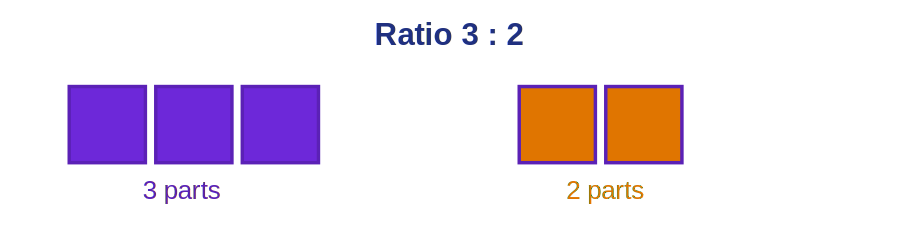
Ratio and proportion a ratio compares two amounts as a : b; a proportion says two ratios are equal, a : b = c : d A ratio like 12 : 18 simplifies by dividing both parts by their common factor, here 6, to give 2 : 3. Two ratios are in proportion when they simplify to the same thing. In real life: Recipes use ratios, for example 2 cups of rice to 3 cups of water, and the same ratio scales up for a larger meal. |
|
Worked example 1 Question. Simplify the ratio 12 : 18.
Answer: 12 : 18 = 2 : 3. |
2. The unitary method and direct proportion
|
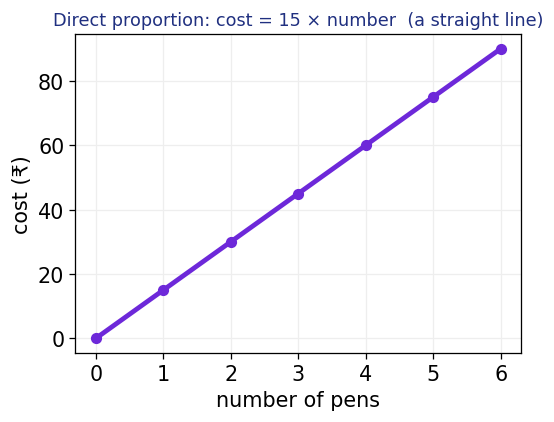
Direct proportion and the unitary method in direct proportion, as one amount multiplies, so does the other; the unitary method finds the value of one unit first, then scales up To find the cost of many, first find the cost of one, then multiply. A direct proportion always plots as a straight line through the origin, because the ratio stays constant. In real life: Buying petrol works this way, twice the litres cost twice as much, so the cost is directly proportional to the litres. |
|
Worked example 2 Question. If 5 pens cost ₹75, find the cost of 8 pens.
Answer: 8 pens cost ₹120. |
|
Worked example 3 Question. If 4 kg of rice costs ₹100, find the cost of 7 kg.
Answer: 7 kg costs ₹175. |
Practise with the interactive
Try it hands on: change the ratio and the amount, and watch the unitary method and the straight line of direct proportion update live. The interactive opens right here in the lesson.
Practice set A, multiple choice
1. The ratio 10 : 15 in simplest form is …
| 1 | Divide both by 5. 10÷5 : 15÷5. |
| 2 | So. 2 : 3. |
2. In direct proportion, if one amount doubles the other …
Also doubles, because their ratio stays the same.
3. The graph of a direct proportion is …
A straight line through the origin, since the ratio is constant.
4. If 3 books cost ₹90, one book costs …
| 1 | Divide. 90 ÷ 3. |
| 2 | So. ₹30. |
Practice set B, short answer
1. Simplify 24 : 36.
| 1 | HCF is 12. divide both by 12. |
| 2 | So. 2 : 3. |
2. If 6 apples cost ₹48, find the cost of 10.
| 1 | One apple. 48 ÷ 6 = ₹8. |
| 2 | Ten apples. 8 × 10 = ₹80. |
3. A car travels 240 km on 8 litres. How far on 5 litres?
| 1 | Per litre. 240 ÷ 8 = 30 km. |
| 2 | Five litres. 30 × 5 = 150 km. |
Quick summary
| Idea | The idea |
| Ratio | a : b compares two amounts. |
| Simplify | divide by the common factor. |
| Proportion | two equal ratios. |
| Unitary method | find one unit first. |
| Direct proportion | ratio stays constant. |
| Graph | straight line through origin. |
| Open the Virtual Lab |
These free Grade 8 Maths revision notes explain ratio, proportion, the unitary method and direct proportional reasoning problems, with clear step by step worked examples and labelled diagrams for every student following the new Ganita Prakash book.
© 2026 School Revise. All rights reserved. This lesson is original content written by School Revise, aligned to the CBSE and NCERT Class 8 Mathematics (Ganita Prakash) syllabus. Unauthorised copying, reproduction or redistribution is not permitted. Curriculum names are used only to indicate alignment.
 Google