Curriculum
GRADE VIII MATHS
Chapters
0/14
-
Square And Cube
 Preview
 -
Power Play
Preview
-
Story Of Numbers
Preview
-
Quadrilaterals
Preview
-
Number Play
Preview
-
Distribute Mutiply
Preview
-
Proportional Reasoning 1
Preview
-
Fraction In Disguise
Preview
-
Baudhayana-Pythagoras
Preview
-
Proportional Reasoning 2
Preview
-
Geometric Themes
Preview
-
Dots And Lines
Preview
-
Algebra Play
Preview
-
Area
Preview
Ganita Prakash
0/14

Area
School Revise · Grade 8 · Maths · Chapter 14 · Ganita Prakash
Area
Mathematics, Class 8, Ganita Prakash. Area measures the space inside a flat shape. This chapter gives the area formulas for triangles, parallelograms, trapeziums and circles, and finds the area of composite shapes.
|
|
||
|
|
What this chapter is about
How much carpet covers a floor, or paint a wall? That is area. In this chapter we learn the area formula for each common shape, understand where each comes from, and split composite shapes into simpler pieces.
1. Areas of the common shapes
|
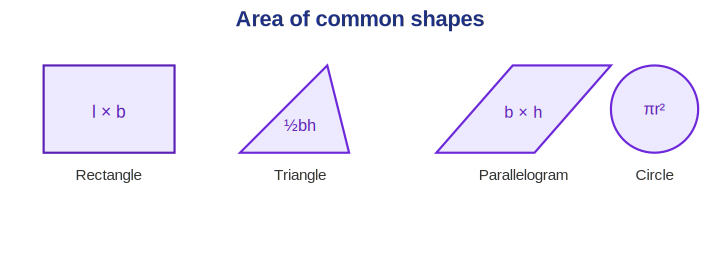
Area formulas rectangle = l × b; triangle = ½ × base × height; parallelogram = base × height; trapezium = ½(a + b) × h; circle = πr² A triangle is half a rectangle of the same base and height, which is why the half appears. A trapezium averages its two parallel sides. The circle uses π, about 22/7 or 3.14. In real life: Flooring, painting and farming all need area, from tiles for a room to seed for a field. |
|
Worked example 1 Question. Find the area of a triangle with base 8 and height 5.
Answer: The area is 20 square units. |
2. Trapeziums, circles and composite shapes
|
Trapezium and circle a trapezium area is half the sum of the parallel sides times the height; a circle area is π times the radius squared For a composite shape, split it into shapes you know, find each area, then add them. Always keep the same units throughout. In real life: An L shaped room is measured by splitting it into two rectangles, finding each area and adding them. |
|
Worked example 2 Question. Find the area of a trapezium with parallel sides 6 and 10 and height 4.
Answer: The area is 32 square units. |
|
Worked example 3 Question. Find the area of a circle of radius 7. Take π = 22/7.
Answer: The area is 154 square units. |
Practise with the interactive
Try it hands on: change the dimensions of a shape and watch its area update from the formula, then combine shapes. The interactive opens right here in the lesson.
Practice set A, multiple choice
1. The area of a rectangle is …
Length times breadth, l × b.
2. The area of a triangle with base 10 and height 6 is …
| 1 | ½ × 10 × 6. ½ × 60. |
| 2 | So. 30. |
3. The area of a circle is …
πr², pi times the radius squared.
4. A trapezium has parallel sides 4 and 8 and height 3. Its area is …
| 1 | ½ × (4 + 8) × 3. ½ × 12 × 3. |
| 2 | So. 18. |
Practice set B, short answer
1. Find the area of a parallelogram with base 12 and height 5.
| 1 | base × height. 12 × 5. |
| 2 | So. 60. |
2. Find the area of a circle of radius 14. Take π = 22/7.
| 1 | πr² = (22/7) × 14². (22/7) × 196 = 22 × 28. |
| 2 | So. 616. |
3. An L shape is a 4×3 rectangle plus a 2×2 square. Find its area.
| 1 | Add the two areas. 4×3 + 2×2 = 12 + 4. |
| 2 | So. 16 square units. |
Quick summary
| Idea | The idea |
| Rectangle | l × b. |
| Triangle | ½ × base × height. |
| Parallelogram | base × height. |
| Trapezium | ½(a + b) × h. |
| Circle | πr². |
| Composite | split, find, add. |
| Open the Virtual Lab |
These free Grade 8 Maths revision notes explain the area of triangles, parallelograms, trapeziums, circles and composite shapes, with clear step by step worked examples and labelled diagrams for every student following the new Ganita Prakash book.
© 2026 School Revise. All rights reserved. This lesson is original content written by School Revise, aligned to the CBSE and NCERT Class 8 Mathematics (Ganita Prakash) syllabus. Unauthorised copying, reproduction or redistribution is not permitted. Curriculum names are used only to indicate alignment.
 Google