Curriculum
GRADE VIII MATHS
Chapters
0/14
-
Square And Cube
 Preview
 -
Power Play
Preview
-
Story Of Numbers
Preview
-
Quadrilaterals
Preview
-
Number Play
Preview
-
Distribute Mutiply
Preview
-
Proportional Reasoning 1
Preview
-
Fraction In Disguise
Preview
-
Baudhayana-Pythagoras
Preview
-
Proportional Reasoning 2
Preview
-
Geometric Themes
Preview
-
Dots And Lines
Preview
-
Algebra Play
Preview
-
Area
Preview
Ganita Prakash
0/14

Geometric Themes
School Revise · Grade 8 · Maths · Chapter 11 · Ganita Prakash
Exploring Some Geometric Themes
Maths, Class 8, Ganita Prakash. Two beautiful ideas meet here. This chapter explores fractals, shapes made of smaller copies of themselves, and visualising solids through their nets and faces.
|
|
||
|
|
What this chapter is about
Some shapes repeat themselves at every size, and every solid can be unfolded flat. In this chapter we explore fractals, which are self-similar shapes, and learn to visualise solids using their nets and by counting faces, edges and vertices.
1. Fractals
|
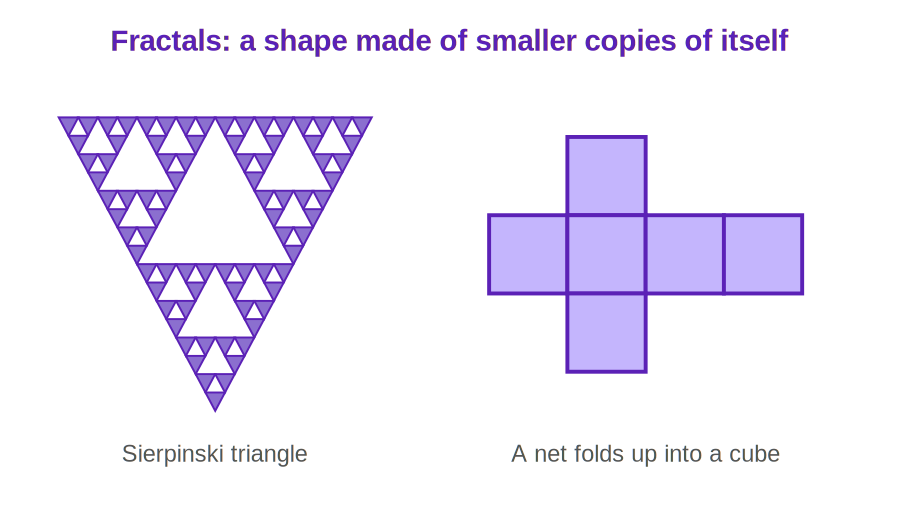
Fractals a fractal is a shape made of smaller copies of itself; zooming in, the same pattern appears again and again, which is called self-similarity A fractal is built by repeating a simple rule. In the Sierpinski triangle, each triangle is replaced by three smaller triangles, again and again, so the whole is made of copies of itself. In real life: A fern leaf, a coastline and the branching of a tree all show fractal, self-similar patterns in nature. |
|
Worked example 1 Question. In the Sierpinski triangle, one triangle becomes three smaller ones each step. How many after two steps?
Answer: After two steps there are 9 small triangles. |
2. Visualising solids
|
Nets, faces, edges and vertices a net is a flat shape that folds up into a solid; a solid has flat faces, straight edges where faces meet, and vertices where edges meet Unfolding a solid into its net helps us see all its faces at once. A cube, for example, has 6 square faces, 12 edges and 8 vertices, and its net is six squares joined in a cross. In real life: A cardboard box is made from a flat net that is folded and glued into a solid cuboid. |
|
Worked example 2 Question. How many faces, edges and vertices does a cube have?
Answer: A cube has 6 faces, 12 edges and 8 vertices. |
|
Worked example 3 Question. A net has 6 equal squares joined in a cross. What solid does it fold into?
Answer: It folds into a cube. |
Practise with the interactive
Practise it: repeat the fractal rule step by step and watch the self-similar pattern grow, then fold a net into its solid. The interactive opens right here in the lesson.
Practice set A, multiple choice
1. A fractal is a shape made of …
Smaller copies of itself, showing self-similarity.
2. A net is …
A flat shape that folds up into a solid.
3. A cube has …
6 faces, 12 edges and 8 vertices.
4. Self-similarity means …
The same pattern appears again as you zoom in.
Practice set B, short answer
1. Name one fractal pattern found in nature.
Any one of: a fern leaf, a coastline, a branching tree, a snowflake.
2. How many faces does a net with 6 squares fold into?
6 faces, folding into a cube.
3. In the Sierpinski triangle, how many small triangles after three steps?
27, since 3 × 3 × 3 = 27.
Quick summary
| Idea | The idea |
| Fractal | made of smaller copies of itself. |
| Self-similar | same pattern at every size. |
| Rule | repeat a simple step. |
| Net | folds up into a solid. |
| Cube | 6 faces, 12 edges, 8 vertices. |
| Visualise | unfold to see all faces. |
| Open the Virtual Lab |
These free Grade 8 Maths revision notes explain fractals and self-similar shapes, and visualising solids through their nets, with clear step by step worked examples and labelled diagrams for every student following the new Ganita Prakash book.
© 2026 School Revise. All rights reserved. This lesson is original content written by School Revise, aligned to the CBSE and NCERT Class 8 Mathematics (Ganita Prakash) syllabus. Unauthorised copying, reproduction or redistribution is not permitted. Curriculum names are used only to indicate alignment.
 Google