Curriculum
GRADE VIII MATHS
Chapters
0/14
-
Square And Cube
 Preview
 -
Power Play
Preview
-
Story Of Numbers
Preview
-
Quadrilaterals
Preview
-
Number Play
Preview
-
Distribute Mutiply
Preview
-
Proportional Reasoning 1
Preview
-
Fraction In Disguise
Preview
-
Baudhayana-Pythagoras
Preview
-
Proportional Reasoning 2
Preview
-
Geometric Themes
Preview
-
Dots And Lines
Preview
-
Algebra Play
Preview
-
Area
Preview
Ganita Prakash
0/14

Algebra Play
School Revise · Grade 8 · Maths · Chapter 13 · Ganita Prakash
Algebra Play
Maths, Class 8, Ganita Prakash. Algebra can explain why number tricks always work. This chapter uses letters to reveal the secret behind think-of-a-number tricks, number pyramids and grid puzzles.
|
|
||
|
|
What this chapter is about
A friend guesses your number every time, how? In this chapter we use algebra to explain think-of-a-number tricks, to build and read number pyramids, and to crack grid puzzles, seeing why the patterns always hold.
1. Think-of-a-number tricks
|
Using a letter for the number if we call the starting number n, every step of a trick becomes an algebra expression, and simplifying it reveals why the answer is always the same Writing the unknown as n lets us follow a trick line by line. When the n terms cancel, the final answer no longer depends on the number chosen, which is the secret of the trick. In real life: Party tricks that name your number rely on this: the algebra guarantees the result whatever you start with. |
|
Worked example 1 Question. Think of a number, add 5, double it, subtract 10, then halve it. Show you always get back your number.
Answer: The result is n, your starting number, whatever you chose. |
2. Number pyramids and grids
|
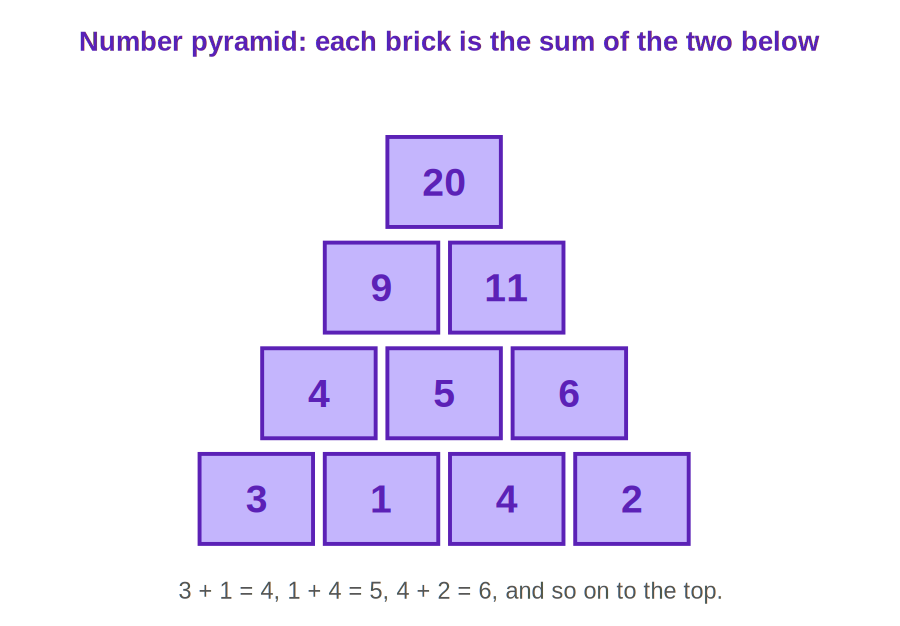
Number pyramids in a number pyramid each brick is the sum of the two bricks directly below it; using letters for the bottom bricks, algebra predicts every brick above If the bottom bricks are a, b and c, the next row is (a + b) and (b + c), and the top is a + 2b + c. The letters show which bottom brick affects the top most, and by how much. In real life: Puzzle pages use these pyramids and grids, and algebra is the quick way to fill in the missing numbers. |
|
Worked example 2 Question. A pyramid has bottom bricks 3, 1, 4, 2. Find the top brick.
Answer: The top brick is 20. |
|
Worked example 3 Question. A pyramid’s bottom two bricks are n and 4, and the brick above is 9. Find n.
Answer: n = 5. |
Practise with the interactive
Practise it: change the bottom bricks of a number pyramid and watch algebra fill every brick above, revealing the pattern. The interactive opens right here in the lesson.
Practice set A, multiple choice
1. In a think-of-a-number trick, we call the number …
A letter such as n, then follow each step as algebra.
2. In a number pyramid, each brick is …
The sum of the two bricks directly below it.
3. If the bottom bricks are a, b, c, the top brick is …
a + 2b + c.
4. A trick always gives the same answer when …
The n terms cancel, so the result no longer depends on the number chosen.
Practice set B, short answer
1. Bottom bricks 2, 5, 1. Find the top brick.
| 1 | Next row: 2 + 5 = 7 and 5 + 1 = 6. then 7 + 6. |
| 2 | Top. 13. |
2. Think of n, treble it, add 6, divide by 3, subtract 2. What do you get?
| 1 | 3n, then 3n + 6, then (3n + 6) ÷ 3 = n + 2. then n + 2 − 2. |
| 2 | Result. n, the starting number. |
3. In a pyramid, the two bottom bricks are 6 and n, and the brick above is 10. Find n.
6 + n = 10, so n = 4.
Quick summary
| Idea | The idea |
| Let n be | the unknown number. |
| Trick | follow steps as algebra. |
| Secret | the n terms cancel. |
| Pyramid | brick = sum of two below. |
| Bottom a, b, c | top is a + 2b + c. |
| Algebra | fills every missing number. |
| Open the Virtual Lab |
These free Grade 8 Maths revision notes explain algebra behind number tricks, number pyramids and grid puzzles explained, with clear step by step worked examples and labelled diagrams for every student following the new Ganita Prakash book.
© 2026 School Revise. All rights reserved. This lesson is original content written by School Revise, aligned to the CBSE and NCERT Class 8 Mathematics (Ganita Prakash) syllabus. Unauthorised copying, reproduction or redistribution is not permitted. Curriculum names are used only to indicate alignment.
 Google