Curriculum
GRADE VIII MATHS
Chapters
0/14
-
Square And Cube
 Preview
 -
Power Play
Preview
-
Story Of Numbers
Preview
-
Quadrilaterals
Preview
-
Number Play
Preview
-
Distribute Mutiply
Preview
-
Proportional Reasoning 1
Preview
-
Fraction In Disguise
Preview
-
Baudhayana-Pythagoras
Preview
-
Proportional Reasoning 2
Preview
-
Geometric Themes
Preview
-
Dots And Lines
Preview
-
Algebra Play
Preview
-
Area
Preview
Ganita Prakash
0/14

Baudhayana-Pythagoras
School Revise · Grade 8 · Maths · Chapter 9 · Ganita Prakash
The Baudhayana-Pythagoras Theorem
Mathematics, Class 8, Ganita Prakash. In a right angled triangle the three sides obey a beautiful rule, known in ancient India to Baudhayana. This chapter states the theorem, shows why it is true, and uses it to find distances.
|
|
||
|
|
What this chapter is about
Long before Pythagoras, the Indian scholar Baudhayana wrote this rule for right angled triangles. In this chapter we meet the theorem, see the square on the longest side equals the other two squares added, and use it to solve real distance problems.
1. The theorem and why it is true
|
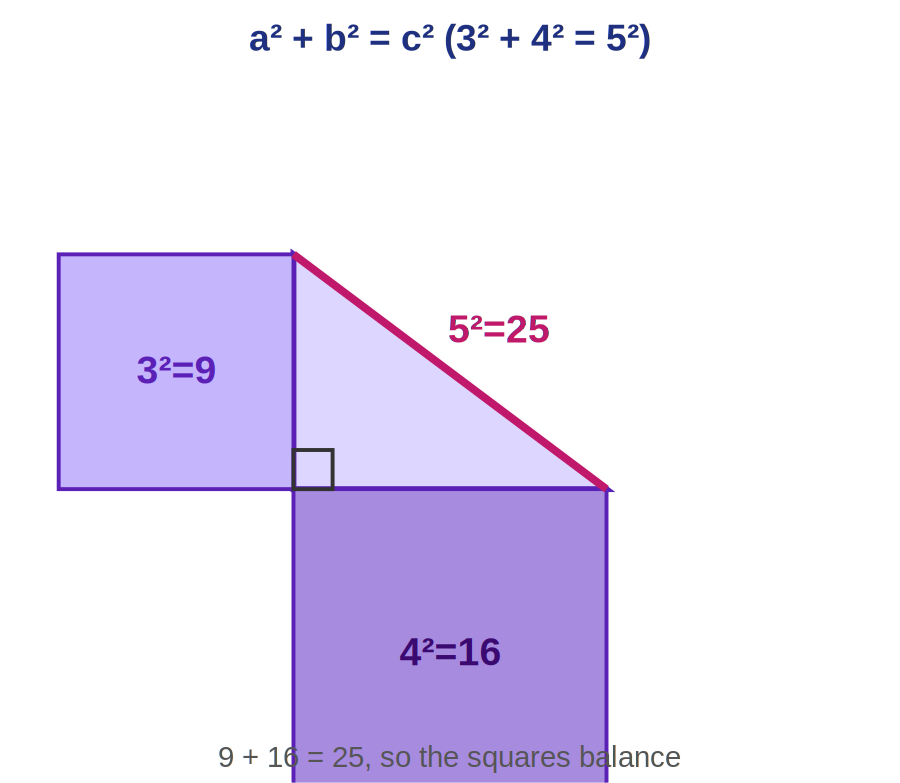
Baudhayana-Pythagoras theorem in a right angled triangle, the square on the longest side (the hypotenuse) equals the sum of the squares on the other two sides: a² + b² = c² The hypotenuse c is opposite the right angle and is the longest side. The picture shows a 3, 4, 5 triangle: the squares of areas 9 and 16 exactly fill the square of area 25, since 9 + 16 = 25. In real life: A builder makes a perfect right angle by measuring sides 3, 4 and 5 units, because only a right angle makes 3² + 4² equal 5². |
|
Worked example 1 Question. A right triangle has legs 3 and 4. Find the hypotenuse.
Answer: The hypotenuse is 5. |
2. Finding a missing side
|
Finding any side rearrange the theorem: a leg is found by subtracting, leg = √(c² − other leg²) If you know the hypotenuse and one leg, subtract their squares and take the root. Three whole numbers that fit the theorem, like 3, 4, 5 or 5, 12, 13, are called Pythagorean triples. In real life: To find how tall a ladder reaches up a wall, the wall and ground are the legs and the ladder is the hypotenuse. |
|
Worked example 2 Question. A right triangle has hypotenuse 13 and one leg 5. Find the other leg.
Answer: The other leg is 12. |
|
Worked example 3 Question. Is a triangle with sides 6, 8, 10 right angled?
Answer: Yes, since 6² + 8² = 10², it is right angled. |
Practise with the interactive
Try it hands on: drag the legs of a right triangle and watch the squares on the sides, seeing a² + b² always equal c². The interactive opens right here in the lesson.
Practice set A, multiple choice
1. The hypotenuse is …
The side opposite the right angle, and always the longest side of a right triangle.
2. For legs 5 and 12, the hypotenuse is …
| 1 | 5² + 12² = 25 + 144 = 169. c = √169. |
| 2 | So. = 13. |
3. Which is a Pythagorean triple?
3, 4, 5, because 3² + 4² = 5² (9 + 16 = 25).
4. The theorem holds only in a …
Right angled triangle, where one angle is exactly 90°.
Practice set B, short answer
1. Find the hypotenuse for legs 8 and 15.
| 1 | 8² + 15² = 64 + 225 = 289. c = √289. |
| 2 | So. = 17. |
2. A ladder 10 m long leans with its foot 6 m from a wall. How high does it reach?
| 1 | Height = √(10² − 6²). √(100 − 36) = √64. |
| 2 | So. = 8 m. |
3. Is 9, 12, 15 a right triangle?
| 1 | 9² + 12² = 81 + 144 = 225. 15² = 225. |
| 2 | They match. so yes. |
Quick summary
| Idea | The idea |
| Theorem | a² + b² = c². |
| Hypotenuse | longest side, opposite the right angle. |
| Find hypotenuse | add the leg squares, take root. |
| Find a leg | subtract, then take root. |
| Triple | 3, 4, 5 and 5, 12, 13. |
| Only in | right angled triangles. |
| Open the Virtual Lab |
These free Grade 8 Maths revision notes explain the Baudhayana Pythagoras theorem, its proof and everyday distance problems, with clear step by step worked examples and labelled diagrams for every student following the new Ganita Prakash book.
© 2026 School Revise. All rights reserved. This lesson is original content written by School Revise, aligned to the CBSE and NCERT Class 8 Mathematics (Ganita Prakash) syllabus. Unauthorised copying, reproduction or redistribution is not permitted. Curriculum names are used only to indicate alignment.
 Google