Curriculum
GRADE VIII MATHS
Chapters
0/14
-
Square And Cube
 Preview
 -
Power Play
Preview
-
Story Of Numbers
Preview
-
Quadrilaterals
Preview
-
Number Play
Preview
-
Distribute Mutiply
Preview
-
Proportional Reasoning 1
Preview
-
Fraction In Disguise
Preview
-
Baudhayana-Pythagoras
Preview
-
Proportional Reasoning 2
Preview
-
Geometric Themes
Preview
-
Dots And Lines
Preview
-
Algebra Play
Preview
-
Area
Preview
Ganita Prakash
0/14

Story Of Numbers
School Revise · Grade 8 · Maths · Chapter 3 · Ganita Prakash
A Story of Numbers
Maths, Class 8, Ganita Prakash. Numbers have been written in many ways across history. This chapter follows early number systems, our place value system, and the powerful idea of a base.
|
|
||
|
|
What this chapter is about
Long ago, people wrote numbers with tally marks, symbols and words. In this chapter we see some early number systems, understand how our place value system works, and meet the idea of a base, which decides the size of each bundle.
1. Early number systems and place value
|
Place value in our system the place of a digit decides its value: reading from the right the places are ones, tens, hundreds and so on, each ten times the one before Early systems used repeated symbols, which made large numbers long to write. Our place value system uses just ten digits and the position of each digit, so any number, however large, is short to write. In real life: The year 2026 means 2 thousands, 0 hundreds, 2 tens and 6 ones, all packed into four digits by place value. |
|
Worked example 1 Question. What is the value of the digit 7 in 3 705?
Answer: The 7 stands for 700. |
2. The idea of a base
|
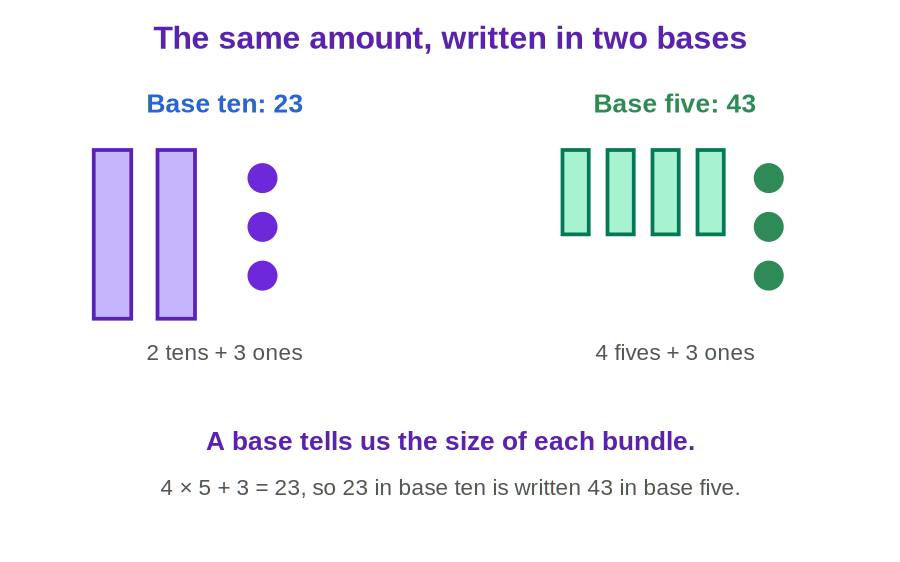
Base the base of a number system is the size of each bundle; in base ten we bundle in tens, but we can bundle in other sizes, such as five, and the digits then count those bundles In base five the places are ones, fives, twenty-fives and so on. The same amount can be written in different bases, though its value does not change. This is exactly how our place value works, with ten as the base. In real life: Clocks use base sixty for minutes and seconds, which is why 60 seconds roll over into 1 minute. |
|
Worked example 2 Question. Write the base-ten number 23 in base five.
Answer: 23 in base ten is 43 in base five (since 4 × 5 + 3 = 23). |
|
Worked example 3 Question. In base five, what does 43 stand for?
Answer: 43 in base five equals 23 in base ten. |
Practise with the interactive
Practise it: pick a number and watch it bundle into tens for place value, then switch the base and see the same amount regrouped. The interactive opens right here in the lesson.
Practice set A, multiple choice
1. The value of a digit depends on …
Its place in the number, in a place value system.
2. The base of a system is …
The size of each bundle, for example ten in base ten.
3. In base five, the places from the right are …
Ones, fives, twenty-fives, and so on.
4. The digit 5 in 4 512 stands for …
500, since it is in the hundreds place.
Practice set B, short answer
1. Write 12 (base ten) in base five.
| 1 | Two fives make 10, with 2 left over. so 2 fives and 2 ones. |
| 2 | Written. 22 in base five. |
2. What does 31 in base five equal in base ten?
3 fives and 1 one = 3 × 5 + 1 = 16.
3. Why is place value shorter than repeated symbols?
It uses the position of just ten digits, so even huge numbers stay short.
Quick summary
| Idea | The idea |
| Early systems | repeated symbols, long to write. |
| Place value | position gives value. |
| Places | ones, tens, hundreds … |
| Base | the size of each bundle. |
| Base ten | bundles of ten. |
| Other bases | same amount, regrouped. |
| Open the Virtual Lab |
These free Grade 8 Maths revision notes explain number systems, place value, and the idea of a base, with clear step by step worked examples and labelled diagrams for every student following the new Ganita Prakash book.
© 2026 School Revise. All rights reserved. This lesson is original content written by School Revise, aligned to the CBSE and NCERT Class 8 Mathematics (Ganita Prakash) syllabus. Unauthorised copying, reproduction or redistribution is not permitted. Curriculum names are used only to indicate alignment.
 Google