Curriculum
Mathematics Grade XI
Grade 11 Mathematics
0/14
-
Chapter 1: Sets
 Preview
 -
Chapter 2: Relations and Functions
Preview
-
Chapter 3: Trigonometric Functions
Preview
-
Chapter 4: Complex Numbers and Quadratic Equations
Preview
-
Chapter 5: Linear Inequalities
Preview
-
Chapter 6: Permutations and Combinations
Preview
-
Chapter 7: Binomial Theorem
Preview
-
Chapter 8: Sequences and Series
Preview
-
Chapter 9: Straight Lines
Preview
-
Chapter 10: Conic Sections
Preview
-
Chapter 11: Introduction to Three Dimensional Geometry
Preview
-
Chapter 12: Limits and Derivatives
Preview
-
Chapter 13: Statistics
Preview
-
Chapter 14: Probability
Preview
Chapter 1: Sets
|
Class 11 • Mathematics • Chapter 1 SetsThe language of well-defined collections, on which the rest of mathematics is built.
|
|
Chapter Roadmap What a Set Is • Types of Sets • Subsets and Power Set • Venn Diagrams • Operations on Sets • Complement and De Morgan • Key Results • Applications |
| 1 |
Why Sets Matter |
A set is simply a well-defined collection of objects: the vowels of the alphabet, the natural numbers below 10, or the students in a class. The word ‘well-defined’ is important, because for any object we must be able to say clearly whether it belongs to the collection or not. This single idea is the starting point of modern mathematics.
Sets give us a precise language for grouping objects and describing how groups relate to one another. They are the foundation for relations and functions, for probability, and for almost every later topic. In this chapter you will learn how to write sets, the different types of sets, how one set can sit inside another, and how to combine sets using union, intersection, difference and complement, with Venn diagrams to picture it all.
A set is a well-defined collection of distinct objects. Each object is an element. We write a ∈ A to mean ‘a belongs to A’ and a ∉ A to mean ‘a does not belong to A’. The order of elements does not matter, and an element is never listed twice.
|
| 2 |
Key Terms You Must Know |
| Term | Meaning | Example |
| Set | A well-defined collection of distinct objects. | A = {1, 2, 3} |
| Element | An object that belongs to a set, shown with ∈. | 2 ∈ A |
| Roster form | Listing all elements inside curly brackets. | {a, e, i, o, u} |
| Set-builder form | Describing elements by a common rule. | {x : x is a vowel} |
| Empty set | A set with no elements, written ∅ or { }. | {x : x is a month with 32 days} |
| Subset | A is a subset of B if every element of A is in B. | {1, 2} ⊆ {1, 2, 3} |
| Universal set | The set U containing all objects under discussion. | U = {1, 2, …, 10} |
| 3 |
Core Concepts, Step by Step |
1. What a Set Is and How to Write ItA set is a well-defined collection of distinct objects, and each object in it is an element. We can describe a set in two ways. In roster form we simply list the elements inside curly brackets, for example {1, 2, 3, 4, 5}. In set-builder form we state a rule that the elements share, for example {x : x is a natural number and x < 6}. Roster form is handy for small sets; set-builder form is better for large or infinite sets where listing is impractical.
|
2. Types of SetsSets come in several kinds. The empty set, written ∅ or { }, has no elements at all. A finite set has a countable number of elements, while an infinite set goes on without end, such as the set of all natural numbers. Two sets are equal when they have exactly the same elements, regardless of order or repetition, so {1, 2, 3} and {3, 2, 1} are equal. Sets with the same number of elements are called equivalent, which is a weaker idea than equality.
|
3. Subsets, Power Set and Universal SetA set A is a subset of B, written A ⊆ B, when every element of A is also in B. The empty set is a subset of every set, and every set is a subset of itself. Intervals such as [2, 5] are subsets of the real numbers. The power set of A is the set of all its subsets; if A has n elements, its power set has 2ⁿ elements. The universal set U is the big set that contains all the objects we are currently discussing.
|
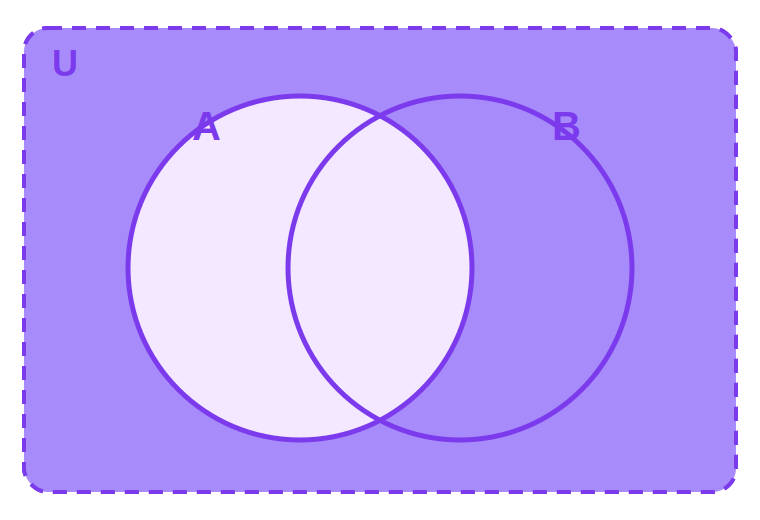
4. Venn DiagramsA Venn diagram pictures sets as regions inside a rectangle that stands for the universal set U. Overlapping regions show elements shared between sets, and separate regions show elements that belong to only one set. Venn diagrams turn wordy set problems into clear pictures, which is why they are so useful for solving the survey and counting questions that appear in exams. The figure below shows two sets A and B inside U.
|
|
A Venn diagram: two sets A and B inside the universal set U
|
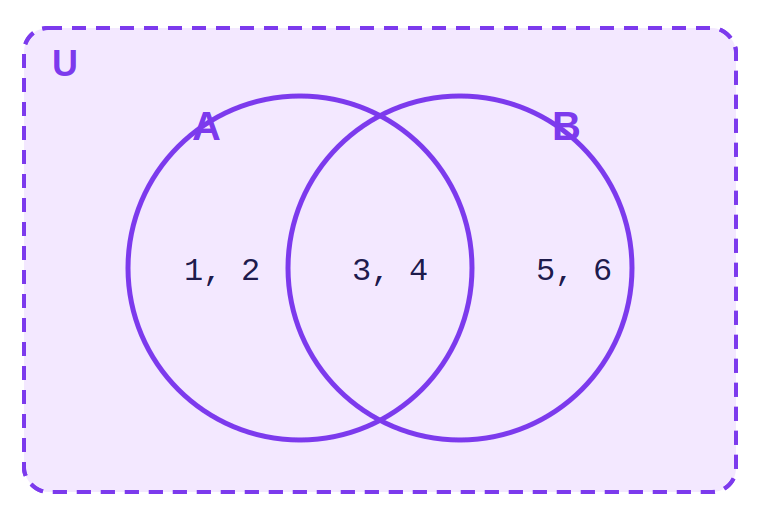
Here A = {1, 2, 3, 4} is the left circle and B = {3, 4, 5, 6} is the right circle. The lens where they overlap holds the shared elements 3 and 4, which is the intersection. Everything inside either circle makes up the union, and anything inside the rectangle but outside both circles lies in neither set.
5. Operations on SetsSets are combined using three main operations. The union A ∪ B is the set of all elements in A or B (or both). The intersection A ∩ B is the set of elements in both A and B. The difference A − B is the set of elements in A but not in B. These operations obey friendly laws: they are commutative (A ∪ B = B ∪ A), associative, and distributive, just like addition and multiplication of numbers. The table below summarises them.
|
|
The main operations on sets
|
|
The same operations shown as shaded Venn diagrams
|
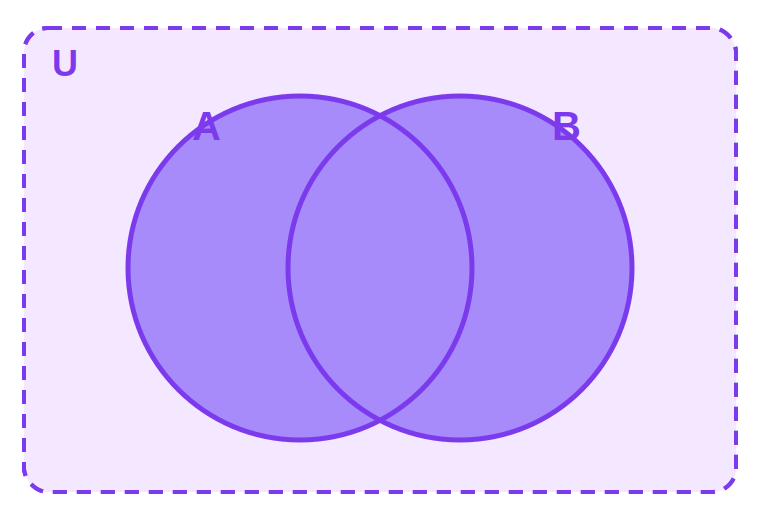
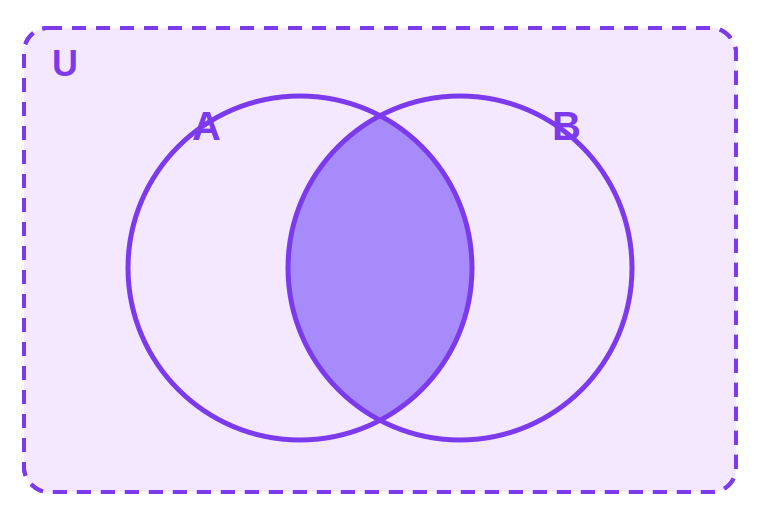
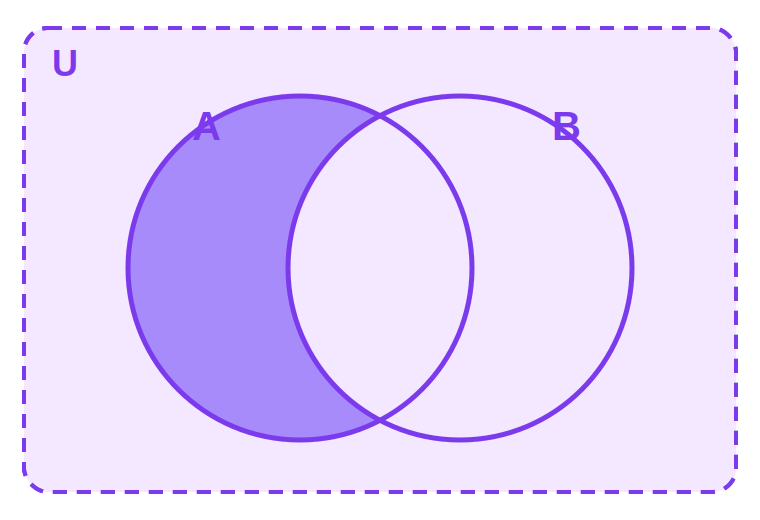
In each diagram the shaded region is the set named beneath it. The union shades both circles, the intersection shades only the overlapping lens, the difference A − B shades the part of A outside B, and the complement A′ shades everything inside U that lies outside A. Reading a set operation as a shaded region is the quickest way to picture what it means.
6. Complement and De Morgan’s LawsThe complement of a set A, written A′, is the set of all elements of the universal set U that are not in A. Complements interact with union and intersection through De Morgan’s laws: (A ∪ B)′ = A′ ∩ B′ and (A ∩ B)′ = A′ ∪ B′. In words, the complement of a union is the intersection of the complements, and the complement of an intersection is the union of the complements. These laws are used constantly to simplify expressions and to solve Venn diagram problems.
|
| 4 |
Key Results & Proofs |
Three results are used again and again in this chapter and beyond. Each follows from carefully checking which elements belong to which set.
Statement. A set with n elements has exactly 2ⁿ subsets. Proof Think of building a subset one element at a time.
So a set of 3 elements has 2³ = 8 subsets, including the empty set and the set itself. |
||||||||||||||||
Statement. For any two sets, (A ∪ B)′ = A′ ∩ B′. Proof Chase a typical element and see which sets it can belong to.
The companion law (A ∩ B)′ = A′ ∪ B′ is proved in exactly the same way. |
||||||||||||||||||
Statement. For two finite sets, n(A ∪ B) = n(A) + n(B) − n(A ∩ B). Proof Think about which elements get counted more than once when you add the sizes.
This inclusion and exclusion idea is the key to almost every Venn diagram word problem. |
||||||||||||
| 5 |
Worked Examples |
Question: Write the set of vowels in the English alphabet in roster form. ▶ Show full workingList the elements inside curly brackets.
Answer: {a, e, i, o, u}. |
||||||||
Question: Write {x : x is a natural number and x < 6} in roster form. ▶ Show full workingList the natural numbers that fit the rule.
Answer: {1, 2, 3, 4, 5}. |
||||||||
Question: Write the set {2, 4, 6, 8, 10} in set-builder form. ▶ Show full workingFind the common rule the elements obey.
Answer: {x : x is an even natural number and x ≤ 10}. |
||||||||
Question: Are the sets {1, 2, 3} and {3, 2, 1} equal? ▶ Show full workingTwo sets are equal when they have the same elements, regardless of order.
Answer: Yes, they are equal sets. |
||||||||
Question: List all the subsets of {a, b}. ▶ Show full workingInclude the empty set, the single-element sets and the whole set.
Answer: { }, {a}, {b}, {a, b}; the power set has 4 elements. |
||||||||
Question: How many subsets does a set with 5 elements have? ▶ Show full workingUse the result that a set of n elements has 2ⁿ subsets.
Answer: 32 subsets. |
Question: If A = {1, 2, 3, 4} and B = {3, 4, 5, 6}, find A ∪ B. ▶ Show full workingThe union collects every element in either set, listing each once.
Answer: A ∪ B = {1, 2, 3, 4, 5, 6}. |
|||||||||
Question: For the same A and B, find A ∩ B. ▶ Show full workingThe intersection keeps only the elements common to both.
Answer: A ∩ B = {3, 4}. |
|||||||||
Question: For the same A and B, find A − B and B − A. ▶ Show full workingThe difference keeps the elements of one set that are not in the other.
Answer: A − B = {1, 2} and B − A = {5, 6}. |
||||||||
Question: Let U = {1, 2, …, 10} and A = {2, 4, 6, 8, 10}. Find A′. ▶ Show full workingThe complement keeps every element of U that is not in A.
Answer: A′ = {1, 3, 5, 7, 9}. |
|||||||||
Question: Verify De Morgan’s law (A ∪ B)′ = A′ ∩ B′ for U = {1, 2, 3, 4, 5, 6}, A = {1, 2, 3}, B = {3, 4}. ▶ Show full workingWork out both sides separately and compare.
Answer: Both sides equal {5, 6}, so the law holds. |
||||||||||||||
Question: In a class of 40 students, 25 like Maths, 20 like Science and 10 like both. How many like at least one of the two? ▶ Show full workingUse the counting formula n(A ∪ B) = n(A) + n(B) − n(A ∩ B).
Answer: 35 students like at least one of the two subjects. |
| 6 |
Where You Meet This in Real Life |
|
Organising and classifying Sorting people, products or files into groups, such as students who play cricket or hockey, is exactly the language of sets. |
|
Databases and searches Searching with ‘and’, ‘or’ and ‘not’ matches intersection, union and complement, so every database query is built on set operations. |
|
Surveys and statistics Counting how many people read newspaper A or B, or both, uses Venn diagrams and the counting formula every day in market research. |
|
Probability The events in probability are sets of outcomes, so union, intersection and complement carry straight over into the next stage of your studies. |
|
Logic and computing Computer logic, search engines and circuit design all rest on the same union, intersection and complement that you learn here. |
| 7 |
Practice Sets A to D |
|
Practice Set A – Basics |
|
A1. Write the set of the first five odd natural numbers in roster form. ▶ Reveal full workingList them inside curly brackets.
Answer: {1, 3, 5, 7, 9}. |
|||||||
|
A2. Write {a, e, i, o, u} in set-builder form. ▶ Reveal full workingDescribe the common rule.
Answer: {x : x is a vowel in the English alphabet}. |
||||
|
A3. Is the set {x : x is a month with 32 days} empty? ▶ Reveal full workingCheck whether any object satisfies the rule.
Answer: Yes, it is the empty set. |
|||||||
|
A4. How many elements does the power set of {1, 2, 3} have? ▶ Reveal full workingUse 2ⁿ with n = 3.
Answer: 8. |
|
Practice Set B – Conceptual |
|
B1. What is the difference between equal sets and equivalent sets? ▶ Reveal full workingCompare elements with number of elements.
Answer: Equal sets share all elements; equivalent sets only share the same count. |
|||||||
|
B2. What is the empty set and how is it written? ▶ Reveal full workingDescribe a set with nothing in it.
Answer: The set with no elements, written ∅ or { }. |
|||||||
|
B3. Is every set a subset of itself, and is the empty set a subset of every set? ▶ Reveal full workingRecall the rules for subsets.
Answer: Yes to both. |
|||||||
|
B4. What is the universal set? ▶ Reveal full workingThink about the big set in any discussion.
Answer: The set U that contains all objects under discussion. |
|||||||
|
Practice Set C – Application / Numerical |
|
C1. If A = {1, 2, 3, 4, 5} and B = {2, 4, 6}, find A ∪ B and A ∩ B. ▶ Reveal full workingUnion collects everything; intersection keeps the common elements.
Answer: A ∪ B = {1, 2, 3, 4, 5, 6}; A ∩ B = {2, 4}. |
|
C2. Let U = {1, 2, …, 10} and A = {1, 3, 5, 7, 9}. Find A′. ▶ Reveal full workingTake every element of U that is not in A.
Answer: {2, 4, 6, 8, 10}. |
|
C3. If A = {a, b, c, d} and B = {b, d, e}, find A − B and B − A. ▶ Reveal full workingRemove the shared elements from each set.
Answer: A − B = {a, c}; B − A = {e}. |
|
C4. Find the number of subsets and proper subsets of {p, q, r, s}. ▶ Reveal full workingA proper subset is any subset except the set itself.
Answer: 16 subsets and 15 proper subsets. |
|
Practice Set D – HOTS / Word Problems |
|
D1. In a survey of 100 people, 60 read newspaper A, 40 read B and 20 read both. How many read at least one, and how many read neither? ▶ Reveal full workingUse the counting formula, then subtract from the total.
Answer: 80 read at least one; 20 read neither. |
|
D2. Verify De Morgan’s law (A ∩ B)′ = A′ ∪ B′ for U = {1, …, 6}, A = {1, 2, 3, 4}, B = {3, 4, 5}. ▶ Reveal full workingWork out both sides and compare.
Answer: Both sides equal {1, 2, 5, 6}, so the law holds. |
|||||||||||||
|
D3. A set A has 3 elements. How many subsets and how many proper subsets does it have? ▶ Reveal full workingUse 2ⁿ for subsets, then remove the set itself for proper subsets.
Answer: 8 subsets and 7 proper subsets. |
|
D4. Show that if A ⊆ B and B ⊆ A, then A = B. ▶ Reveal full workingUse the meaning of a subset in both directions.
Answer: They contain the same elements, so A = B. |
|||||||||||||
|
Chapter Summary Everything in One Glance
|
||||||||||||||||||
| 8 |
Are You Exam-Ready? |
|
8-Point Exam Quick-Check
|
||||||||||||||||||||||||||||||||
|
School Revise Virtual Lab Practice the concepts in this chapter with interactive simulations and visual tools.
|
|
Class 11 Mathematics Chapter 1: Sets, Complete Notes and Practice These free Class 11 Maths Chapter 1 Sets notes follow the latest NCERT 2026-27 syllabus and give complete, exam-ready coverage for board exams and competitive foundations. Includes worked examples, step-by-step proofs and graded practice, free on SchoolRevise.com. |
 Google