Curriculum
Mathematics Grade XI
Grade 11 Mathematics
0/14
-
Chapter 1: Sets
 Preview
 -
Chapter 2: Relations and Functions
Preview
-
Chapter 3: Trigonometric Functions
Preview
-
Chapter 4: Complex Numbers and Quadratic Equations
Preview
-
Chapter 5: Linear Inequalities
Preview
-
Chapter 6: Permutations and Combinations
Preview
-
Chapter 7: Binomial Theorem
Preview
-
Chapter 8: Sequences and Series
Preview
-
Chapter 9: Straight Lines
Preview
-
Chapter 10: Conic Sections
Preview
-
Chapter 11: Introduction to Three Dimensional Geometry
Preview
-
Chapter 12: Limits and Derivatives
Preview
-
Chapter 13: Statistics
Preview
-
Chapter 14: Probability
Preview
Chapter 3: Trigonometric Functions
|
Class 11 • Mathematics • Chapter 3 Trigonometric FunctionsMeasuring angles and working with sine, cosine and the other ratios for every angle.
|
|
Chapter Roadmap Angles • Degree & Radian Measure • Trigonometric Functions • Signs in Quadrants • Domain & Range • Sum & Difference Formulas • Multiple-Angle Identities • Applications |
| 1 |
Why Trigonometry Goes Far Beyond Triangles |
In earlier classes you used sine, cosine and tangent only for right-angled triangles. In Class 11 the subject grows up. Angles are no longer trapped between 0° and 90°; they can spin round and round, in either direction, and can even be measured in a natural unit called the radian. Once angles are set free, the trigonometric ratios become true functions that repeat in smooth waves.
This is why trigonometry quietly runs the modern world. The sound coming from your earphones, the alternating current in your home, the GPS signal that locates your phone, and the orbit of a satellite are all described by sine and cosine waves. This chapter builds that machinery: how to measure angles properly, how to define the six trigonometric functions on a unit circle, how their signs change across the four quadrants, and how to combine angles with the powerful sum, difference and multiple-angle formulas.
A straight angle of 180° equals π radians. So 1 radian ≈ 57.3°, and to convert: multiply degrees by π/180 to get radians, or multiply radians by 180/π to get degrees.
|
| 2 |
Key Terms You Must Know |
| Term | Meaning | Example |
| Angle | The amount of rotation of a ray about its starting point; positive if anticlockwise, negative if clockwise. | A 90° turn from east to north |
| Degree | An angle unit where one full turn is 360°. | A right angle is 90° |
| Radian | The natural angle unit; the angle that an arc equal in length to the radius subtends at the centre. | π rad = 180° |
| Unit circle | A circle of radius 1 centred at the origin, used to define trig functions for any angle. | x² + y² = 1 |
| Periodic function | A function whose values repeat after a fixed interval called the period. | sin x repeats every 2π |
| Quadrant | One of the four regions of the plane; the sign of each trig function depends on it. | Quadrant I: 0 to 90° |
| 3 |
Core Concepts, Step by Step |
1. Measuring Angles: Degrees and RadiansAn angle measures rotation. Going anticlockwise gives a positive angle; clockwise gives a negative one, and the ray can turn past a full circle. Two units are used. In degree measure a full turn is 360°. In radian measure, one radian is the angle made at the centre by an arc whose length equals the radius. The bridge between them is π radians = 180°. A handy length formula follows: for a circle of radius r, an arc that subtends an angle θ (in radians) has length l = rθ.
|
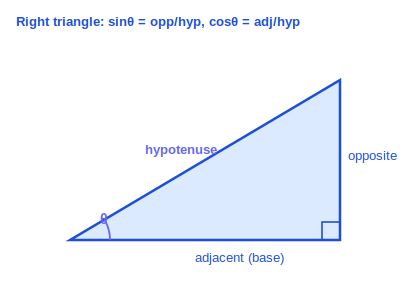
2. Starting Point: the Right TriangleFor an acute angle θ, the three main ratios come straight from a right-angled triangle. Label the side opposite θ as a, the side next to θ (touching the right angle) as b, and the longest side facing the right angle as the hypotenuse c. The figure below shows how each ratio is just one side divided by another.
|
|
The right triangle: SOH-CAH-TOA
The small square marks the right angle (90°); the angle θ sits at the opposite corner. Reading the sides relative to θ: |
|
The right triangle: sides and the angle θ
|
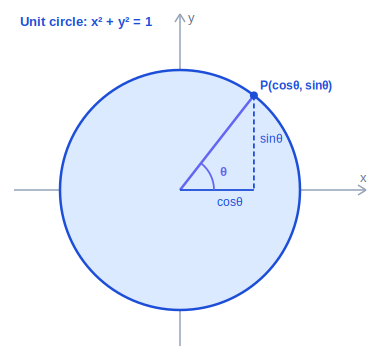
3. Growing Up: the Unit CircleTo handle any angle (not just 0°-90°), we move to the unit circle: a circle of radius 1 centred at the origin. Place the angle θ at the centre, measured anticlockwise from the positive x-axis, and look at where its arm meets the circle at point P(x, y). Then cos θ = x and sin θ = y. The other four follow: tan θ = sin θ/cos θ, cot θ = cos θ/sin θ, sec θ = 1/cos θ, cosec θ = 1/sin θ. Because the radius is 1, the point obeys x² + y² = 1, which immediately gives the fundamental identity sin²θ + cos²θ = 1.
|
|
The unit circle: P(cosθ, sinθ) on a circle of radius 1
|
4. Signs of the Functions in the Four QuadrantsAs θ grows, P travels around the circle and the signs of x and y change, so the functions change sign too. The figure below shows which functions are positive in each quadrant. A quick way to recall it, reading Quadrants I to IV in order: All, Sine, Tangent, Cosine.
|
|
The unit circle and the four quadrants
An angle θ meets the unit circle at P(cos θ, sin θ): the x-coordinate is cos θ and the y-coordinate is sin θ. The sign of each function therefore follows the quadrant in which P lands. |
|
Standard angles on the unit circle (worth knowing by heart)
|
5. Domain and Range of the Trigonometric FunctionsSince sine and cosine are coordinates on the unit circle, their outputs always lie between −1 and 1; both are defined for every real angle. So sin x and cos x have domain R and range [−1, 1]. The function tan x is undefined wherever cos x = 0 (at odd multiples of π/2) and its range is all real numbers. The reciprocals sec x and cosec x have outputs of size at least 1 and skip the angles where their denominators vanish. Sine, cosine, cosec and sec repeat every 2π, while tan and cot repeat every π.
|
6. Sum, Difference and Multiple-Angle FormulasThese let you handle combined angles:
• sin(A ± B) = sin A cos B ± cos A sin B • cos(A ± B) = cos A cos B ∓ sin A sin B • tan(A ± B) = (tan A ± tan B)/(1 ∓ tan A tan B) Setting B = A gives the double-angle forms: sin 2A = 2 sin A cos A, cos 2A = 1 − 2 sin²A = 2 cos²A − 1, and tan 2A = (2 tan A)/(1 − tan²A). The triple-angle forms are sin 3A = 3 sin A − 4 sin³A and cos 3A = 4 cos³A − 3 cos A. |
Beyond the board syllabus, the general solution of a trigonometric equation is worth knowing for JEE: sin θ = sin α gives θ = nπ + (−1)ⁿ α, cos θ = cos α gives θ = 2nπ ± α, and tan θ = tan α gives θ = nπ + α, where n is any integer. Treat this as enrichment, not core Class 11 board material.
|
| 4 |
Key Results & Proofs |
Trigonometry is built on a few results that are actually proved, not merely stated, and every identity in this chapter follows from them. Here are the central ones, derived line by line.
Statement. For every angle θ, sin²θ + cos²θ = 1. Proof On the unit circle, the arm of angle θ meets the circle at P(cos θ, sin θ). Because P lies on the circle, its coordinates satisfy the circle’s equation.
Dividing both sides by cos²θ gives 1 + tan²θ = sec²θ; dividing by sin²θ gives 1 + cot²θ = cosec²θ. |
Statement. For all angles A and B, cos(A − B) = cos A cos B + sin A sin B. Proof On the unit circle mark P₁(cos A, sin A) and P₂(cos B, sin B). The angle between OP₁ and OP₂ is (A − B). We find the squared chord length P₁P₂² in two ways, then equate them.
This one result is the parent of the whole family: replacing B with −B gives cos(A + B) = cosA cosB − sinA sinB, and the sine formulas follow from the link sin θ = cos(90° − θ). |
|||||||||||||||||||||||||||||||||||||||||||||||
Statement. sin(A + B) = sin A cos B + cos A sin B. Proof Use the complementary-angle link sin θ = cos(90° − θ) together with Result 2.
Replacing B with −B gives sin(A − B) = sinA cosB − cosA sinB. |
Statement. sin 2A = 2 sin A cos A, and cos 2A = cos²A − sin²A = 1 − 2 sin²A. Proof Set B = A in the sum formulas just proved.
The third form cos 2A = 2 cos²A − 1 comes the same way using sin²A = 1 − cos²A. Setting B = 2A then yields the triple-angle formulas. |
| 5 |
Worked Examples |
Question: Convert 150° into radians. ▶ Show full workingTo change degrees into radians we multiply by π/180, because 180° = π radians.
Answer: 150° = 5π/6 radians. |
Question: Convert 3π/4 radians into degrees. ▶ Show full workingTo change radians into degrees we multiply by 180/π so the π cancels.
Answer: 3π/4 = 135°. |
Question: Find the length of an arc that subtends 60° at the centre of a circle of radius 21 cm. (Take π = 22/7.) ▶ Show full workingThe formula is l = rθ, but θ must be in radians first.
Answer: Arc length = 22 cm. |
Question: If sin θ = 3/5 and θ lies in Quadrant I, find cos θ and tan θ. ▶ Show full workingUse sin²θ + cos²θ = 1 to get cos θ, then build tan θ from sine and cosine.
Answer: cos θ = 4/5, tan θ = 3/4. |
Question: State the sign of cos θ and tan θ when θ lies in Quadrant III. ▶ Show full workingUse the A-S-T-C rule for which functions are positive in each quadrant.
Answer: cos θ < 0, tan θ > 0. |
|||||||||||
Question: Find sin 75° using the sum formula. ▶ Show full workingSplit 75° into 45° + 30° (two angles we know), then use sin(A + B) = sin A cos B + cos A sin B.
Answer: sin 75° = (√3 + 1)/(2√2). |
Question: Find cos 15° using the difference formula. ▶ Show full workingSplit 15° = 45° − 30°, then use cos(A − B) = cos A cos B + sin A sin B.
Answer: cos 15° = (√3 + 1)/(2√2). |
Question: If cos A = 4/5 with A in Quadrant I, find sin 2A. ▶ Show full workingFirst find sin A from the identity, then use sin 2A = 2 sin A cos A.
Answer: sin 2A = 24/25. |
Question: Prove that (1 + tan²θ) cos²θ = 1. ▶ Show full workingReplace 1 + tan²θ with sec²θ, then write sec in terms of cos.
Answer: Proved, the expression equals 1. |
Question: Find tan(A + B) if tan A = 1/2 and tan B = 1/3. ▶ Show full workingUse tan(A + B) = (tan A + tan B)/(1 − tan A tan B).
Answer: tan(A + B) = 1. |
Question: Express 2 sin 5x cos 3x as a sum. ▶ Show full workingUse the product-to-sum identity 2 sin A cos B = sin(A + B) + sin(A − B), with A = 5x and B = 3x.
Answer: 2 sin 5x cos 3x = sin 8x + sin 2x. |
Question: Find the value of cos 2A if sin A = 1/3. ▶ Show full workingChoose the form cos 2A = 1 − 2 sin²A, since we already know sin A.
Answer: cos 2A = 7/9. |
| 6 |
Where You Meet This in Real Life |
|
Sound and music Every musical note is a sine wave of a fixed frequency. Mixing notes simply adds waves, the same sum and difference idea you study here. |
|
Electricity at home Alternating current rises and falls as a sine wave, which is why mains voltage is written in the form V = V₀ sin(ωt). |
|
GPS and navigation Satellites locate your phone by triangulation, solving triangles with the very sine and cosine rules trigonometry provides. |
|
Architecture and engineering Ramps, roofs and bridges are designed using angle measures and trigonometric ratios to balance loads and slopes safely. |
|
Astronomy and tides The rise and fall of ocean tides and the apparent motion of stars are modelled with periodic sine and cosine functions. |
| 7 |
Practice Sets A-D |
|
Practice Set A – Basics |
|
A1. Convert 90° to radians. ▶ Reveal full workingMultiply by π/180.
Answer: π/2 radians. |
|
A2. Convert π/6 radians to degrees. ▶ Reveal full workingMultiply by 180/π.
Answer: 30°. |
|
A3. State the range of sin x and of cos x. ▶ Reveal full workingsin x and cos x are coordinates of a point on a circle of radius 1.
Answer: [−1, 1] for both. |
|||||||
|
A4. In which quadrant are all six trigonometric functions positive? ▶ Reveal full workingA function is positive when its coordinate is positive.
Answer: Quadrant I. |
|||||||
|
Practice Set B – Conceptual |
|
B1. Why is tan x undefined at x = 90°? ▶ Reveal full workingtan x is a fraction: tan x = sin x / cos x.
Answer: Undefined, because cos 90° = 0. |
||||||||||||
|
B2. State the period of sin x and of tan x. ▶ Reveal full workingThe period is how far you travel before the wave repeats.
Answer: sin x: 2π; tan x: π. |
|||||||
|
B3. If cos θ = −1/2 and θ is in Quadrant II, find sin θ. ▶ Reveal full workingUse sin²θ = 1 − cos²θ.
Answer: sin θ = √3/2. |
|
B4. Explain why sin²θ + cos²θ = 1 holds for every angle. ▶ Reveal full workingOn the unit circle cos θ is the x-coordinate and sin θ the y-coordinate.
Answer: It is the unit-circle equation x² + y² = 1. |
|
Practice Set C – Application / Numerical |
|
C1. Find the arc length for θ = π/4 on a circle of radius 8 cm. ▶ Reveal full workingθ is already in radians, so use l = rθ directly.
Answer: 2π cm ≈ 6.28 cm. |
|
C2. Find sin 105° using a sum formula. ▶ Reveal full workingSplit 105° = 60° + 45°.
Answer: sin 105° = (√3 + 1)/(2√2). |
|
C3. If tan A = 3/4 and A is acute, find tan 2A. ▶ Reveal full workingUse tan 2A = (2 tan A)/(1 − tan²A).
Answer: tan 2A = 24/7. |
|
C4. Express cos 7x + cos 3x as a product. ▶ Reveal full workingUse cos C + cos D = 2 cos((C+D)/2) cos((C−D)/2).
Answer: 2 cos 5x cos 2x. |
|
Practice Set D – HOTS / Proofs |
|
D1. Prove that cos 3A = 4 cos³A − 3 cos A. ▶ Reveal full workingWrite 3A = 2A + A and expand step by step.
Answer: Proved. |
|
D2. If sin A + sin B = 1/2 and cos A + cos B = 1, find tan((A+B)/2). ▶ Reveal full workingTurn each sum into a product, then divide one equation by the other.
Answer: tan((A+B)/2) = 1/2. |
|
D3. Prove that (sin 3x + sin x)/(cos 3x + cos x) = tan 2x. ▶ Reveal full workingTurn the top and bottom into products, then cancel.
Answer: Proved. |
|
D4. Find the maximum and minimum values of 3 sin x + 4 cos x. ▶ Reveal full workingAny a sin x + b cos x swings between −√(a²+b²) and +√(a²+b²).
Answer: Maximum 5, minimum −5. |
||||||||||||||||
|
Chapter Summary Everything in One Glance
|
||||||||||||||||||
| 8 |
Are You Exam-Ready? |
|
8-Point Exam Quick-Check
|
||||||||||||||||||||||||||||||||
|
School Revise Virtual Lab Practice the concepts in this chapter with interactive simulations and visual tools.
|
|
Class 11 Mathematics Chapter 3: Trigonometric Functions, Complete Notes and Practice These free Class 11 Maths Chapter 3 Trigonometric Functions notes follow the latest NCERT 2026-27 syllabus and give complete, exam-ready coverage for board exams and competitive foundations. Includes worked examples, step-by-step proofs and graded practice, free on SchoolRevise.com. |
 Google