Curriculum
Mathematics Grade XI
Grade 11 Mathematics
0/14
-
Chapter 1: Sets
 Preview
 -
Chapter 2: Relations and Functions
Preview
-
Chapter 3: Trigonometric Functions
Preview
-
Chapter 4: Complex Numbers and Quadratic Equations
Preview
-
Chapter 5: Linear Inequalities
Preview
-
Chapter 6: Permutations and Combinations
Preview
-
Chapter 7: Binomial Theorem
Preview
-
Chapter 8: Sequences and Series
Preview
-
Chapter 9: Straight Lines
Preview
-
Chapter 10: Conic Sections
Preview
-
Chapter 11: Introduction to Three Dimensional Geometry
Preview
-
Chapter 12: Limits and Derivatives
Preview
-
Chapter 13: Statistics
Preview
-
Chapter 14: Probability
Preview
Worksheets
0/14

Chapter 5: Linear Inequalities
|
Class 11 • Mathematics • Chapter 5 Linear InequalitiesComparing quantities that are not equal, and finding every value that fits.
|
|
Chapter Roadmap Inequalities • Rules for Solving • One Variable • On the Number Line • Two Variables • Graphical Solution • Systems of Inequalities • Applications |
| 1 |
Why Linear Inequalities Matter |
In real life, things are rarely exactly equal. A train must reach the station in at most two hours. A budget must stay within 5,000 rupees. A bridge must carry at least a certain load. Each of these is a comparison, not an equation, and that is exactly what an inequality describes.
So far you have solved equations, where two sides are equal and the answer is usually a single value. An inequality compares two sides that are not equal, using the signs less than, greater than, less than or equal to, and greater than or equal to. Its answer is not one number but a whole range of numbers. In this chapter you will solve linear inequalities in one variable and show the answer on a number line, then move to two variables and shade the region of the plane that works, and finally handle several inequalities at once as a system.
An equation has an equals sign and usually one solution. An inequality uses <, >, ≤ or ≥ and has a whole set of solutions. The one rule that is easy to forget: when you multiply or divide both sides by a negative number, the inequality sign reverses.
|
| 2 |
Key Terms You Must Know |
| Term | Meaning | Example |
| Inequality | A statement that two quantities are not equal, using <, >, ≤ or ≥. | x < 5 |
| Strict inequality | Uses < or >; the boundary value is not included. | x > 2 |
| Slack inequality | Uses ≤ or ≥; the boundary value is included. | x ≤ 7 |
| Solution | Any value of the variable that makes the inequality true. | x = 1 satisfies x < 5 |
| Solution set | The set of all values that satisfy the inequality. | {x : x < 5} |
| Number line | A line used to picture the solution as a ray or a segment. | An open ray for x > 2 |
| Half-plane | The region on one side of a line; the solution of a two-variable inequality. | x + y ≤ 4 |
| 3 |
Core Concepts, Step by Step |
1. Reading an InequalityAn inequality compares two quantities. The sign < means ‘less than’, > means ‘greater than’, ≤ means ‘less than or equal to’, and ≥ means ‘greater than or equal to’. The signs < and > are called strict, because the boundary value is left out. The signs ≤ and ≥ are called slack, because the boundary value is allowed. A linear inequality is one where the variable appears only to the first power, such as 3x + 2 < 11, with no x² or higher.
|
2. The Rules for SolvingSolving an inequality is almost the same as solving an equation. You may add or subtract the same number on both sides, and the sign stays the same. You may multiply or divide both sides by the same positive number, and the sign stays the same. But there is one special case: if you multiply or divide both sides by a negative number, you must reverse the inequality sign. The table below collects the rules at a glance.
|
|
What each operation does to a < b
|
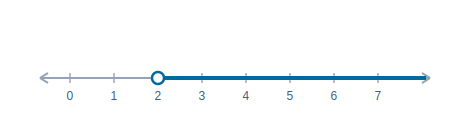
3. Solving in One Variable and Showing It on a Number LineTo solve a linear inequality in one variable, collect the variable terms on one side and the numbers on the other, then make the coefficient of the variable equal to 1, remembering the sign rule. The answer is a range of values, which we picture on a number line. We use an open (hollow) circle for < and >, because the boundary value is excluded, and a closed (solid) circle for ≤ and ≥, because it is included. The figure below shows the idea.
|
|
Showing a solution on the number line
|
4. Inequalities in Two VariablesAn inequality such as 2x + 3y ≤ 6 involves two variables, so its solution is not a set of points on a line but a whole region of the plane. The matching equation 2x + 3y = 6 is a straight line that splits the plane into two halves, called half-planes. One half-plane satisfies the inequality and the other does not. We draw the boundary line solid for ≤ or ≥ (the line is included) and dashed for < or > (the line is excluded).
|
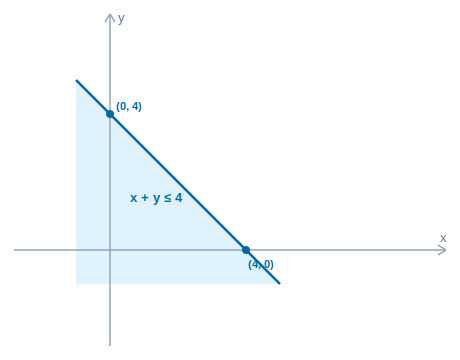
5. The Graphical MethodTo solve a two-variable inequality, draw the boundary line, then choose any test point not on the line (the origin (0, 0) is easiest when the line does not pass through it). Put the test point into the inequality. If it makes the inequality true, shade the side that contains the test point; if it is false, shade the other side. The shaded region is the complete solution. The figure below shows this for x + y ≤ 4.
|
|
Shading the correct half-plane
|
6. Systems of Linear InequalitiesOften several conditions must hold at the same time, for example x ≥ 0, y ≥ 0 and x + y ≤ 5. Each inequality shades its own region, and the solution of the whole system is the region where all of them overlap. This common region is the foundation of linear programming, which you will meet in Class 12 for finding the best possible value of a quantity under several constraints.
|
| 4 |
Key Results & Proofs |
Two rules sit underneath everything in this chapter, and both can be proved from one simple idea: a < b is just another way of saying that b − a is positive.
Statement. If a < b, then a + c < b + c for every real number c. Proof Start from what a < b actually means.
The same reasoning works for subtracting a number, and for the signs >, ≤ and ≥. |
|||||||||||
Statement. If a < b and k > 0, then ka < kb; but if a < b and k < 0, then ka > kb. Proof Again begin from b − a > 0, and watch the sign of the product.
This is the one rule students most often forget: dividing or multiplying by a negative number flips the inequality sign. |
|||||||||||
| 5 |
Worked Examples |
Question: Solve 3x − 5 < 7, where x is a real number. ▶ Show full workingTreat it like an equation: get x by itself. We only add and divide by a positive number, so the sign stays the same.
Answer: x < 4, that is, every real number less than 4. |
Question: Solve −2x + 1 ≥ 7. ▶ Show full workingWatch the final step, where we divide by a negative number and the sign reverses.
Answer: x ≤ −3. |
Question: Solve 2(x − 1) < x + 3. ▶ Show full workingOpen the bracket first, then gather x on one side and numbers on the other.
Answer: x < 5. |
Question: Solve the double inequality 3 ≤ 2x − 1 < 9. ▶ Show full workingDo the same operation to all three parts at once.
Answer: 2 ≤ x < 5. |
||||||||||||||
Question: Solve x/3 > (x − 2)/2. ▶ Show full workingClear the fractions by multiplying both sides by a positive number, then finish carefully.
Answer: x < 6. |
Question: Solve 5x − 3 < 3x + 7 and describe the solution on a number line. ▶ Show full workingCollect terms, solve, then read off the picture.
Answer: x < 5, shown as an open ray pointing left from 5 (5 not included). |
Question: Solve 24x < 100 when x is a natural number. ▶ Show full workingSolve as usual, then keep only the natural numbers that fit.
Answer: x ∈ {1, 2, 3, 4}. |
|||||||||||||||||
Question: Is the point (1, 1) a solution of 2x + 3y ≤ 6? ▶ Show full workingPut the point into the left side and compare with the right side.
Answer: Yes, (1, 1) satisfies 2x + 3y ≤ 6. |
|||||||||
Question: Solve x + y ≤ 4 graphically. ▶ Show full workingDraw the boundary line, test the origin, then shade.
Answer: The solution is the half-plane on the origin side of x + y = 4, including the line itself. |
|||||||||||
Question: Solve the system x ≥ 0, y ≥ 0, x + y ≤ 5. ▶ Show full workingEach inequality gives a region; the answer is where they all overlap.
Answer: The overlapping triangle with corners (0, 0), (5, 0) and (0, 5). |
||||||||||||||
Question: Solve 7x + 3 < 5x + 9. ▶ Show full workingCollect terms and divide.
Answer: x < 3. |
Question: The longest side of a triangle is twice the shortest side, and the third side is 2 cm shorter than the longest. If the perimeter is at least 166 cm, find the smallest the shortest side can be. ▶ Show full workingName the shortest side, write the other sides in terms of it, then form an inequality from the perimeter.
Answer: The shortest side must be at least 33.6 cm. |
|||||||||||||||||||||
| 6 |
Where You Meet This in Real Life |
|
Budgets and shopping Staying within a fixed amount of money is a less-than-or-equal-to condition; inequalities tell you how many items you can afford. |
|
Marks and cut-offs A pass mark, a distinction, or a cut-off for admission is an at-least condition written with ≥. |
|
Speed and safety limits Speed limits, weight limits on lifts and bridges, and dosage limits in medicine are all inequalities that keep us safe. |
|
Business and profit A business makes a profit only when revenue is greater than cost, which is a simple inequality between two expressions. |
|
Linear programming Factories decide how much of each product to make under limits on time, material and labour; the allowed plans form a region defined by many inequalities. |
| 7 |
Practice Sets A to D |
|
Practice Set A – Basics |
|
A1. Solve x + 5 < 9. ▶ Reveal full workingMove the number across.
Answer: x < 4. |
|
A2. Solve 4x ≥ 20. ▶ Reveal full workingDivide by a positive number.
Answer: x ≥ 5. |
|
A3. Solve −3x < 12. ▶ Reveal full workingDivide by a negative number and reverse the sign.
Answer: x > −4. |
|
A4. Write the solution of x ≤ 3 in natural numbers. ▶ Reveal full workingList the natural numbers that fit.
Answer: x ∈ {1, 2, 3}. |
||||
|
Practice Set B – Conceptual |
|
B1. Why does the inequality sign reverse when we multiply by a negative number? ▶ Reveal full workingTest it on a true statement.
Answer: Because multiplying by a negative reverses order on the number line. |
|||||||||||||
|
B2. What is the difference between an open circle and a closed circle on a number line? ▶ Reveal full workingThink about whether the boundary is included.
Answer: Open means excluded (strict); closed means included. |
|||||||
|
B3. When is the boundary line of a two-variable inequality solid, and when is it dashed? ▶ Reveal full workingDecide whether points on the line count.
Answer: Solid for ≤ and ≥; dashed for < and >. |
|||||||
|
B4. What does the solution of a system of inequalities look like? ▶ Reveal full workingCombine the separate regions.
Answer: The common overlapping region of all the inequalities. |
|||||||
|
Practice Set C – Application / Numerical |
|
C1. Solve 2(2x + 3) − 10 < 6(x − 2). ▶ Reveal full workingOpen the brackets, collect, and finish (watch the negative).
Answer: x > 4. |
|
C2. Solve the double inequality −8 ≤ 5x − 3 < 7. ▶ Reveal full workingApply each step to all three parts.
Answer: −1 ≤ x < 2. |
|||||||||||||
|
C3. Find all integers x satisfying 5x − 7 > 2x + 5. ▶ Reveal full workingSolve, then list the integers.
Answer: x ∈ {5, 6, 7, …}. |
||||||||||||||||
|
C4. Solve the system x ≥ 0, y ≥ 0, 2x + y ≤ 6 and name the corner points of the region. ▶ Reveal full workingEach inequality gives a region; find the overlap.
Answer: Triangle with corners (0, 0), (3, 0) and (0, 6). |
|||||||||||||
|
Practice Set D – HOTS / Word Problems |
|
D1. A small business sells x units. Its revenue is 5x and its cost is 2x + 90. For how many units does it make a profit? ▶ Reveal full workingProfit means revenue greater than cost.
Answer: More than 30 units (x > 30). |
|
D2. Solve (2x + 1)/3 > (x − 1)/2. ▶ Reveal full workingClear the fractions first.
Answer: x > −5. |
|
D3. Find the values of x for which both 3x − 7 > 2 and 2x + 1 < 11 hold. ▶ Reveal full workingSolve each, then take the overlap.
Answer: 3 < x < 5. |
||||||||||
|
D4. A student scores 70 and 75 in the first two tests, each out of 100. What is the least she must score in the third test so that the average of the three is at least 80? ▶ Reveal full workingWrite the average as an inequality.
Answer: At least 95 marks. |
|
Chapter Summary Everything in One Glance
|
||||||||||||||||||
| 8 |
Are You Exam-Ready? |
|
8-Point Exam Quick-Check
|
||||||||||||||||||||||||||||||||
|
School Revise Virtual Lab Practice the concepts in this chapter with interactive simulations and visual tools.
|
|
Class 11 Mathematics Chapter 5: Linear Inequalities, Complete Notes and Practice These free Class 11 Maths Chapter 5 Linear Inequalities notes follow the latest NCERT 2026-27 syllabus and give complete, exam-ready coverage for board exams and competitive foundations. Includes worked examples, step-by-step proofs and graded practice, free on SchoolRevise.com. |
 Google